Detailed Explanation of High-Efficiency Cultivation Techniques for Small Wax Gourds
Black-skinned wax gourd is the wax gourd variety with the largest cultivation area in South China, with an annual sowing area of more than 800,000 mu. At present, the main cultivar of black-skinned wax gourd is still a farmer variety. As the market's requirements for product quality are increasing day by day, and diseases and insect pests occur severely in vegetable-growing areas, farmer varieties can no longer meet production needs. There is an urgent need for disease-resistant, superior...
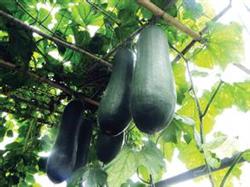 In recent years, the market demand for small wax gourds has gradually expanded. Protected facilities can be used for early spring cultivation and delayed autumn cultivation, and combined with open-field cultivation, they can be marketed from May to December, achieving high returns through forms such as gift vegetable combination packaging and brand sales.
Variety selection At present, small wax gourd varieties are relatively abundant. Among the chieh-qua type are Suixing, Qixing, Jiangxin, Yueke No. 2, Yueke No. 6, Cuibeibei, Bilü Feicui, etc. Among the small wax gourd type are Zaolü, Lül ing, Lüchun, Qingchunzao, Huazhen, Jinpeng Bilü, Qingpi Xiao Donggua, etc. Because plant growth traits differ greatly among varieties, the first female flower node on the main vine of some varieties is around the tenth node, while that of others is around the twentieth node. Appropriate cultivation methods should be determined according to variety traits. Yield per mu varies with cultivation season and cultivation method, generally 1,500-3,500 kg.
Seed treatment The seed coat of small wax gourd seeds is relatively hard, so seed treatment is needed. Seeds can be soaked in warm water at 55°C, maintaining a stable water temperature for 15 minutes, then soaked for 6 hours after the water temperature cools to 30°C. Rub the seeds clean, wrap them in a wet towel, and place them at 30°C for germination. Sow when the seeds show white and the sprouts are about 0.5 cm long. Generally, good-quality seeds can germinate in 2-3 days.
Maintain suitable temperature The suitable temperature for wax gourd growth is 20-30°C, and 25°C is suitable for flowering and fruit setting. Therefore, heat preservation should be strengthened in the early stage of spring early-maturing cultivation and the late stage of autumn delayed cultivation. In high-temperature seasons, attention should be paid to ventilation and cooling.
Meet light requirements Small wax gourds like light, and planting density should not be too high. Good light exposure is beneficial to plant growth and fruit coloring, but strong light should be avoided to prevent sunburn damage to the fruit.
Fertilizer and water management Small wax gourds have well-developed root systems and prefer deep, fertile soil, so deep ploughing and intensive cultivation should be carried out and more organic fertilizer should be applied. Their stems and leaves are luxuriant, and the fruit has high water content and a high water requirement, especially during stem vine growth and young fruit growth. According to research, producing every 5,000 kg of wax gourd requires 15-18 kg of pure nitrogen, 12-13 kg of phosphorus pentoxide, and 12-15 kg of potassium oxide, with a ratio of about 1.3:1:1. Fertilizer and water should be controlled at the early flowering stage and early fruit-setting stage, while more fertilizer and water are needed during the vigorous stem vine growth stage and fruit expansion stage, so fertilizer and water should be applied in time.
Pruning and vine tying Small wax gourd stems and vines grow quickly and have strong branching ability. If allowed to grow freely under trellis cultivation, the branches and leaves become too luxuriant, which is unfavorable for fruit setting and prone to diseases and insect pests. Small wax gourds mainly set fruit on the main vine, so measures such as pinching, removing side buds, pruning, fruit thinning, and vine tying should be used for regulation. For varieties with higher first flowering nodes, the stems and vines should first trail on the ground and then be tied to the trellis.
Timely pollination Small wax gourds cultivated under protected facilities require artificial supplementary pollination to facilitate fruit setting. Pinch the side branches at the node of the pollinated female flower to facilitate fruit setting and young fruit growth.
Prevent and control diseases and insect pests The main diseases and insect pests on small wax gourds include powdery mildew, gray mold, aphids, melon fruit borer, leafminer, etc. Integrated control can be achieved by combining cultivation management measures such as mulching with plastic film, pruning, removing withered and yellow leaves and weeds, and yellow sticky board trapping with pesticide spraying.
Harvest in time For some varieties, the fruit is basically formed 10 days after flowering, while for others it is only initially formed 20 days after flowering. Harvest in time according to variety characteristics and market in batches.