Key Technical Points for Transplanting Spring Corn with Plastic Film Mulch Cultivation
Q: The spring corn already has more than ten leaves, and now the field has a very high population of small brown planthoppers. Can I spray chlorpyrifos or fipronil to control them? A: The main damage small brown planthoppers cause to corn is spreading the viral disease maize rough dwarf. According to relevant data, the susceptible leaf-age period for corn runs from emergence to the 6-leaf stage (9 visible leaves),...
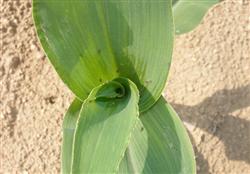 Transplanting spring corn with plastic film mulch cultivation means using plastic-film arched sheds to grow seedlings in nutritional pots, then transplanting them under plastic film mulch. It targets the two major climatic disasters affecting corn seedlings in the early stage, freezing injury and waterlogging damage, and overcomes the shortcomings of single plastic film cultivation, such as low emergence rate from early sowing and difficulty in getting strong seedlings, forming an assembled and complete new technology system for strong seedlings and early development of spring corn. It makes corn sowing basically unaffected by weather conditions, securing early, complete, and uniform strong seedlings. It further improves the ecological conditions for spring corn, promoting corn growth and development along a normal track throughout, thereby achieving high yield. Xiangshui County adopted transplanting plastic film mulch cultivation for 30,000 mu of spring corn, with an average yield per unit area of 642 kg, an increase of 9.8% over single plastic film mulch cultivation. This method is also an effective way to achieve multiple cropping systems centered on corn.
1. Select excellent hybrid varieties. Based on the local accumulated temperature over the year plus the temperature increase from film mulching totaling 2650°C to 2800°C, for transplanting plastic film mulch cultivation, late-maturing type corn hybrids can be selected. High-yield practice has proven that Yedan No. 13 and Yedan No. 12 are currently the ideal varieties for achieving super-high yields in this region. For double-season corn cultivation or single plastic film mulch cultivation, medium-maturing corn hybrids Yedan No. 22, Xiyu No. 3, and Suyu No. 9 should be selected. These medium-to-late maturing varieties have a compact plant type and good light penetration; thick, sturdy stalks and strong lodging resistance; large ears with many kernels, high productivity per plant, and great yield potential; and a moderate growth period. With transplanting plastic film mulch cultivation, they generally mature around mid-July, with little effect on the following crop of corn.
2. Timely double-film seedling raising. On the basis of the original single-film frame seedling raising, add an additional layer of plastic film over the bed surface. Double-film seedling raising significantly increases temperature, 2°C to 3°C higher than single film. It can accelerate the soil moisture circulation rate in the seedbed, prompt uniform seed water absorption, and achieve neat and robust emergence. It cultivates early strong seedlings for timely transplanting, fully leveraging the advantage of early seedling and early development.
① Fertilize the seedbed: Implement fertile-bed seedling raising, selecting rapeseed seedbeds and dry-raised rice seedling beds as spring corn seedling beds. Leave sufficient seedbed area in proportion. For seedling raising with 5 cm pot diameter, the ratio of seedbed to field area is 1:20; for large-pot seedling raising with pot diameter above 7 cm, the ratio of seedbed to field area is 1:10 to 15. In early spring, promptly plow the bed soil and let it fully weather in the sun, prompting the bed soil to become activated and loose. Before making pots, clear weeds from the seedbed to improve pot-making quality and efficiency. Spring corn seedbeds should be rich in nutrients, which requires, first, improving the pot bed soil; second, timely supplying multi-nutrient ingredients; and third, scientifically preparing nutritional soil. According to production practice, before Spring Festival make standard beds 1.5 m wide and 4.5 m long. Use 300 kg to 400 kg of human and livestock manure, 3 kg of phosphate fertilizer, 1.5 kg to 2 kg of ammonium bicarbonate, and 0.5 kg of potassium fertilizer to fertilize and make nutritional soil. Then add 150 mL of Huimanfeng, mix evenly to increase seedbed nutrients, enhance seedling stress resistance, and improve corn seedling quality.
② Make enough pots: Fully and evenly mix the bed soil, fertilizers, and Huimanfeng, add an appropriate amount of water, then make 4800 to 5000 pots per mu. Ensure enough effective plant number for transplanting.
③ Sow at the right time: The suitable period for seedling sowing is March 15 to 20, the seedling stage is 15 to 20 days, and at the 2.5-leaf to 3.5-leaf stage, transplant to the field under plastic film mulch in early April.
④ Cultivate strong seedlings: Carefully raise seedlings and cultivate strong seedlings. Water the seedbed thoroughly with bottom moisture, sow 1 to 2 large seeds per pot, and promptly cover with moist fine soil 1.5 cm to 2 cm. Lay plastic film flat, then cover with an arched shed film, seal all around, and keep warm and moist to promote growth. After full emergence, remove the flat-laid plastic film. Supplement water flexibly, watering promptly when the bed surface turns white. Ventilate and cool promptly at high-temperature noon. At the 1-leaf-1-heart stage, gradually uncover the arched shed film to harden seedlings, generally for about 3 days. One day before planting, spray seedlings with vitality essence diluted in water to enhance corn resistance and cultivate robust, highly resistant early strong seedlings.
3. Timely transplanting. In this region, when the temperature steadily passes 12°C, around April 5, when corn seedlings have reached the 2-leaf-1-heart stage, they can be removed from the bed and transplanted. Transplanting should be timely for a high survival rate, preventing delayed transplanting from affecting corn seedling quality and post-planting establishment, so as to ensure that plastic film mulched corn can fully utilize local heat resources.
4. Apply sufficient base fertilizer. Ten days before transplanting corn seedlings, apply sufficient base fertilizer to the field. Plastic film mulched corn consumes relatively more soil fertility, so organic fertilizer should be increased and chemical fertilizers used in balance. According to local soil characteristics, corn generally requires per mu over its life 2000 kg to 4000 kg of decomposed barnyard manure, 20 kg to 25 kg of pure nitrogen, 10 kg to 15 kg of phosphorus pentoxide, 15 kg of potassium oxide, and 1 kg to 1.5 kg of zinc sulfate. Topdressing plastic film mulched corn is relatively difficult, early growth is fast, and nutrient demand is large, so the proportion of base fertilizer application should be increased. Fifty percent of nitrogen fertilizer, and all phosphorus, potassium, and zinc fertilizers are applied as base fertilizer. When finely preparing the bed surface, apply evenly under the plastic film. Before mulching, with sufficient soil moisture, use 150 g of 40% atrazine suspension concentrate per mu plus 100 mL to 150 mL of 72% Dual emulsifiable concentrate, diluted in 50 kg of water, and spray evenly on the soil surface, which can effectively suppress field weeds throughout the corn growth period.
5. Plant enough plants. Most corn hybrids currently used in production bear one ear per plant, so one plant fewer means one ear fewer, directly affecting yield improvement. Generally, high-yield fields should have about 4500 plants, and super-high-yield fields should have 5000 to 5500 plants. Adopt wide-narrow row planting, with wide rows 80 cm and narrow rows 40 cm, and plant spacing designed according to high yield. Use a pot-making tool to open holes in the plastic film, then transplant the nutritional pot seedlings into the holes. Transplant with fertilizer and water so that the nutritional pot seedlings closely contact the soil, and cover the film openings well, so that they survive after planting and grow rapidly.
6. Timely topdressing. Skillfully apply jointing fertilizer. When corn has 6 expanded leaves, apply jointing fertilizer, with nitrogen fertilizer accounting for 15% of total nitrogen fertilizer. Heavily apply ear fertilizer. When corn has 10 to 11 expanded leaves, at the large trumpet stage, apply fertilizer per mu accounting for 35% of total nitrogen fertilizer, to promote female ear floret differentiation and kernel formation, and water thoroughly, meeting the fertilizer and water needs of corn growth, so that ear and kernel weight increase synchronously.
7. Control pests and diseases. In transplanted plastic film mulched corn, because the soil environmental conditions are changed, underground pests are active earlier and damage is relatively severe, so timely control is needed. When transplanting, bring pesticide to the field. Use 3% carbofuran granules per mu mixed with 15 kg of fine soil, applied under the plastic film before planting. Or use 50% methamidophos emulsifiable concentrate at 500 times dilution, prepare poisoned bait, and scatter it on the ground before mulching. At the corn large trumpet stage, use 4 kg to 5 kg of carbofuran granules plus 5 kg to 10 kg of fine sand to make poisonous sand and pour it into the whorl, scattering it at the heart leaves. Or use 90% trichlorfon at 1500 to 2000 times dilution to pour into the heart leaves; each kilogram of solution can treat 100 corn plants. This controls corn borer. Around tasseling, use 100 g to 150 g of 50% Jinggangmycin per mu, diluted in 50 kg of water, and spray stems and leaves to control sheath blight and large and small leaf spot diseases.
8. Open ditch systems well. After corn planting, promptly dig field cross ditches so that the field ditch system is unobstructed, able to irrigate and drain, with no water accumulation in the field after 200 mm of daily rainfall. Ditch system standards should be high, increasing field ditch density, lowering groundwater, draining surface water, and preventing waterlogging damage. During drought, irrigate promptly to prevent drought and promote robust corn growth.