How to fertilize celery scientifically? Mastering the right method is key
How should celery be fertilized scientifically when grown? 1. Nutrient requirements: For autumn-sown celery, nutrient uptake is high during the peak period of vegetative growth; during this period, the uptake of the five elements nitrogen, phosphorus, potassium, magnesium and calcium accounts for more than 84% of total uptake. Celery has the highest demand for nitrogen, followed by calcium and potassium, and the least for phosphorus and magnesium. Celery also has a substantial requirement for boron...
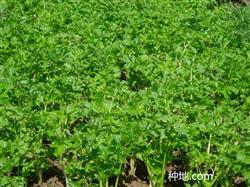
How should celery be fertilized scientifically when grown?
1. Nutrient requirements: For autumn-sown celery, nutrient uptake is high during the peak period of vegetative growth; during this period, the uptake of the five elements nitrogen, phosphorus, potassium, magnesium and calcium accounts for more than 84% of total uptake. Celery has the highest demand for nitrogen, followed by calcium and potassium, and the least for phosphorus and magnesium. Celery also has a very large requirement for boron; in boron-deficient soil, or when uptake is inhibited by drought and low temperatures, the leaf stalks tend to split horizontally, known as "stalk break disease", which seriously affects yield and quality.
2. Fertilization techniques: At a medium fertility level, the total fertilizer application per mu over the whole growing period of celery is 2500-3000 kg of farmyard manure (or 350-400 kg of commercial organic fertilizer), 13-16 kg of nitrogen fertilizer, 5-6 kg of phosphate fertilizer and 6-9 kg of potassium fertilizer. Nitrogen and potassium fertilizers are split into a base application and three topdressings, with an application ratio of 2:3:3:2; all phosphate fertilizer is applied as base fertilizer; chemical fertilizers and farmyard manure (or commercial organic fertilizer) are applied mixed together.
Base fertilizer: Apply 2500-3000 kg of farmyard manure or 350-400 kg of commercial organic fertilizer, 4-5 kg of urea, 11-13 kg of diammonium phosphate and 4-5 kg of potassium sulfate per mu.
Topdressing: After the seedlings have recovered, during the heart-leaf growth stage, apply 6-8 kg of urea and 3-4 kg of potassium sulfate per mu; in the early stage of vigorous growth, apply 8-11 kg of urea and 3-5 kg of potassium sulfate per mu; in the middle stage of vigorous growth, apply 6-8 kg of urea and 3-4 kg of potassium sulfate per mu.
Foliar topdressing: If heart rot is found, spray the leaves with 0.3%-0.5% calcium nitrate or calcium chloride. Foliar spraying of boron fertilizer can to a certain extent prevent stalk splitting; each time spray 40-75 kg of 0.2% borax or boric acid solution per mu. In protected cultivation, carbon dioxide gas fertilizer can be applied additionally.
More celery growing techniques