Detailed Explanation of Pollution-Free Water Dropwort Cultivation Techniques
How to grow water dropwort in summer? Water dropwort is a semi-cold-hardy aquatic vegetable, and it stops growing when the temperature exceeds 30°C. In the Suzhou area, planting generally begins in mid-to-late September, and harvesting ends in early-to-mid March of the following year. To solve the problem of the summer vegetable shortage, we have developed a summer planting production model and techniques for water dropwort...
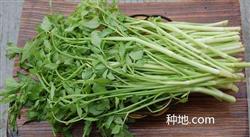 How do you grow pollution-free water dropwort? What steps should be followed?
Pollution-free water dropwort cultivation methods:
1. Select excellent varieties. Choose water dropwort varieties with high yield, good quality, and good taste, such as the early-maturing Baiqin and the late-maturing Tieganqing.
II. Key cultivation measures
1. Site selection. Choose a location with an independent irrigation and drainage system, clean water sources, and no "three wastes" discharged within a 3-kilometer radius.
2. Sprouting. For early dropwort, in mid-to-late August, and for late dropwort, in early-to-mid September, select mature stems with a stalk thickness of 0.8-1.0 cm, uniform thickness from top to bottom, tight internodes, more numerous and plump axillary buds, and no pests or diseases as seed plants. Tie the seed plants into small bundles 20 cm in diameter and stack them crosswise in a ventilated place, with a height of 1-1.5 m being suitable. Cover the surroundings and top of the seed pile with rice straw to retain moisture, covering by day and uncovering at night, and water the seed pile thoroughly with cool water once each day at 8 a.m. and 4-5 p.m. After 7-10 days of piling, the axillary buds of the seed plants begin to sprout and short roots appear, after which they can be planted.
3. Land preparation. Prepare the land at the same time as sprouting. After deep plowing, apply 4000 kg of decomposed quail manure, 30-50 kg of high-concentration compound fertilizer, and 50 kg of superphosphate per mu. To prevent the soil solution from becoming too acidic, 75-100 kg of quicklime can be applied per mu. At the same time, increase calcium fertilizer application to improve the plants' disease resistance. Three days before planting, level the field. Dig ditches around the field to facilitate irrigation and drainage. At the same time, use 15% quizalofop-p-ethyl emulsifiable concentrate to control weeds in the field.
4. Planting. Carry this out in the afternoon. Along the perimeter ditch around the field, place the seed plants perpendicular to the perimeter ditch, with the bases facing outside the field and the tips facing into the field. The spacing between seed plants is 3-4 cm, arranged neatly in a ring. The rest of the field is broadcast, and the usual amount of seed plants used per mu is 800-1000 kg.
5. Transplanting. About 1 month after planting, the seedlings have grown into independent individuals. At this time, the old stems of the seed plants have rotted, and the seedlings can be planted into the soil on the spot.
6. Field management. (1) Water management. After planting water dropwort, maintain a shallow water layer in the field. Eight to 10 days after planting, drain appropriately and let the field dry for 1-2 days. After rooting, gradually deepen the water layer to 3-4 cm to promote rapid growth. During the entire vigorous growth period, generally maintain the water layer at 8-10 cm. During the overwintering period, to prevent freezing, raise the water layer to 15-20 cm. (2) Fertilizer management. Base fertilizer application is primary, with appropriate topdressing. The first topdressing is 15 days after planting, applying 5 kg of urea per mu; the second topdressing is about 15 days after the first topdressing, applying 15 kg of high-concentration compound fertilizer per mu; the third topdressing can be determined according to plant growth.
7. Disease and pest control. The main pest harming water dropwort is aphids, and the main diseases are leaf spot and rust, and safe control should be carried out.
More celery cultivation techniques