What are the control methods for rape black spot disease?
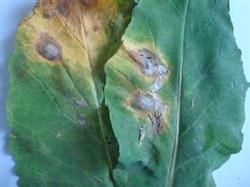
I. Symptoms Rape black spot disease mainly damages leaves, leaf stalks, stems and siliques. When leaves are infected, brown round spots appear initially, slightly concentric-ringed, sometimes with a yellow halo around them, and under high humidity black mold-like growth forms on them. When the leaf stalk and the junction between the leaf stalk and the main stem are infected, elliptical to spindle-shaped ring-patterned spots form, encircling...
I. Symptoms
Rape black spot disease mainly damages leaves, leaf stalks, stems and siliques. When leaves are infected, brown round spots appear initially, slightly concentric-ringed, sometimes with a yellow halo around them, and under high humidity black mold-like growth forms on them. When the leaf stalk and the junction between the leaf stalk and the main stem are infected, elliptical to spindle-shaped ring-patterned spots form; when they encircle the side branches and the main stem completely, the side branches or the whole plant may die.
II. Control methods
(1) Choose disease-resistant varieties, such as "Yuyou 18" and others;
(2) Carry out large-scale crop rotation; promote the use of compost fermented with enzyme bacteria; adopt formula fertilization techniques; avoid excessive or one-sided application of nitrogen fertilizer, and pay attention to increasing potassium fertilizer;
(3) Seed treatment. Dress seeds with 50% thiram wettable powder at 0.4% of seed weight or 50% iprodione wettable powder at 0.2-0.3%;
(4) At the early stage of disease onset, immediately spray 75% chlorothalonil wettable powder at 600 times dilution, or 40% difenoconazole or 80% Dacotech M45 wettable powder at 500 times dilution, or 64% oxadixyl-mancozeb wettable powder at 500 times dilution, or 50% iprodione wettable powder at 1500 times dilution, or 80% Pencao wettable powder at 800 times dilution; you can also use 12% copper octanoate EC at 600 times dilution or Bordeaux mixture at 1:1:150 dilution.