Comprehensive Control Techniques for White Rust of Rapeseed
The pathogen of rapeseed white rust is Albugo candida, a disease commonly occurring on rapeseed and cruciferous vegetables in the Yangtze River basin, often occurring together with rapeseed downy mildew on the same flower stalk. I. Symptoms: All aboveground organs of rapeseed are susceptible throughout the entire growth period. Pale green small spots first appear on the leaf surface, later turning yellow...
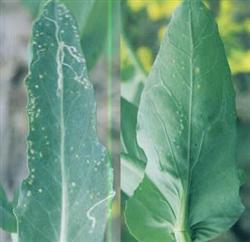
The pathogen of rapeseed white rust is Albugo candida, a disease commonly occurring on rapeseed and cruciferous vegetables in the Yangtze River basin, often occurring together with rapeseed downy mildew on the same flower stalk.
I. Symptoms: All aboveground organs of rapeseed are susceptible throughout the entire growth period. Pale green small spots first appear on the leaf surface, later becoming yellow round lesions; on the underside of the leaf, raised white paint-colored blister spots grow at the lesion sites, and after the blisters rupture, white powder is released. In severe cases, diseased leaves turn yellow and fall off. After the young stems and flower stalks are affected, they become swollen and curved into a "dragon head" shape, commonly known as "dragon head disease." When flower organs are affected, the petals become deformed and enlarged, turning green and leaf-like, and do not wither for a long time, nor do they set seed. Affected stems, branches, flower stalks, flower organs and siliques can all develop oblong or short strip-shaped blister spots and white mold layers.
II. Transmission route: Oospores oversummer or overwinter in diseased residues, in the soil and on seeds.
III. Disease occurrence pattern: Sporangia are produced on the lesions and spread by wind and rain to cause secondary infection. In winter, oospores or mycelium overwinter in diseased plants, and the following year the diseased parts again produce large numbers of sporangia that spread and cause damage again.
IV. Control methods:
① Select resistant varieties. Mustard-type rapeseed has the strongest resistance, cabbage-type is next, and Chinese cabbage-type is susceptible. There are many highly resistant varieties that can be selected according to local conditions.
② Select disease-free plants for seed production or treat the seeds.
③ Cultivation for disease prevention. Adopt paddy-upland rotation or rotation with non-cruciferous crops, apply fertilizer rationally, apply sufficient basal fertilizer, heavily apply fertilizer at the seedling and bolting stages, remove old diseased leaves and "dragon heads," use deep furrows and narrow beds, and prevent waterlogging and other disease prevention measures.
④ Chemical control. Spray when the bolting height is 17-33 cm or at the beginning of flowering, when there is a relatively large amount of disease on the short-stalked leaves. Choose 25% Ridomil wettable powder at 600-800 times dilution, 80% fosetyl-aluminum wettable powder at 500 times dilution, 50% thiophanate wettable powder at 1000-1500 times dilution, 50% Tuzet wettable powder at 1000 times dilution, 65% zineb wettable powder at 500 times dilution; begin spraying when the rate of diseased leaf plants at the early flowering stage is above 10%, once every 7 days, spraying 2-3 times, with 50 kg of spray solution per mu each time.