What are the pollution-free cultivation methods for garlic chives?
How do you grow pollution-free garlic chives? What should you pay attention to? For open-field cultivation of garlic chives, the root stock must first be developed, which can be done by direct seeding or by raising seedlings. At present, most regions in China use the seedling-raising method; garlic chives occupy little space during the seedling stage, are easy to manage, suffer little weed damage, and develop robust root stock with a long lifespan. ① Cultivating strong seedlings: When...
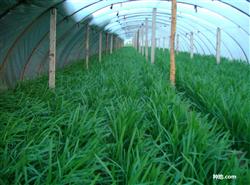
How do you grow pollution-free garlic chives? What should you pay attention to?
For open-field cultivation of garlic chives, the root stock must first be developed, which can be done by direct seeding or by raising seedlings. At present, most regions in China use the seedling-raising method; garlic chives occupy little space during the seedling stage, are easy to manage, suffer little weed damage, and develop robust root stock with a long lifespan.
① Cultivating strong seedlings: When raising seedlings in a seedbed, the seedbed should be chosen on high, dry land that can be irrigated in drought and drained in waterlogging, sheltered from the wind and facing the sun, in soil where cotton and scallion, garlic and other allium vegetables have not been grown for 3 to 4 years, and apply 60000 to 75000 kg/ha of high-quality decomposed organic fertilizer, 600 kg/ha of superphosphate, 1500 kg/ha of plant ash, or a combined application of 750 kg/ha of nitrogen, phosphorus and potassium compound fertilizer. After fertilizing, plow deeply 20 to 25 cm, harrow fine and level to make beds. Before sowing, choose a sunny day to sun the seeds for 1 to 2 days to improve the germination rate and germination vigor. Choose garlic chive varieties with high quality, high yield, resistance to pests and diseases, strong stress resistance, wide adaptability and good marketability, such as 791, Pingjiu No. 2, Shouguang Majie garlic chives, Hanzhong winter garlic chives, Beijing Tiesimiao, Hangzhou snow garlic chives, Shanhaiguan Tiesimiao, etc. Soak the seeds in 55°C warm water for 10 minutes or in 600 times carbendazim solution for 30 minutes. Wash the seeds disinfected with the medicinal solution with clean water, then soak them in 30°C warm water for 24 hours, keep them moist for germination, and sow after 2 to 3 days. Seedlings emerge 10 to 15 days after sowing, and watering, topdressing, weeding and pest control should be done in time. Seedbed seedling raising takes about 60 days, during which 2 to 3 topdressings should be applied in combination with watering, each time with 150 to 300 kg/ha of urea or 150 kg/ha of diammonium phosphate. When the seedlings have 7 to 9 leaves and a plant height of 18 to 20 cm, they should be transplanted at the right time.
② Applying heavy base fertilizer and transplanting at the right time: Although garlic chives have strong adaptability to soil, the production of pollution-free garlic chive products has strict requirements for the soil environment. Choose plots 1000 to 2000 m away from pollution sources where cotton and scallion, garlic and other allium vegetables have not been planted for 3 to 4 years, and the previous crop is best cabbage, spring cauliflower or seed-production Chinese cabbage. After the previous crop is harvested, clean the garden field in time and shallow-plow and harrow fine. The plot for open-field garlic chive planting is best no shorter than 150 m from east to west. In northern regions, windbreaks should be set up. Both windbreaks and field beds should run east-west. After the beds are made, apply 60000 to 75000 kg/ha of fully decomposed high-quality organic fertilizer, 300 to 450 kg/ha of diammonium phosphate, and 1500 kg/ha of plant ash, spread evenly and plow the soil, and after the soil and fertilizer are mixed evenly, rake the bed surface level. Generally, transplanting 3 million to 4.5 million plants/ha is appropriate. The overwintering ability and next year's growth of garlic chives mainly depend on how many nutrients the plants accumulate before winter, and the accumulation of nutrients depends on the autumn growth of the garlic chives. Therefore, fertilizer management should be strengthened during the seedling stage. Generally, water once every 5 to 7 days, and apply quick-acting nitrogen fertilizer 2 to 3 times in combination with watering, each time applying 150 to 225 kg/ha of urea or 150 kg/ha of diammonium phosphate, and finally apply 15000 kg/ha of diluted manure water. Before overwintering, the main task is to develop roots and nourish the plants, laying the foundation for harvesting in the second spring. After the weather warms up in the second spring, a layer of decomposed organic fertilizer of about 750 kg/ha can be spread on the bed surface. For old-root garlic chives more than two years old, about 2 cm of soil should also be covered. If conditions permit, measures such as removing roots, firming clumps and earthing up can also be taken, which can raise soil temperature, kill garlic chive maggots by sun exposure, loosen the soil, promote root growth, and prevent lodging and root rot. If no fertilizer was applied in winter, heavy application of farmyard manure should be made in spring, applying 22500 kg/ha of decomposed farmyard manure, spread on the bed surface 1 to 2 cm, to facilitate the garlic chives' root jumping. Generally, do not water after spring fertilization; if the weather is dry, water after the seedlings are 10 cm tall, and do not apply fertilizer with the water, especially not quick-acting nitrogen fertilizer. If there is more rain and snow in winter and the soil moisture is good, watering can also begin after the first harvest, and the soil should be loosened in time to preserve moisture. After each harvest, when new leaves grow out 3 to 4 days later, topdress appropriately, applying 150 kg/ha of compound fertilizer or 15000 to 22500 kg/ha of high-quality decomposed organic fertilizer.
In summer, with high temperatures, the leaf tissue fibers increase, the texture becomes coarse, and growth weakens, showing a summer dormancy phenomenon. Generally, no more harvesting is done, and root stock cultivation should continue to be strengthened to lay a good foundation for autumn production. For perennial garlic chives, the main focus should be on controlling water and fertilizer, and preventing pests and diseases and controlling weeds.
In autumn, the climate is cool and the temperature difference between day and night is large, which is the season most suitable for garlic chive growth and also the best period for cultivating root stock. During this period, physiological activity is the strongest; especially from the Beginning of Autumn to the Autumn Equinox, heavy fertilizer and water should be applied to promote vigorous growth. Around the Beginning of Autumn, each time apply 15000 to 22500 kg/ha of high-quality decomposed dried manure or 7500 kg/ha of soybean cake or 600 to 750 kg/ha of diammonium phosphate and 15 kg/ha of zinc sulfate, water once every 5 to 7 days, watering 2 to 3 times in a row, and topdressing 2 to 3 times. If conditions permit, a separate application of 1500 to 2250 kg/ha of plant ash can be spread. Harvest 1 to 2 times between late August and late September. After entering October, watering and topdressing should be stopped, using drought to control the garlic chives' excessive vegetative growth, forcing nutrients to transfer more rapidly to the bulbs and root system, ensuring safe overwintering.
Click to see more garlic chive cultivation techniques
Click to see more vegetable cultivation techniques