How to Treat Stunted Growth in Rapeseed with Targeted Control
[Distribution and Damage] It occurs in all rapeseed-producing areas, with more frequent occurrence in the Yangtze River Basin and South China. This disease is caused by Alternaria brassicae (Berk.) Sacc., A. brassicicola (Sehw.) Wiltshire, and A. raphani Gr. et S...
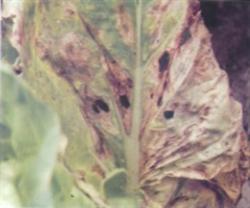 After transplanting and seedling recovery, during the early field growth stage, rapeseed sometimes shows stunted growth phenomena such as reddening and yellowing leaves, curled leaf centers, slow or halted growth, and poor development. To control stunted growth in rapeseed, targeted measures should be taken based on investigating the causes.
Stunted growth caused by drought or waterlogging. Drought not only causes a lack of water in the plants but is also accompanied by nutrient deficiency symptoms, such as reddening and purpling of leaves. Field investigation shows that the soil surface turns white and hardens, and may even crack, and plants may wilt at noon on sunny days; it may also be caused by poor drainage in the transplanting field, or continuous rainy weather after transplanting causing oxygen deprivation and stunted growth. For drought-induced stunted growth, if it is no-till transplanting, furrow irrigation can be used, filling water to 2/3 of the furrow depth to allow water to seep and infiltrate the soil; if it is a plowed and transplanted field, watering (sprinkling) to combat drought can be used, combined with topdressing, that is, applying dilute fertilizer solution; for stunted growth caused by waterlogging, drainage ditches should be cleared or deepened to lower the groundwater level. Combined with intertillage, apply plant ash or decomposed barnyard (compost) manure to raise soil temperature.
Stunted growth caused by fertilizer deficiency. Plants are short, leaves are narrow, leaf color is yellow-green, and in severe cases the leaves at the stem base turn red, indicating nitrogen deficiency. Quick-acting nitrogen fertilizer should be applied promptly, using 15 kg of ammonium bicarbonate per mu dissolved in dilute manure water for drenching; if the upper leaves are dark green and lusterless, the lower leaves are purple-red, leaf emergence is slow, and root development is poor, it is a phosphorus deficiency symptom. For this, foliar spray with 0.3% potassium dihydrogen phosphate solution 2-3 times, once every 3-5 days. At the same time, apply 25 kg of superphosphate per mu or 30-40 kg of calcium magnesium phosphate fertilizer. Before application, the phosphate fertilizer can be mixed with organic fertilizer for composting and fermentation, and applied after decomposition; stunted growth may also be caused by boron deficiency, manifested as slow plant growth, and in severe cases root rot, dead heart, and purpling of leaves. For this, spray 30-40 kg of 0.1% borax solution per mu on the leaves, or apply 0.5-1.0 kg of borax per mu mixed with 100-150 kg of water around the roots.
Stunted growth caused by pests and diseases. The common one is severe damage by aphids, causing plant stunting and thereby inducing viral disease damage. For this, aphid damage must be strictly prevented; when localized aphid damage is found, spray with 100% imidacloprid (imidacloprid, Yibianjing, Kangfuduo, Dagongchen) at 2500-3000 times dilution; when viral disease symptoms are found, promptly spray with 5% Junduqing at 300-400 times dilution 2-3 times, once every 7-10 days. At the same time, pay attention to using 2.5% deltamethrin to control cabbage caterpillars, etc.
Stunted growth caused by soil compaction. Due to compaction, plant root development is poor. Intertillage should be done well: the first time shallow hoeing and fine hoeing, loosening the surface soil; the second time shallow hoeing near the plants to scrape weeds, and deep hoeing between rows to loosen the soil and remove weeds.