How to Grow Bitter Melon Efficiently? A Detailed Guide to Practical Cultivation Techniques
How to grow bitter melon efficiently? Please advise. Bitter melon, also known as balsam pear, is a cucurbitaceous vegetable plant that thrives in high temperatures, is relatively heat-tolerant and not cold-tolerant, and can be grown year-round in our county. In recent years, with the continuous adjustment and optimization of crop structures and the ongoing development and demand of the melon and vegetable consumer market, bitter melon has become one of our county's specialty vegetables for northbound transport and export...
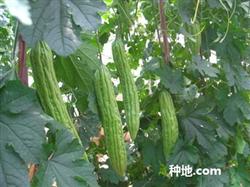
How to grow bitter melon efficiently? Please advise.
Bitter melon, also known as balsam pear, is a cucurbitaceous vegetable plant that thrives in high temperatures, is relatively heat-tolerant and not cold-tolerant, and can be grown year-round in our county. In recent years, with the continuous adjustment and optimization of crop structures and the ongoing development and demand of the melon and vegetable consumer market, bitter melon has become one of our county's specialty vegetables for northbound transport and export earnings.
I. Selecting good varieties. In recent years, the improved varieties selected in our county include Thailand Penang bitter melon, early-maturing Thai bitter melon and Australian bitter melon. Australian bitter melon is especially popular. This variety is mid-to-late maturing; the fruit is 25-30 cm long with a transverse diameter of 5-8 cm; the skin is light green; the flesh is 1.2-1.5 cm thick, tender and smooth, slightly bitter, and of excellent quality; a single fruit weighs 250-500 g, and the yield is relatively high.
II. Selecting and preparing the land. It is best to choose land near a water source with deep, loose, well-drained soil for planting.
III. Sowing at the right time. For autumn planting of bitter melon, July-August is the best sowing period, and for winter planting, November-December. Autumn planting is especially favorable, as the climate is suitable, the harvest period is long, and the yield is high. The produce can be transported north and also exported for earnings, giving relatively good economic returns.
IV. Reasonable close planting. Bitter melon has vigorous growth, many lateral roots and a long growth period. The suitable planting density (spacing) must be reasonable. The general row and plant spacing is: for a ""-shaped trellis, (120+140)÷2×120 cm; for a "π"-shaped trellis, (130+170)÷2×110 cm. About 400-450 plants per mu.
V. Applying sufficient base fertilizer and sowing carefully. When planting, plow (open) furrows according to the planting spacing, dig holes in the furrows, and apply composted superphosphate (100 kg), high-quality farmyard manure or cattle pen manure (1000-1500 kg) and imported Finnish N15P15K15 compound fertilizer (7-8 kg) into the holes, then mix evenly. Then sow the seeds by dibbling into the holes, 1-2 seeds per hole (seeds can be dibbled as dry kernels, or soaked in clean water for 3-5 hours, dried and then dibbled). Afterwards, water thoroughly. Alternatively, first apply the imported Finnish compound fertilizer into the holes and mix with the soil, water thoroughly, then dibble the seeds, and finally cover the seeds with composted high-quality farmyard manure or cattle pen manure.
VI. Building trellises and pruning. When the seedlings have 5-6 true leaves, bamboo should be inserted promptly to build the trellis. There are two types of trellises, the ""-shaped trellis and the "π"-shaped trellis, depending on the materials used. When the vines grow to 50-60 cm, they can be trained onto the trellis and spread evenly over it. After training the vines onto the trellis, promptly remove the short, weak and damaged lateral vines (branches) within 40 cm of the base of the main vine and those on the upper part that do not bear female flowers.
VII. Scientific fertilization and watering. For fertilizing bitter melon, the principle of "light application at the seedling stage, heavy application at the flowering and fruiting stage" should be well followed. When the seedlings are 70-80 cm tall, apply per mu 40-50 kg of phosphate fertilizer, 15 kg of nitrogen fertilizer and 10 kg of potassium fertilizer into the holes; at full flowering stage, apply per mu 30-35 kg of ternary compound fertilizer between the rows. Thereafter, the variety, timing and amount of fertilizer applied should be adjusted according to seedling condition and weather.
Bitter melon likes moisture and dislikes waterlogging; watering can be reasonably adjusted according to soil moisture conditions.
VIII. Preventing and controlling pests and diseases.
Powdery mildew and leaf spot: spray with 25% Bipuer or 25% Fuliku at 1500-2000 times dilution, or 25% chlorothalonil at 600-800 times dilution.
Phytophthora blight: spray with 60% Tianyike at 800-1000 times dilution, or 64% Sandofan 150 g diluted in 50 kg of water.
Spodoptera litura: spray to kill with 45% Aema at 1000-1500 times dilution.
Aphids: apply per mu 10-20 g of 10% Shikejing diluted in 50 kg of water, or spray to kill with 10% Yashijing at 3000 times dilution.
Melon fruit fly: spray to kill with 10% Sideskuai or 25% Shichongluo at 1000 times dilution.
Click to get more bitter melon growing techniques
Click to get more vegetable growing techniques