What are the control methods for greenhouse whitefly on bitter melon?
How to control whitefly on greenhouse bitter melon? Please advise. Greenhouse whitefly, also known as glasshouse whitefly, belongs to the order Homoptera, family Aleyrodidae. In the late 1970s, with the expansion of protected vegetable growing areas such as greenhouses and plastic tunnels, the occurrence and distribution of this pest showed a trend of spreading and expanding. At present, it occurs and causes damage in most areas of our country, ...
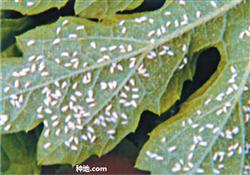
How to control whitefly on greenhouse bitter melon? Please advise.
Greenhouse whitefly, also known as glasshouse whitefly, belongs to the order Homoptera, family Aleyrodidae. In the late 1970s, with the expansion of protected vegetable growing areas such as greenhouses and plastic tunnels, the occurrence and distribution of this pest showed a trend of spreading and expanding. At present, it occurs and causes damage in most areas of our country, and has become an important pest of vegetables grown in tunnels and greenhouses. Greenhouse whitefly mainly feeds by adults and nymphs gathering on the underside of leaves to suck plant sap, causing leaves to fade green and turn yellow, wilt, and even die, affecting the normal growth and development of crops. At the same time, large amounts of honeydew secreted by adults accumulate on leaf surfaces and fruits, causing sooty mold, seriously affecting photosynthesis and respiration, and reducing crop yield and quality. In addition, this pest can also transmit certain viral diseases. Greenhouse whitefly has many host plants. Vegetables, flowers, and crops alone number more than 200 species. On vegetables, it mainly damages cucumber, tomato, eggplant, pepper, watermelon, winter melon, cabbage, Chinese cabbage, cowpea, hyacinth bean, lettuce, celery, etc.
Morphological identification
1. Adult body length is about 0.8-1.4 mm. Pale yellow-white to white, both male and female have wings, and the wing surface is covered with white waxy powder. When the female adult rests, the two wings are folded flat; the male's are slightly raised upward in a roof-like shape.
2. Egg is long oval, length 0.2-0.25 mm. Newly laid eggs are pale yellow, then gradually turn dark brown. The egg has a stalk and is laid on the underside of leaves.
3. Nymph is long oval, flat. First instar body length 0.29 mm; second instar 0.38 mm; third instar 0.52 mm. Pale green, semi-transparent, with filamentous protrusions of uneven length on the body surface.
4. Pupa, i.e. the fourth-instar nymph. Body length 0.7-0.8 mm, oval, milky white or pale yellow, usually with 8 pairs of waxy filamentous protrusions of uneven length on the dorsum.
Occurrence pattern
Under greenhouse conditions, greenhouse whitefly can occur for more than 10 generations a year, and can overwinter on greenhouse vegetables in various developmental stages, or continue to cause damage. In winter in warm regions, eggs can overwinter on Asteraceae plants. The following spring, it gradually migrates and spreads from overwintering sites to sunny beds and open-field vegetables and flowers. From May to June, population density grows relatively slowly; from July to August, population density grows relatively quickly; from August to September, damage is most severe; after late October, as temperature drops, the population gradually decreases and begins to migrate into greenhouses to cause damage or overwinter.
Greenhouse whitefly adults have a strong taxis toward yellow, but avoid white and silvery white, and are not good at flying. In the field, it first occurs spot by spot, then gradually spreads and expands. Field population distribution is uneven; adults like to gather on the underside of tender leaves in the upper part of the plant and lay eggs on tender leaves. As the plant grows, adults continuously move to upper leaves, thus forming a certain pattern in the distribution of each developmental stage on the plant: the uppermost tender leaves have the most adults and newly laid pale yellow eggs; leaves slightly lower are mostly dark brown eggs; further down are successively young nymphs, older nymphs, and pupae. Adult emergence is concentrated in the early morning. Female adults lay eggs 1-3 days after mating. Eggs are mostly laid on the underside of leaves, with the egg stalk inserted into the leaf tissue through stomata, maintaining water balance with the host and being extremely difficult to detach. Each female lays 120-130 eggs, with a maximum of 534 eggs.
The optimum temperature for adult activity of greenhouse whitefly is 25-30°C. Eggs, older nymphs, and "pupae" have strong resistance to temperature and pesticides. Once mixed occurrence of various developmental stages occurs on crops, control becomes very difficult. Greenhouse whitefly is selective about hosts; in greenhouses and tunnels where cucumber and tomato are mixed-planted, occurrence is high and damage is severe. When a single host is planted, or a host that whitefly does not prefer is planted, occurrence is lighter. According to surveys, the population of greenhouse whitefly is generally greater in autumn greenhouses and tunnels than in spring greenhouses and tunnels; greater in open-field vegetables than in spring and autumn tunnels; and greater in vegetable plots close to greenhouses than in distant ones, with more severe damage as well.
Control methods
1. Agricultural control
1) Cultivate insect-free seedlings. Disinfect greenhouses and seedlings before planting. Use 80% dichlorvos 0.4-0.6 kg per mu of greenhouse for fumigation, or spray with 40% omethoate emulsifiable concentrate at 1000 times dilution.
2) Rational layout. In open fields near tunnels and greenhouses, avoid planting vegetables that are susceptible to whitefly parasitism and severe occurrence, such as cucurbits, solanaceous fruits, and common beans; advocate planting cruciferous vegetables that whitefly does not prefer. In tunnels and greenhouses, avoid mixed planting of cucumber, tomato, common bean, etc., to prevent mutual spread of whitefly, worsening damage and increasing control difficulty.
3) Seal nylon gauze at greenhouse and tunnel ventilation openings to control external pest sources. When pest infestation occurs, combine with pruning and shoot removal, remove old leaves carrying pests, and take them out of the greenhouse to bury or burn.
2. Physical control. Taking advantage of the yellow-loving habit of greenhouse whitefly, in the early stage of whitefly occurrence, place yellow boards coated with machine oil inside the greenhouse or tunnel, higher than the vegetable plants, to trap adult whiteflies.
3. Biological control. When the whitefly population on vegetables in the greenhouse or tunnel is 0.5-1 insect/plant, release Encarsia formosa "black pupae", 3-5 per plant, once every 10 days or so, for a total of 3-4 releases. The parasitism rate can reach more than 75%, giving good control of whitefly.
4. Chemical control
1) Smoke method. Use 22% dichlorvos smoke agent 0.5 kg per mu of greenhouse, and fumigate in the evening with the greenhouse closed; or use 80% dichlorvos emulsifiable concentrate 0.4-0.5 kg per mu, pour it onto carriers such as sawdust, then add several red-hot coal balls to produce smoke.
2) Spray method. You can use 10% buprofezin emulsifiable concentrate at 1000 times dilution, or 10% imidacloprid wettable powder at 1000 times dilution, or 2.5% bifenthrin emulsifiable concentrate at 2000 times dilution, or 2.5% cyhalothrin emulsifiable concentrate at 3000 times dilution, or 20% fenpropathrin emulsifiable concentrate at 2000 times dilution, or 40% dimethoate emulsifiable concentrate at 1000 times dilution, or 80% dichlorvos emulsifiable concentrate at 1000 times dilution, or 25% methomyl emulsifiable concentrate at 1000 times dilution. Spray once every 5-7 days, with continuous application 3-4 times.
Because whitefly generations overlap, various developmental stages exist on the same crop at the same time, and currently used pesticides do not include types suitable for all developmental stages, so in chemical control it is necessary to apply pesticides several times in succession to achieve good control efficacy.
Click to get more bitter melon cultivation techniques
Click to get more vegetable cultivation techniques