Want high yields from spring-planted corn? Remember these seven criteria when choosing seed
At sowing, apply 30-40 kg of compound fertilizer per mu; the fertilizer should be placed between two rows or two corn plants, at a depth of more than 10 cm, and covered with soil after application. At the 3-leaf stage, water once with dilute manure water, 1500-2000 kg per mu. After thinning at the 5-leaf stage, depending on the amount of base fertilizer and the corn's growth, appropriately apply a top dressing to promote...
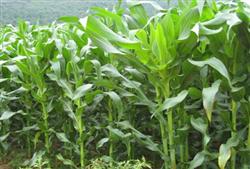 Corn can be planted in multiple crops a year. Spring corn is the season with the higher corn yield of the year. To achieve high yields from spring-planted corn, doing a good job of scientific seed selection is an important part. How can scientific seed selection help achieve high yields from spring-planted corn? The key is to follow these seven aspects:
Choose seed based on the height of the terrain. Mountain land has higher temperatures, so it is suitable to choose late-maturing varieties or mid-to-late-maturing varieties with a long growth period; flat land is suitable for mid-to-late-maturing varieties; low-lying land is suitable for mid-to-early-maturing varieties.
Choose seed based on soil fertility. Plots with good soil fertility are suitable for high-yield varieties that like fertilizer and water; plots with poorer soil fertility are suitable for varieties tolerant of barren soil.
Choose seed based on the previous crop variety. If the previous crop was soybean, the soil fertility is relatively good, and high-yield varieties are suitable; if the previous corn crop grew well and had a high yield, this variety can continue to be used; if the previous corn crop was infected with a certain disease, avoid varieties prone to that disease when choosing seed.
Choose seed based on the level of cultivation. Farmers who cultivate more carefully can choose varieties that demand a high level of cultivation; farmers who do not cultivate carefully are suitable for choosing varieties with less strict cultivation requirements.
Choose seed based on the severity of disease. The more prominent disease is corn rough dwarf disease, which is mainly related to the soil. If soil nutrients are unbalanced, plots with abnormal ground temperature are not suitable for planting Denghai 9; Denghai 9 is suitable for planting in plots with balanced soil nutrients and a high degree of maturity, where plants grow robustly and can achieve high yields.
Choose seed based on precipitation and accumulated temperature. The general experience for estimating precipitation and accumulated temperature to choose varieties is: if the previous winter had little snowfall and the winter was not cold, the following summer will have relatively more rainfall and the accumulated temperature will not be high, so varieties with a very long growth period are not recommended, to prevent insufficient accumulated temperature from affecting maturity. Conversely, if the previous winter had heavy snowfall and the winter was very cold, the following summer will generally have less rainfall and the accumulated temperature will be higher. When choosing varieties, emphasis should be placed on drought resistance, and varieties with a long growth period can be planted. Low-lying land can appropriately be planted with some mid-to-late-maturing varieties.
Choose seed based on appearance and packaging. Seed of reliable quality generally has the following appearance and packaging features: the packaging bag is sealed in one piece, with the seed company's name, detailed address and contact phone number; the seed label clearly states the production date, purity and cleanliness, moisture content and germination rate, and the seed's shape, size and color are also uniform and consistent.