What are the early-maturing cultivation techniques for bitter melon in greenhouses?
How do you make greenhouse bitter melon mature early? Please advise. Bitter melon is a typical heat-tolerant summer vegetable; in open-field cultivation it takes about 6-7 months to reach market, while in greenhouse cultivation it can reach market more than 1 month earlier. Variety selection. Good bitter melon varieties suitable for greenhouse cultivation include: Sichuan Changbai bitter melon, Hunan Lanshan bitter melon, Jiangxi Yangzizhou...
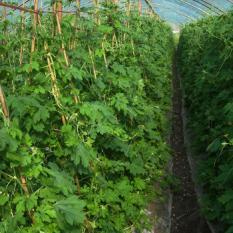
How do you make greenhouse bitter melon mature early? Please advise
Bitter melon is a typical heat-tolerant summer vegetable; in open-field cultivation it takes about 6-7 months to reach market, while in greenhouse cultivation it can reach market more than 1 month earlier.
Variety selection. Good bitter melon varieties suitable for greenhouse cultivation include: Sichuan Changbai bitter melon, Hunan Lanshan bitter melon, Jiangxi Yangzizhou bitter melon, Ji'an white bitter melon, etc.
Raising strong seedlings. In the first and middle ten days of January, raise seedlings in an electric heating hotbed inside the greenhouse, using nutrient pots to protect the roots. Bitter melon seeds have a hard shell like a turtle shell; they need to be rinsed with boiling water or warm water, stirred until no longer too hot to touch, then soaked at room temperature (around 25°C) for 24-28 hours, taken out, washed, wrapped well, and kept at 30°C-35°C for 7-10 days to germinate. Each 667 sq m (1 mu) of greenhouse needs about 200 grams of seed.
Transplanting. In the middle and last ten days of February, when the seedlings have 4-5 leaves, transplant them into high beds 1.2 m wide including the ditch, planting 1 row, with a plant spacing of 0.5 m, planting 1100 plants per 667 sq m.
Management after transplanting. 1. Temperature and humidity control in the greenhouse. After transplanting, keep the greenhouse closed during the seedling recovery period to raise the temperature and promote recovery. Before the end of March, keep warm and prevent freezing, with appropriate ventilation during the day. Before the end of April, pay attention to keeping warm at night, and ventilate during the day to reduce humidity. After May, focus on ventilation to lower temperature and remove moisture; start ventilating when the midday temperature reaches 30°C, and stop ventilating when the temperature inside the greenhouse drops to 25°C in the afternoon. In June, remove the bottom skirt film of the greenhouse and keep the top film to protect against rain. 2. Fertilizer and water management. Bitter melon likes fertilizer and moisture; under conditions of sufficient water and fertilizer, the yield is high and the quality is good. On the basis of applying sufficient base fertilizer, fertilizer and water management must also be strengthened. Although bitter melon is tolerant of fertilizer, its tolerance is weak at the seedling stage, and slightly concentrated fertilizer will burn the seedlings, so topdressing should be light early and heavy later. During the seedling recovery period after transplanting, 10% dilute manure water is sufficient; during the period of vigorous growth of stems, vines and leaves and during the flowering and fruiting period, apply 1-2 heavy fertilizations, each time applying 25-30 kg of compound fertilizer per 667 sq m, and afterward, after each harvest, apply a topdressing of a mixture of 0.2% urea and 0.3% potassium dihydrogen phosphate once. The characteristics of water management are: after seedling recovery, water can be appropriately controlled in the early growth stage to keep the soil moist. During the rainy season, clean the ditches and drain in time. 3. Pruning and trellising. Bitter melon has strong branching; greenhouse cultivation has a high planting density, making it even more prone to overly dense vines and leaves, poor ventilation and light penetration, wasted nutrients, and effects on yield and commercial quality. Therefore, pruning must be strengthened, and trellis cultivation should be used. When vines begin to grow tendrils, promptly set up a trellis in a herringbone shape or an arched or trapezoidal trellis, and guide the vines onto the trellis. Bitter melon mainly sets fruit on the main vine; side vines should be removed. Under conditions of sufficient fertilizer and water, a few side vines can also be retained in the later stage to increase late-season yield. At the same time, in the middle and late production stages, old leaves and diseased leaves should be removed at any time to facilitate ventilation. 4. Artificial supplementary pollination. Because early-maturing cultivation of bitter melon occurs at low temperatures, the greenhouse door is opened little, air movement inside the greenhouse is small, and there are few insects for pollination, natural pollination is difficult. Therefore, artificial pollination is needed, and 20-40 mg/L of 2,4-D should be applied to the female flower pedicel or young fruit to increase the fruit-setting rate of bitter melon, overcome fruit abortion, promote fruit enlargement, and increase yield.
Click to get more bitter melon cultivation techniques
Click to get more vegetable cultivation techniques