How to cultivate bitter melon to achieve high yields?
The bitter melon fruit is rich in vitamin C, higher than that of tomatoes, and contains a glycoside that gives it a distinctive bitter taste. It is produced and marketed during the off-season in summer and autumn, making it one of the popular seasonal vegetables. Growing bitter melon has low costs and high returns. Its high-yield cultivation techniques are as follows: 1. Select good varieties. The Changbai bitter melon and Dabai bitter melon varieties are preferable....
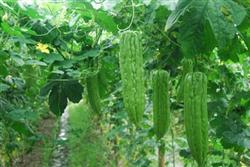
The bitter melon fruit is rich in vitamin C, higher than that of tomatoes, and contains a glycoside that gives it a distinctive bitter taste. It is produced and marketed during the off-season in summer and autumn, making it one of the popular seasonal vegetables. Growing bitter melon has low costs and high returns. Its high-yield cultivation techniques are as follows:
1. Select good varieties. The Changbai bitter melon and Dabai bitter melon varieties are preferable.
2. Sowing and raising seedlings. For open-field cultivation, the suitable sowing period is from late March to early April. Because bitter melon seeds have a hard seed coat, seed soaking and sprouting are required. First soak the seeds in warm water at 50-60°C; after the water cools, continue soaking for 36-48 hours so the seeds fully absorb water and swell. After soaking, wrap the seeds in gauze and place them in a warm environment at about 30°C to sprout. After sprouting, sow them into nutrient pots and build arched frames covered with film to keep them warm while raising seedlings. The seedling age is 30-40 days, and they are transplanted when they have 2-3 true leaves.
3. Land preparation and transplanting. Ten days before transplanting, plow the soil deeply and let it bake. Apply more than 2000 kg of high-quality composted barnyard manure per mu, plus 30 kg of superphosphate. The phosphate fertilizer should preferably be mixed with the barnyard manure and composted for more than half a month before application. Before planting, level and rake the soil finely, and open beds and make ridges. The bed width is 2-2.7 m, and the ditch depth is 15 cm. Plant two rows per bed, with a plant spacing of 50-60 cm. After planting, water thoroughly to settle the roots.
4. Trellising and pruning. When the plants grow to 30 cm, build a flat trellis and train the vines onto it to avoid the vines and leaves tangling with each other, and prune rationally. Bitter melon mainly sets fruit on the main vine, so single-vine or double-vine pruning is suitable. Promptly remove thin, weak side vines and old yellow leaves. For double-vine pruning, keep only 1 thick, strong side vine at the base.
5. Rational fertilization. After the plants survive transplanting, promptly apply 1 application of seedling-promoting fertilizer, applying 1000 kg of human feces and urine diluted 1:4 per mu. After the vines are trained onto the trellis, apply 1 application of trellising fertilizer, applying 15 kg of compound fertilizer per mu. During the young fruit stage, apply 1 application of fruit-strengthening fertilizer, applying 20 kg of compound fertilizer per mu. Around "Summer Solstice," apply 1 more application of autumn melon fertilizer, applying 20 kg of compound fertilizer per mu, applied in holes and covered with soil afterward. If the soil is dry, irrigate promptly.
6. Disease and pest control. For Fusarium wilt, in the early stage of the disease, drench the roots with a 1000-fold solution of 70% thiophanate-methyl wettable powder, or a 500-fold solution of 50% carbendazim wettable powder, or an 800-fold solution of potassium permanganate, once every 5-7 days, for 3-4 consecutive applications. For aphids, use 20 g of 10% imidacloprid wettable powder per mu (such as Dagongchen, Yibianjing, Kenuo Sijihong, etc.), dilute with 50 kg of water, and spray to kill them. For red spider mites, conventional spraying control can be used, such as 1000-fold Propargite solution, 2500-fold Bafenling solution, or 2000-fold Kemanyao solution.
7. Timely harvesting. When the young fruit has fully developed and the tumor-like protrusions on the rind have expanded, it is the suitable harvest period.
Click to get more bitter melon cultivation techniques
Click to get more vegetable cultivation techniques