How to Graft Bitter Melon? Methods and Key Technical Points Explained
1. Grafting bitter melon is mainly aimed at preventing Fusarium wilt. The main grafting method is the approach grafting method, which is divided into: 1. Seedling approach grafting 2. Mature plant approach grafting. 1. Seedling approach grafting (currently the main grafting method used in seedling nurseries): Bitter melon and loofah are simultaneously disinfected, soaked and germinated, then sown separately in plastic seedling trays; the medium in the cells is best peat moss, or a self-mixed blend of 1 part decomposed compost and 3 parts river sand or clean soil. After sowing, place in a sunny, well-ventilated spot; when the first true leaf has fully grown and the second true leaf is about to appear, this is the suitable period for grafting. The steps are:
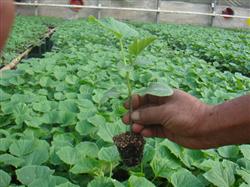
1. Grafting bitter melon is mainly aimed at preventing Fusarium wilt. The main grafting method is the approach grafting method, which is divided into: 1. Seedling approach grafting 2. Mature plant approach grafting.
1. Seedling approach grafting (currently the main grafting method used in seedling nurseries): Bitter melon and loofah are simultaneously disinfected, soaked and germinated, then sown separately in plastic seedling trays; the medium in the cells is best peat moss, or a self-mixed blend of 1 part decomposed compost and 3 parts river sand or clean soil. After sowing, place in a sunny, well-ventilated spot; when the first true leaf has fully grown and the second true leaf is about to appear, this is the suitable period for grafting. The steps are:
(a) First pull up the loofah together with its medium, and at 2 cm below the loofah leaf (the hypocotyl), use a knife to make a slanted cut from top to bottom, about 0.5 cm long, forming a tongue-shaped incision; at the same time pinch off the growing tip of the loofah, but keep the cotyledons.
(b) Also pull up the bitter melon from the seedling tray together with its medium, and at 1.5 cm below the cotyledons (the hypocotyl), use a knife to make a slanted cut from bottom to top, about 0.5 cm long, also forming a tongue-shaped incision. The incisions on both should not be too short, too shallow, or too deep; ideally the cut should reach about 3/5 of the depth of the hypocotyl.
(c) After the incisions of the loofah and bitter melon are inserted into each other and fit snugly together, use a grafting clip to clamp and secure the joined area. The bitter melon goes on the inner side of the clip, and the loofah on the outer side. Then plant them together in a larger black seedling pot and place in a shade shed for 1-2 days, after which move them out into full sunlight for seedling growth. After about 9 days, once the grafted seedlings' wounds have truly healed, cut off the bitter melon hypocotyl, then manage for about another 20 days before transplanting to the field.
2. Mature plant approach grafting: Bitter melon is germinated and sown in a seedbed, and when it has 8-12 true leaves, the growing tip is pinched off (about 3-4 cm long, which can also serve as scion for cleft grafting). At the same time, loofah is soaked and germinated, then sown in seedling pots; after sprouting, when it has 2-3 true leaves, the growing tip is pinched off (keeping the cotyledons and 1 true leaf). For the bitter melon, after the main vine's growing tip is pinched off, the terminal bud of the lateral vine that grows from the leaf axil is used for approach grafting. The approach grafting steps are similar to the grafting method above; after healing, cut off the source of the bitter melon's lateral vine, then manage for 15 days before transplanting.
2. The advantage of mature plant approach grafting is that the grafted site is high, so after field planting the healed area during the growth period is high above the ground, which can avoid infection by soil-borne pathogens; the disadvantage is that the rootstock has more lateral buds, which need to be removed early.
3. Precautions:
1. The fixing clips can be reused after grafting, but they need to be disinfected, and the operator's hands or tools must be kept clean.
2. The rootstock should not be watered heavily before grafting; keeping it moderately moist is sufficient, and water should be replenished after grafting.
3. The blade used must be sharp, the cut surface of the scion must be smooth, aligned with the ridge surface, and grafting should be done immediately after cutting.
4. After grafting, place in a windless spot; shading can reduce transpiration. Grafting in the low-temperature season requires insulation; grafting after the Start of Spring (Lichun) gives a higher survival rate.
5. After grafting, when replenishing water, use a fine-mesh sprinkler; the water pressure must not be too strong, and pay attention to disease prevention and control.
6. After the graft has taken, the lateral buds sprouting from the rootstock should be removed early.
Click to get more bitter melon cultivation techniques
Click to get more vegetable cultivation techniques