Spring Field Management Measures for Winter Wheat in Northern Xinjiang
Green-up Stage Management: After the beginning of spring (late March to early April), carry out spring harrowing in a timely manner, with a harrowing depth of 5 cm. Harrowing with a smoothing harrow or diagonal harrowing is preferable. Green-up fertilizer should be applied just before or at the early stage of wheat green-up, and it is advisable to apply more to weak seedlings, less or none to strong seedlings, and none to excessively vigorous seedlings. For wheat fields where the total number of stems per mu before winter is less than 400,000 and the wheat seedlings are growing weakly, late...
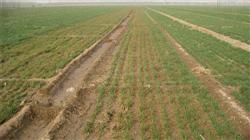
Green-up Stage Management
After the beginning of spring (late March to early April), carry out spring harrowing in a timely manner, with a harrowing depth of 5 cm. Harrowing with a smoothing harrow or diagonal harrowing is preferable. Green-up fertilizer should be applied just before or at the early stage of wheat green-up, and it is advisable to apply more to weak seedlings, less or none to strong seedlings, and none to excessively vigorous seedlings. For wheat fields where the total number of stems per mu before winter is less than 400,000 and the wheat seedlings are growing weakly, and for late-sown wheat fields, apply 8-10 kg of urea per mu just before or at the early stage of wheat green-up, using a fertilizer applicator for banded application, by topdressing on snow or topdressing before rain.
To control monocotyledonous weeds such as wild oat, green foxtail and barnyardgrass in the field, generally Puma and similar herbicides give good control results; use 50-60 ml of 6.9% Puma emulsifiable concentrate per mu, sprayed on the foliage at the 3-5 leaf stage of the weeds. To control dicotyledonous weeds such as goosefoot, bitter sowthistle, flixweed and wild rape in the field, use 50-60 ml of 72% 2,4-D butyl ester emulsifiable concentrate per mu, or 50 ml of 75% Baikuojing emulsifiable concentrate, or 1.2 g of 75% DuPont Giant suspension concentrate, sprayed on the foliage at the 2-4 leaf stage of the weeds.
When the infestation rate of wheat leafminer reaches more than 10%, or wheat aphids reach more than 500 per hundred plants, or wheat thrips reach more than 200 per hundred spikes, use 10% imidacloprid wettable powder or 1.8% abamectin per mu. When the disease index of powdery mildew and rust reaches 20-30%, use 25% triadimefon wettable powder or 12.5% diniconazole (Dilikan) wettable powder; during the occurrence period of bacterial leaf streak, use 72% agricultural streptomycin or Keshade 2000 for control.
Management of Wheat Fields Suffering Freeze Damage
Winter freeze damage: According to the symptoms of wheat plants after freezing, freeze damage can be divided into two categories: the first is severe freeze damage, that is, the main stem and large tillers are frozen to death and the heart leaves dry up. The second is general freeze damage, with symptoms of yellow-white dry leaves, but neither the main stem nor the large tillers are frozen to death. Remedial measures after the occurrence of winter freeze damage: First, apply nitrogen fertilizer in a timely manner; the first application is immediately after the field thaws, applying quick-acting nitrogen fertilizer, with 10-15 kg of urea per mu, applied in furrows to improve fertilizer efficiency; the second application is at the wheat jointing stage, applying jointing fertilizer together with irrigation at the jointing stage, with 10-15 kg of urea per mu.
Late spring cold: In various parts of northern Xinjiang, strong cooling weather processes are prone to occur in spring, with a large temperature drop, the minimum temperature reaching below 0°C, leaves being frozen, and the main stems of individual wheat fields dying. Early spring prevention of late spring cold freeze damage: First, moderately inhibit the growth of excessively vigorous wheat fields; the main measures are early spring compaction and chemical control by spraying growth inhibitors such as Zhuangfeng'an and chlormequat at the stem elongation stage. Second, irrigate to reduce the fluctuation of ground temperature and increase soil temperature. Third, use smoke to raise the ground air temperature, which has the effect of reducing frost damage.
Drainage and Waterlogging Prevention
In Changji, Tacheng, Ili Prefecture direct-administered areas and other places in northern Xinjiang, snowfall is frequent and snow accumulation is relatively thick. When spring temperatures rise and the snow melts, water is likely to accumulate in the fields, causing poor development of the wheat root system and tender and weak plants, and lodging may occur later. At the same time, high humidity in the wheat fields aggravates the occurrence of diseases, insect pests and weeds. Therefore, the green-up water may be omitted, and attention should be paid to field drainage, especially in low-lying areas.