Off-Season Radish Cultivation Methods and Key Technical Points
How are off-season radishes grown? Here is an introduction to off-season radish, which mainly refers to white radish cultivated in spring and summer, as opposed to the large radish grown in the autumn crop and stored over winter. White radish has an attractive appearance, a crisp texture, a sweet taste and is fresh and juicy. It is a vegetable people love to eat and is also one of the main varieties for export and deep processing,...
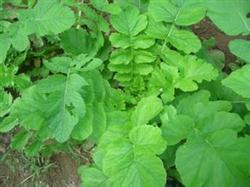
How are off-season radishes grown? Here is an introduction
Off-season radish mainly refers to white radish cultivated in spring and summer, as opposed to the large radish grown in the autumn crop and stored over winter. White radish has an attractive appearance, a crisp texture, a sweet taste and is fresh and juicy. It is a vegetable people love to eat and is also one of the main varieties for export and deep processing. Because it is cultivated off-season, it has large market potential, commands a high price and brings good economic returns. The key technical points for off-season cultivation of summer white radish are introduced below.
I. Variety Selection
For summer cultivation, choose varieties that are heat-tolerant, disease-resistant and high-yielding, such as Xiazaosheng No. 3, Xiaqiu Meinong, Baiqiu Meinong and Baiyu Wang. These varieties have an attractive appearance, with pure white, smooth skin and few fibrous roots; the roots are straight, reach 35-40 cm in length, have a fleshy root diameter of about 6-6.5 cm, and a single plant weight can reach more than 1 kg. They have relatively strong resistance to soft rot and black rot, taste good and yield high. In addition, Dafu Ling has root skin that is half white and half green, a fleshy root diameter of about 8.5 cm, a single plant weight that can reach more than 0.9 kg, and relatively good disease resistance.
II. Main Cultivation Season and Sowing Period
For summer cultivation, sow from late June to early July and harvest from late August to early September.
III. Land Preparation, Fertilization and Sowing
Because white radish has long fleshy roots, it needs a relatively deep plough layer (more than 30 cm), and the soil should preferably be loose, fertile sandy loam. Before sowing, fully prepare the land, loosen the soil, rake it level, and remove stones, tiles and hard objects from the soil. Apply 2000 kg of high-quality decomposed organic fertilizer, 20 kg of diammonium phosphate and 3-4 kg of potash fertilizer per mu as base fertilizer. With a row spacing of 50 cm, form small ridges 15 cm high, open a furrow in the middle of the small ridge, and sow in holes or drills with dark water, using 2-4 seeds per hole. The final thinning spacing between plants is 25-30 cm.
IV. Field Management
For summer cultivation, the main priorities are heat resistance, drought resistance, waterlogging prevention and pest and disease prevention. The cultivation plot must be chosen where irrigation and drainage are convenient and the soil is loose, fertile sandy loam. For land preparation, fertilization, sowing methods and sowing rate, drainage ditches should be set up in the field so that waterlogging can be drained promptly on rainy days.
(1) Avoid rainy days when sowing.
(2) In hot and dry weather, ensure sufficient water. After emergence, water frequently with a small amount of water in the morning and evening, and use well water to lower the soil temperature, so as to improve the field microclimate and keep the soil moist.
(3) On rainy days, open the bed ends to prevent water accumulation and root rotting. After heavy rain, irrigate with clean water to increase the oxygen content of the soil and promote normal root growth.
(4) Thin seedlings and cultivate the soil in time, and control weeds.
(5) When the fleshy root begins to swell, apply an appropriate amount of nitrogen and potassium fertilizer as a top dressing. Ensure a sufficient and uniform supply of water and fertilizer.
V. Pest and Disease Control
For summer cultivation, in addition to controlling aphids and leafminers, it is also necessary to control pests such as cabbage caterpillars and noctuid moths, which can be controlled with Baicao No. 1, Baichongjing or 48% Lorsban.
The main diseases include soft rot, black rot and viral diseases. The control methods are: 1) Strengthen field management, water and fertilize reasonably, and control aphids and weeds. Apply enough decomposed high-quality organic fertilizer as base fertilizer, pay attention to the application of phosphate and potassium fertilizer, and apply an appropriate amount of nitrogen fertilizer as top dressing, not too much. 2) Remove diseased plants promptly and disinfect the spot with quicklime to prevent the spread of infection.
For chemical control of soft rot, Nongkang 751 can be used to dress seeds at 1%-1.5% of seed weight, or Fengling 50 g per mu can be used for seed dressing, or 500 g of Fengling can be mixed with 50 L of water and poured into furrows dug along the side of the vegetable roots or sprayed. In the early stage of the disease, use 72% agricultural streptomycin sulfate at 3000-4000 times dilution. For black rot, seed can be dressed with thiram powder or 35% metalaxyl, and thiram can also be used for soil treatment. In the early stage of the disease, spray 72% agricultural streptomycin at 3000-4000 times dilution or Fengling at 200 times dilution, once every 7-10 days, for 3-4 consecutive sprays.
Click to get more radish cultivation techniques
Click to get more vegetable cultivation techniques