Detailed Explanation of Key Cultivation Techniques for Mini Radishes
How to cultivate mini radishes? Please advise. Mini radish is a small type of radish with a short growth period, and its fleshy root grows rapidly. Each crop's growing period is less than 1 month. The root skin is deep red with a beautiful color. It can be eaten raw, stir-fried or pickled, and has a unique flavor. It is a high-quality pollution-free vegetable and is very popular among consumers. Now...
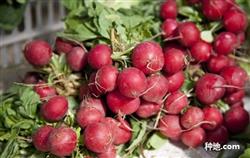
How to cultivate mini radishes? Please advise.
Mini radish is a small type of radish with a short growth period, and its fleshy root grows rapidly. Each crop's growing period is less than 1 month. The root skin is deep red with a beautiful color. It can be eaten raw, stir-fried or pickled, and has a unique flavor. It is a high-quality pollution-free vegetable and is very popular among consumers. Its cultivation techniques are introduced as follows:
1. Variety selection
At present, there are no mini radish varieties promoted on a large scale in China. Imported varieties mainly include Japan's "Twenty-day Radish" and "Forty-day Radish," among which "Twenty-day Radish" is more commonly cultivated. The fleshy roots of both varieties are round, with a diameter of 2-3 cm and a fully swollen single root weight of 15-20 g (commercial maturity requires a single root weight of 10-12 g). The root skin is red, the flesh is white, and the plant height is 20-25 cm. They have strong adaptability but are not heat-tolerant, and are suitable for open-field cultivation in early spring and autumn and protected cultivation in winter. The main differences between the two are as follows: the former prefers a mild climate and has a growth period of 20-25 days; the latter has stronger cold resistance and a growth period of 30-35 days. This article takes "Twenty-day Radish" as an example to briefly introduce its key cultivation techniques.
2. Soil requirements
Mini radish has a relatively small fleshy root and a short growth period, so loose sandy loam with good drainage and irrigation should be selected. There is no strict requirement for soil layer thickness; a depth of more than 20 cm is sufficient. There should be no stones, tiles or other debris in the soil to avoid deformities such as forked fleshy roots. It is not advisable to choose vegetable plots that have been planted for many years, because their topsoil is relatively fertile and generally has high nitrogen, which easily causes excessive leaf growth, nutrient imbalance and many fibrous roots, thus affecting normal expansion of the root. In addition, old vegetable plots retain pathogens and have a high pest population, making diseases and pests more likely to occur.
3. Land preparation and bed making
Only when mini radishes are cultivated in suitable soil can the fleshy roots be thick, well-shaped, smooth-skinned, beautifully colored and of good quality. Therefore, land preparation requires deep plowing and sun-drying of the soil, careful leveling and uniform fertilization, so as to promote an increase in available nutrients and beneficial microorganisms in the soil, store water and preserve fertilizer, and facilitate the roots' absorption of nutrients and water. Fertilization should be mainly base fertilizer; generally no topdressing is needed. Organic fertilizer and compound fertilizer can be applied all at once. Generally, about 2000 kg of decomposed barnyard manure per 667 sq m (1 mu) is applied as base fertilizer. If fertilization is uneven, local fertilizer damage is likely to occur. After land preparation, make flat beds with a width of 1-1.2 m, subject to convenience for field management.
4. Sowing
For open-field sowing, spring sowing is generally from mid-to-late March to late April, autumn sowing from early August to early October, and greenhouse cultivation can be arranged from mid-October to early March. When the temperature is low in deep winter, close the greenhouse to warm the soil 7-10 days before sowing, and sow when the soil temperature in the greenhouse is stably above 5°C. In summer, due to high temperature and rain, the quality of the fleshy root is poor, so it is not suitable for planting. In order to facilitate timely processing after harvest, it is advisable to sow in batches at staggered times. Water thoroughly 3-4 days before sowing. When the water has infiltrated evenly and the surface soil is slightly dry, level the ground and sow. The row spacing is 15 cm, the plant spacing is 3 cm, and the sowing depth is 1.5-2 cm. The sowing rate per 667 sq m is 1000-1200 g.
5. Field management
Mini radish has a short growth period, and field management is relatively simple. For open-field cultivation, if it rains before emergence, the soil may become compacted, so loosen the soil in time so that germinating seeds can emerge smoothly. Water less at the seedling stage, which helps inhibit excessive top growth. It takes about 15 days from root splitting to fleshy root formation. During this period, keep the field soil moist, neither too dry nor too wet. Watering should be uniform, and the soil moisture content is preferably 70%-80%. If water is insufficient, the fibrous roots of the fleshy root will increase, causing rough skin, a strong pungent taste and pithiness. For protected cultivation in winter, pay attention to heat preservation and cold protection. After emergence, maintain 15-20°C during the day and 8-10°C at night, and not lower than 5°C. After the seedlings split roots and during the fleshy root expansion stage, maintain the greenhouse temperature at 13-18°C during the day. During the growing period, topdressing is generally not needed. If the plants are excessively short or the leaves turn yellow, a small amount of quick-acting nitrogen fertilizer can be applied with watering, and a 0.3% potassium dihydrogen phosphate solution can be sprayed. Timely cultivation and weeding help keep the soil loose, prevent surface soil compaction and promote normal expansion of the fleshy root.
6. Control of main diseases and pests
1. Damping-off: It is prone to occur at the seedling stage in plots with repeated continuous cropping, and generally occurs within 5-6 days after emergence. Simple control method: mix pickle water used by farmers for processing pickles and sauerkraut with a small amount of active lactobacillus, dilute with water at a ratio of 1:4-5, and spray once every 2-3 days. The lactic acid bacteria in it can effectively inhibit the occurrence of this disease.
2. Black spot: a fungal disease. Before onset, use 75% chlorothalonil at 500-600 times dilution or 50% procymidone powder at 1500 times dilution, applying once every 5-7 days. In the early stage of the disease, spray 50% carbendazim at 800 times dilution once a week.
3. Aphids and cabbage caterpillars: They are prone to occur during high temperature and drought. Pay attention to timely drought relief and watering. In the early stage of pest occurrence, spray 2.5% deltamethrin at 2000-2500 times dilution for control.
7. Harvest
Mini radishes cultivated in spring and autumn can generally be harvested after 20-22 days of growth, while in the cold winter season the growth period can reach 28-32 days. Harvest in time when the fleshy root diameter is more than 2 cm and the single bulb weight is 10-12 g. Harvesting too early affects yield, while harvesting too late increases the fiber content of the fleshy root and easily produces cracked roots and pithiness, affecting product quality. Water before harvest to make the soil soft and moist. At harvest, pull up the stems and leaves together with the fleshy root. After harvest, select fleshy roots with bright color and uniform shape, wash them with leaves, and they can be sold on the market. The commercial yield can generally reach 1 kg/sq m.
Click to get more radish cultivation techniques
Click to get more vegetable cultivation techniques