How to grow cherry radishes? A few practical methods for you
How to grow cherry radishes? Please advise. Cherry radish is a small type of radish. It is a variety introduced from abroad, with characteristics such as fine and tender texture, rapid growth, and attractive color. It is not only well received by producers and consumers, but also meets the special supply needs of hotels and restaurants, becoming a delicacy on the dining table, with eating methods su...
How to grow cherry radishes? Please advise
Cherry radish is a small type of radish. It is a variety introduced from abroad, with characteristics such as fine and tender texture, rapid growth, and attractive color. It is not only well received by producers and consumers, but also meets the special supply needs of hotels and restaurants, becoming a delicacy on the dining table. It can be eaten raw, stir-fried, pickled, or used as a side dish, and has now become a new type of vegetable with quick results and high returns.
Biological characteristics
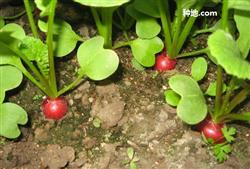
(1) Botanical characteristics. The root of cherry radish is relatively short, with the main root reaching 20 cm deep. Its fleshy root can be round or oval, and the skin color comes in 3 types: red, white, and red on top with white below; the flesh color is mostly white. The weight of a single root is very small, about ten-odd grams to several tens of grams. During the vegetative growth stage, the leaves cluster on a shortened stem. Leaf shapes are divided into whole-leaf and lobed-leaf types, and leaf colors include light green and dark green. The petioles and leaf veins are also mostly green, with a few purple, and the leaves and petioles have fine hairs. The seeds are flat and round, and the seed coat color can be dark brown or light yellow.
(2) Requirements for environmental conditions. Cherry radish is a semi-cold-tolerant vegetable. Its growth temperature range is 5-25°C, the suitable temperature for seed germination is 15-25°C, and the suitable growth temperature is around 20°C. Above 25°C, the accumulation of organic matter decreases and the substances consumed by respiration increase. Below 6°C, growth is slow and it easily passes through the vernalization stage, causing premature bolting. Below 0°C, the fleshy root is prone to freezing damage. It is not very strict about light requirements and is a medium-light vegetable, but during the leaf growth period and fleshy root growth period, sufficient light is beneficial for photosynthesis. It has a relatively wide adaptability to soil. Because its fleshy root is relatively short and small, it is not very strict about soil requirements, but it grows and develops better on sandy soil that is good at retaining water and draining well, loose, and aerated. On the contrary, if soil moisture is insufficient, phenomena such as increased fibrous roots on the fleshy root, rough outer skin, spicy taste, and hollow heart may occur. Under drought or high-temperature conditions, pests and diseases are easily triggered.
(3) Growth and development cycle. The nutritional growth and development cycle of cherry radish can be roughly divided into the following 3 stages:
1. Germination stage
From seed activation to the unfolding of the first true leaf, about 3-5 days are needed.
2. Seedling stage
From the unfolding of true leaves to the formation of 5-7 true leaves, when the root shows the "breaking belly" phenomenon, about 10 days are needed. After the true leaves unfold, the young plant enters the "weaning period," gradually transitioning from growing on nutrients stored in the seed to growing through photosynthesis.
3. Fleshy root growth stage. From root breaking belly to fleshy root formation, about 15 days are needed.
2. Variety selection
The varieties currently commonly used are as follows.
1. Twenty-day Daikon, introduced from Japan. The fleshy root is round, 2-3 cm in diameter, and a single root weighs 15-20 grams. The root skin is red, the flesh is white, the growth period is relatively short at 25-30 days, adaptability is strong, it prefers a mild climate, is not heat-tolerant, and has a beautiful appearance.
2. Forty-day Daikon, introduced from Japan. The fleshy root is round, about 2-3 cm in diameter, the flesh is white, the root skin is red, and a single root weighs 15-20 grams. The plant is short and relatively upright, with a plant height of 20-25 cm. It has relatively strong cold resistance, is not heat-tolerant, and has a growth period of 30-35 days. It has the characteristics of a short growth period and strong adaptability.
3. Cultivation season and cultivation methods. Apart from summer, cherry radish can be cultivated in open fields in spring and autumn as well as in protected areas in winter. Cultivation methods include open-field cultivation and cultivation in greenhouses, large, medium, and small tunnels. However, open-field cultivation in spring and autumn is the main method.
4. Cultivation techniques
(1) Land preparation and bed making
The cultivation plot should first be deeply plowed, the soil sunned, and the land leveled, then 2000 kg of decomposed organic fertilizer should be spread, and a flat bed should be made with a bed width of 1 m, or ridges should be made with a height of 10 cm and a ridge spacing of 10-15 cm. Before sowing, apply 7-10 kg of superphosphate per mu in the beds or ridges.
(2) Sowing and management
Cherry radish is generally sown in rows, with a row spacing of 10 cm, a plant spacing of about 3 cm, and a sowing depth of about 1.5 cm. The seed rate per mu is about 100 grams.
When sowing in open fields in spring, because the climate is cold and windy, sufficient bottom water should be watered before sowing. After sowing, cover with 2 cm of fine soil to prevent soil crusting, reduce water evaporation, and increase soil temperature, which is beneficial for seed germination and seedling emergence. Because cherry radish has a short growth period and a short plant, it can be a good intercropping and relay-cropping variety during the early growth stage of cucurbits and solanaceous fruits. For example, in the Beijing area, intercropping cherry radish among protected head lettuce achieved relatively good results.
Field management of cherry radish is relatively simple. After sowing, when the temperature reaches 22-25°C, seedlings emerge in about 2-3 days. When the cotyledons unfold, thin the seedlings once, keeping the seedlings with very normal cotyledons and thinning out the rest; thinning should be carried out where seedlings are relatively dense. Before the true leaves grow to 3-4 leaves, final thinning should be carried out in time. During the growth period, pay attention to soil moisture, keep the field moist, do not let it become too dry or too wet, and water evenly. Generally, no additional fertilization is needed, but if soil fertility is insufficient, a small amount of quick-acting nitrogen fertilizer can be applied with water. During the growth period, timely cultivation and weeding should be carried out, especially for autumn cultivation. The early stage coincides with the high-temperature and rainy season, when weeds grow vigorously. Remove weeds, keep the soil surface loose, and prevent soil crusting.
(3) Harvest
Cherry radish generally grows for 25-30 days. When the fleshy root is attractive and bright in color and reaches 2 cm in diameter, it can begin to be harvested successively. In different cultivation seasons, harvesting should be done in a timely manner. Too early affects yield, while too late increases fiber and easily produces cracked roots and pithy roots, affecting commercial quality.
Click to get more radish cultivation techniques
Click to get more vegetable cultivation techniques