Technical Guidance on Spring Fertilization Management for Wheat
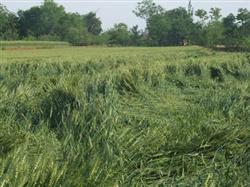
1) Spraying paclobutrazol. At the wheat stem elongation stage, spraying 30 kg of 200 ppm paclobutrazol solution per mu can dwarf the plants, enhance lodging resistance, and also control wheat powdery mildew and improve the plant's nitrogen uptake and utilization rate. (2) Spraying chlormequat chloride. For wheat fields with large populations and vigorous growth, at the early jointing stage, spray per mu 0....
 In order to implement the national soil testing and formulated fertilization project and address the current situation of farmers applying fertilizer blindly, the following guidance on spring fertilization, irrigation and pest and disease control for wheat is proposed in light of the actual conditions of our province, for the reference of the broad farming community.
I. Irrigation
From the perspective of water conservation, we advocate irrigating wheat twice in spring. For wheat fields with normal growth that have already been watered during the freezing period, if soil moisture is good, the green-turning water can be omitted. The first spring irrigation of wheat should be at the stem elongation to jointing stage (late March to early April); the second spring irrigation at the heading to flowering stage (late April to early May). The specific irrigation timing and amount should be determined by the wheat seedling condition and soil moisture. If irrigation conditions are favorable, a third irrigation may be applied during dry weather.
II. Fertilization
1. Choosing fertilizer: For low-yield wheat fields, a single nitrogen fertilizer such as urea or ammonium bicarbonate can be applied as topdressing; for medium- and high-yield fields, it is recommended to use the nitrogen-potassium topdressing specially supplied by soil testing and formulated fertilization companies. The specially supplied nitrogen-potassium topdressing is based on the fertilizer requirements of wheat, with emphasis on the ratios of various nutrients and the ratios of nutrient forms. Experiments have shown that because potassium content is relatively low in most soils, using single nitrogen fertilizers such as urea and ammonium bicarbonate results in poorly developed wheat root systems and easy lodging. Using the specially supplied nitrogen-potassium topdressing can promote wheat root development, resist lodging, enhance wheat's drought resistance, cold resistance and disease resistance, increase thousand-grain weight, and produce a notable yield increase. At equal cost, using the specially supplied nitrogen-potassium topdressing can increase yield by 50-100 kg per mu compared with urea.
2. Ratio and content of nitrogen-potassium topdressing: 30% (25-0-5), 30% (22-0-8), 30% (20-0-10). Select the nitrogen-potassium topdressing with different potassium contents according to the soil's potassium deficiency. It is recommended to apply 25-30 kg per mu.
3. Fertilization timing: 1 For weak seedling wheat fields, spring management should focus on promoting growth, applying green-turning fertilizer together with the green-turning irrigation, and then a second jointing fertilizer at the jointing stage. 2 For general wheat fields, spring management measures should combine promotion and control. For plots with relatively low soil fertility, fertilizer can be applied twice, at the stem elongation stage and the jointing stage; for plots with relatively high soil fertility and strong healthy wheat seedlings, jointing fertilizer should be applied at the jointing stage, preferably after the first internode of wheat has reached its final length. 3 For over-vigorous wheat fields, spring management measures should focus on control. Fertilizer should be applied at the late jointing stage. The topdressing amount should not be too large, to avoid causing wheat to stay green and mature late.
III. Pest and Disease Control
The main diseases of winter wheat include five: take-all, sheath blight, powdery mildew, rust and dwarf virus disease; the main insect pests include four: wheat blossom midge, aphids, red spider mites and small brown planthoppers.
1. For wheat powdery mildew and rust, apply per mu 50 ml of 20% triadimefon emulsifiable concentrate or 75 g of 15% triadimefon wettable powder, mixed with 60-70 kg of water, and spray at the initial stage of disease onset; 2. For wheat take-all, apply per mu 100 ml of 20% triadimefon emulsifiable concentrate or 150 g of 15% triadimefon wettable powder, mixed with 50-80 kg of water, and spray along the rows from the stem elongation stage to the jointing stage; 3. For sheath blight, at the early jointing stage of wheat, apply per mu 100-150 ml of 5% validamycin aqueous solution, mixed with 50-70 kg of water, and spray onto the base of the wheat stems. 4. To control wheat aphids, apply per mu 6 g of 50% pirimicarb wettable powder, mixed with 50-60 kg of water, and spray. 5. To control wheat spider mites, apply per mu 1.8% abamectin at 3000-4000 times dilution for spray control, which can also control small brown planthoppers and prevent dwarf virus disease. In addition, attention should be paid to strengthening the control of wheat yellow dwarf disease, dwarf virus disease, wheat sawfly and underground pests.