How to remedy wheat after a spring frost
Every year in February and March of spring, cold air often breaks out and moves southward in the north, with a large temperature drop during the process, and wheat that has jointed too early often suffers frost damage. At this time, for seedlings growing too vigorously, the method of pressing should be adopted to inhibit growth; for weak seedlings, reasonable topdressing should be applied to promote weak ones into strong ones, so as to enhance cold resistance, and at the same time attention should be paid to listening to the weather...
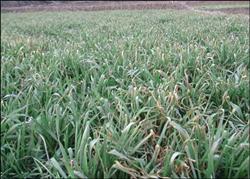
Every year in February and March of spring, cold air often breaks out and moves southward in the north, with a large temperature drop during the process, and wheat that has jointed too early often suffers frost damage. At this time, for seedlings growing too vigorously, the method of pressing should be adopted to inhibit growth; for weak seedlings, reasonable topdressing should be applied to promote weak ones into strong ones, so as to enhance cold resistance, and at the same time attention should be paid to listening to weather forecasts, irrigating before the cold wave arrives, or organizing large-scale unified smoke treatment, so as to prevent and reduce frost damage.
I. Wheat after jointing is not cold-tolerant. Wheat is a relatively low-temperature-tolerant crop, but the cold resistance of wheat is related to the developmental stage it is in. At the seedling stage, cold resistance is strongest during the "vernalization" stage, and after vernalization is completed, cold resistance further declines. When frost damage occurs, under the action of low temperature, the water in the cell tissues of wheat will freeze; when ice forms between cells, the volume increases, and the cells are damaged. If the temperature drops further, the inside of the cells will also freeze, leading to death. After wheat joints, when it encounters a low temperature of -1°C-4°C, the young spike may be frozen to death, or deformed spikes may form. The greater the amplitude and steepness of the cooling process and the longer the low temperature lasts, the more severe the damage.
II. Check the degree of damage after freezing. After wheat suffers freezing, the degree of damage should be checked in a timely manner, and the focus of the check is the young spike. In plants whose young spikes are frozen to death, the heart leaf no longer elongates, most roll into a trumpet shape, and a few wither and die directly. However, some frozen-to-death plants give a false impression: the leaves can still remain green, and some even do not turn yellow and withered until 10-15 days later, so the young spike should be peeled open further to look; if the young spike is found to be milky white and opaque, then it has already been frozen to death.
III. Remedial measures
1. Do not plow up frozen wheat fields at will. Spring frost damage occurs in spring, when the wheat seedling root system is already well developed and the tillering nodes are relatively thick and strong. Even if the aboveground part of the plant is entirely frozen to death, the root system and tillers will not die. As long as management is strengthened, as the temperature rises, new tillers will quickly grow, and it can still head and set grain.
2. Do not cut off the frozen yellow leaves and "dead tillers." Research shows that after wheat suffers freezing, within a certain period, the root system of "dead tillers" has a stronger ability to absorb fertilizer than that of living tillers. After the main stem and large tillers are frozen to death, the nutrients absorbed by their root system can be transferred to the surviving tillers, which is greatly beneficial for frozen wheat seedlings to recover vitality and increase tiller heading.
3. Topdressing and watering. After wheat suffers freezing, nutrients in the body are consumed excessively, and the seedling vigor is very weak. As the temperature rises, new stems and tillers quickly grow, requiring large amounts of water and nutrients. Watering and topdressing should be done in a timely manner, and depending on the seedling condition, apply 5-7.5 kg/mu of urea, or spray a 1%-2% urea solution on the leaves, to promote recovery growth.