How to Grow Yardlong Beans for High Yield? A Detailed Guide to Cultivation Techniques
How can yardlong beans be grown for high yield? Please advise. Yardlong beans, also known as cowpeas or long cowpeas, have a long history of cultivation. Guangdong Province has a relatively large area under yardlong bean cultivation, mainly supplying the market from April to December. In recent years, demand for yardlong beans in the market has been relatively high, and production returns are relatively good, making them a major vegetable crop in many areas of our province. Growing...
How can yardlong beans be grown for high yield? Please advise.
Yardlong beans, also known as cowpeas or long cowpeas, have a long history of cultivation. Guangdong Province has a relatively large area under yardlong bean cultivation, mainly supplying the market from April to December. In recent years, demand for yardlong beans in the market has been relatively high, and production returns are relatively good, making them a major vegetable crop in many areas of our province.
When growing yardlong beans, select superior varieties according to local climate and market demand. For growing white yardlong beans in our province, varieties such as Fengchan No. 3, Fengchan No. 4, and Jindi Yardlong Bean can be chosen; for growing oil-green yardlong beans, the Fengchan No. 2 yardlong bean variety can be used; for growing green yardlong beans, the Teqing yardlong bean variety can be used.
I. Sowing and Raising Seedlings: Direct sowing is generally used. However, during early spring when temperatures are low, if conditions permit, seedlings can be raised in greenhouses or low tunnels and then transplanted; about 8-10 days after sowing, when the first pair of true leaves has unfolded, they should be transplanted in time. After sowing, the bed surface can also be covered with plastic film to increase soil temperature.
II. Reasonable Close Planting: Choose fields with relatively high terrain, good drainage, and neutral or slightly acidic loam or sandy loam for planting. When preparing the land, deep furrows and high beds should be made, and the bed soil should be deeply turned and sun-bleached. In the Guangzhou area, the bed width (including furrows) is generally 1.5-1.8 m, with two rows per bed, 2 seeds per hole, and a plant spacing of about 15 cm. It can also be intercropped with leafy vegetables, using single-row planting, with vegetables such as choy sum and Chinese cabbage intercropped along the bed edges.
III. Reasonable Fertilization: Pay attention to applying sufficient base fertilizer. Generally, apply 1000-1500 kg of organic fertilizer, 50 kg of superphosphate, and 20-30 kg of potassium sulfate per mu. During the seedling stage, 1-2 applications of dilute human manure and urine water, etc. may be made. During the flowering and pod-setting stage, heavy topdressing should be applied in time to prevent premature aging, with 20 kg of compound fertilizer applied per mu, and thereafter once every 7-10 days. When necessary, foliar topdressing should be carried out to reduce flower and pod drop. After the peak podding stage, fertilizer and water management should continue to be strengthened to promote the plants to "reflower," extend the harvest period, and increase yardlong bean yield.
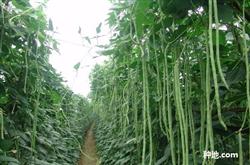
IV. Inserting Stakes and Training Vines: When the seedlings are 25 cm tall, stakes should be inserted and vines trained in time. The staking method varies with the planting method; generally, fence trellises and A-frame trellises are used. A-frame trellises are stable and relatively wind-resistant, and when the pods hang down they will not touch the leaves, which can reduce damage from pod borers. Vine training is generally carried out after 10 a.m. on sunny days, winding the vines counterclockwise around the bamboo stakes.
Click to get more yardlong bean cultivation techniques
Click to get more vegetable cultivation techniques