Foliar topdressing is very necessary in the late growth stage of cotton
This weather pattern of drought early on and rain later is extremely unfavorable for the survival and growth of late-transplanted cotton planted after oilseed rape, with the growth process delayed by about 10 days compared with normal years. In order to increase the rate of flower bud formation in the late stage of cotton and raise the boll-setting rate, it is recommended that cotton farmers strengthen late-stage fertilization management by means of foliar spraying. The specific methods are as follows:...
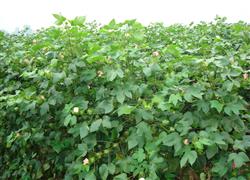
This weather pattern of drought early on and rain later is extremely unfavorable for the survival and growth of late-transplanted cotton planted after oilseed rape, with the growth process delayed by about 10 days compared with normal years. In order to increase the rate of flower bud formation in the late stage of cotton and raise the boll-setting rate, it is recommended that cotton farmers strengthen late-stage fertilization management by means of foliar spraying. The specific methods are as follows:
1. Coordinate pest control with the pace of fertilizer application. Foliar fertilization carried out together with pest control does not mean that fertilizer must be added at every pest control treatment; rather, different types of nutrients such as nitrogen, phosphorus, potassium and trace elements should be applied in rotation, with the same nutrient sprayed once every 7-10 days, and the interval between different nutrients can also be 3-5 days. That is, if nitrogen fertilizer is used the first time, phosphorus and potassium fertilizer should be used the second time, and trace element foliar fertilizer the third time, and so on.
2. Choose good varieties to ensure nutrient balance. Urea is an ideal nitrogen fertilizer variety for foliar spraying; in the late growth stage of cotton, spray an aqueous solution of about 0.5% until the leaves drip. For phosphorus and potassium fertilizer, potassium dihydrogen phosphate is preferable, at a concentration of 0.2%. Trace element foliar fertilizer can effectively reduce the symptoms of nutrient deficiency in the upper leaves and increase the boll-setting rate. In recent years, Xingxin Fuliju, developed and promoted by the provincial soil and fertilizer station, is a new generation of humic acid-type liquid fertilizer, featuring high concentration, high content, high activity and high effectiveness. Using this product can make the root system well developed and the plant robust, enhance photosynthesis, regulate plant physiological functions, and promote plant growth and dry matter accumulation, thereby increasing yield and improving quality.
3. Adjust flexibly to improve photosynthetic efficiency. Foliar fertilization should also be flexibly regulated according to the different growth vigor and appearance of cotton: for cotton with weak growth vigor, nitrogen is generally the main nutrient, combined with phosphorus and potassium fertilizer; for cotton with average growth vigor, nitrogen, phosphorus and potassium are mainly used together; for cotton with excessively vigorous growth, phosphorus and potassium are the main nutrients, combined with mepiquat chloride chemical control, using 3-3.5 grams of pure mepiquat chloride per mu plus water for uniform spraying. Trace element foliar fertilizer can be applied to all types of cotton, and especially for first- and second-class fields it should be used even more.