Detailed Guide to Land Preparation and Fertilization for Garlic Planting
How do you prepare the land and fertilize when planting garlic? Please explain in detail. Garlic has strong adaptability to soil and can grow in all soils except saline-alkali and sandy wasteland. However, because its root system is small and short and its ability to absorb nutrients is poor, sandy soil rich in organic matter, well drained and loose is best. Garlic is afraid of alkali and does not like clay. When cultivated in alkaline soil, the mother cloves rot easily and are prone to damage by garlic maggots, and the seedlings are yellow and weak, with the false stem lodging when alkali returns.
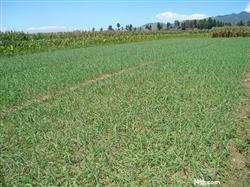
How do you prepare the land and fertilize when planting garlic? Please explain in detail
Garlic has strong adaptability to soil and can grow in all soils except saline-alkali and sandy wasteland. However, because its root system is small and short and its ability to absorb nutrients is poor, sandy soil rich in organic matter, well drained and loose is best. Garlic is afraid of alkali and does not like clay. When cultivated in alkaline soil, the mother cloves rot easily and are prone to damage by garlic maggots, and the seedlings are yellow and weak, with the false stem lodging when alkali returns.
According to the growth characteristics of the garlic root system, fine land preparation is required, with deep plowing and fine harrowing and a level bed surface. Whether for autumn sowing or spring sowing, sufficient decomposed organic fertilizer should be applied before sowing. Spring-sown garlic should be treated before winter by applying 2000-2500 kg of high-quality compost per mu as base fertilizer in combination with deep plowing. After deep plowing and land preparation, make beds with a bed width of 1.2-1.5 m; the bed length should be such that irrigation is even, and high beds with deep furrows should be made to facilitate smooth water flow. Irrigate thoroughly before the soil freezes so that sowing can be done on the frozen surface in early spring.
For autumn-sown garlic, after the previous crop is harvested, plow and turn the land as early as possible, apply organic fertilizer mainly consisting of barnyard manure at 2500-3000 kg per mu, and add quick-acting chemical fertilizers such as nitrogen and phosphorus to meet the needs of garlic root development and seedling growth. If nitrogen and phosphorus are insufficient, rooting ability is weak and seedling growth is poor.
Sowing Garlic
(1) Sowing time
The sowing period of garlic is strictly limited by the season. In the south, the suitable sowing date is when the average daily temperature is about 20-22°C, and it is best to grow 4-5 true leaves before overwintering. In the north, spring sowing of garlic mainly depends on the dates when the soil freezes and thaws. When the average daily temperature is mostly between 3-6°C, sowing is carried out on the frozen surface.
(2) Sowing density
Garlic leaves are upright, which helps sunlight reach the base of the leaf layer, so rational close planting has great potential for increasing yield. When the goal is to harvest garlic bulbs, the row spacing is 16-20 cm or 24-27 cm; the plant spacing is 10-13 cm or 8-10 cm; the sowing rate is 120-150 kg per mu. When larger garlic cloves are used for sowing, the sowing rate per mu is 150-180 kg. When small garlic cloves are used for sowing, only 50-80 kg is needed. When the goal is to harvest green garlic, sowing is denser, with a row spacing of 13 cm and a plant spacing of 4-5 cm, and the sowing rate reaches 250-300 kg per mu.
(3) Sowing depth When sowing, insert the garlic cloves into the soil with the tips slightly exposed; it should not be too deep or too shallow. Then cover with about 3 cm of fine soil to keep it moist.
Garlic is suitable for shallow planting. Otherwise, emergence is delayed, seedlings are weak, and bolting is late. Garlic sowing methods can be divided into wet sowing and dry sowing. Wet sowing is mostly used in spring; dry sowing can be used in both spring and autumn. Garlic can also be sown in mechanical rows to improve mechanical efficiency.
After sowing, in order to keep the soil moist and prevent weeds from growing thickly, a layer of rice straw, wheat straw or other weeds can be spread over the bed surface. After emergence, the covering grass does not need to be removed; after it rots, it can be used as fertilizer.
Click to get more garlic planting techniques
Click to get more vegetable planting techniques