What key techniques are needed to grow cotton well?
To grow cotton well, the following key techniques should be mastered. 1. Strictly control sowing quality. 1. Choose high-quality, high-yield varieties. Choose fine varieties promoted by the local agricultural technology department. 2. Sun the seeds before sowing. Choose a sunny day, spread the seeds on a non-cement surface, and sun them for 4-5 days to promote after-ripening of the seeds, ...
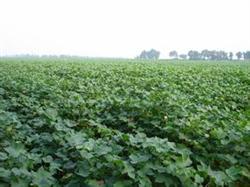
To grow cotton well, the following key techniques should be mastered.
1. Strictly control sowing quality
1. Choose high-quality, high-yield varieties. Choose fine varieties promoted by the local agricultural technology department.
2. Sun the seeds before sowing. Choose a sunny day, spread the seeds on a non-cement surface, and sun them for 4-5 days to promote after-ripening of the seeds and increase the germination rate.
3. Sow at the right time. Generally, sowing begins when the soil temperature at 5 cm stably passes 16°C. The suitable sowing period for plastic-film cotton is April 20-30, and for open-field cotton it is after April 25.
4. Choose a suitable sowing method. Generally, for sandy soil, sow first and then cover with film to prevent surface crusting from pressing the seedlings; for clay soil and saline-alkali land, cover with film first and then sow, which helps raise soil temperature and prevent salt return. After emergence, the seedlings should be released in time to prevent scorching damage.
5. Increase the sowing rate. For manual hole sowing, use 1.5 kg of seed per mu, sowing 3-4 seeds per hole, placed together; for machine sowing, use 2-2.5 kg of seed per mu.
2. Strengthen scientific management
1. Determine the suitable density. Choose different planting densities according to different varieties, different soil fertility, and different cultivation methods. For example, for the nationally approved variety Ji 668, on general soil fertility use 2500-2800 plants per mu; on poor and dry land, use more than 3500 plants per mu; for simplified cultivation plots, use about 2000 plants per mu. For the variety Jiza 3268, under conventional cultivation use 2000-2200 plants per mu; under simplified cultivation use about 1800 plants per mu. For the variety Jiza 566, under conventional cultivation use 1800 plants per mu; under simplified cultivation use about 1500 plants per mu. For DP99B, use more than 3500 plants per mu.
2. Top at the right time. For plots using conventional cultivation, top on July 15-20; for plots using simplified cultivation, top on July 10-15. For DP99B, attention should also be paid to removing the group tips in early to mid-August.
3. Remove the film in time. To prevent premature aging in the later stage, remove the film in time, with the timing controlled in late June.
3. Promote appropriate techniques
(1) Balanced fertilization technique
To improve the comprehensive stress resistance of cotton, the balanced fertilization technique should be vigorously promoted. According to the principle of "moderate nitrogen, increased phosphorus, emphasis on potassium, and supplementation of microelements," adjust the ratio of nitrogen, phosphorus, and potassium to 1:0.5-0.6:1. At the same time, supplement boron, zinc, and other trace fertilizers to increase the boll-setting rate.
1. Apply heavy base fertilizer. Apply all phosphorus and potassium fertilizer and 50%-60% of the nitrogen fertilizer as base fertilizer, applying 10 kg of urea, 15-20 kg of diammonium phosphate, 15-20 kg of potassium sulfate, 1 kg of boron fertilizer, and 2 cubic meters of decomposed organic fertilizer per mu.
2. Apply flower and boll fertilizer as topdressing. In early to mid-July, apply 10-15 kg of urea per mu as topdressing; for plots with little base fertilizer and poor growth, an additional 15 kg of diammonium phosphate may be applied. Water promptly after topdressing; where there is no water source, apply topdressing during rain.
3. Foliar spraying of fertilizer. In the middle and late stages, use 0.5-1.0 kg of urea, 0.2 kg of monopotassium phosphate, or 15 ml of Fuwanjia per mu, add a small amount of boric acid, and dilute with 50 kg of water for spraying. Spray once every 7-10 days, for a total of 2-3 sprays.
(2) Systematic chemical regulation technique
Systematic chemical regulation helps root growth and increases stress resistance; it helps control excessive vegetative growth, coordinate the relationship between vegetative and reproductive growth, and reduce bud and boll shedding. Therefore, the systematic chemical regulation technique for cotton should be promoted, with special attention to chemical control at the bud stage. Generally, follow the principle of "small amounts many times, light first and heavy later, gradually increasing each time," and spray mepiquat chloride 3-4 times throughout the growth period: the 1st time in mid-June, using 1.5 g/mu; the 2nd time in early July, using 2.0 g/mu; the 3rd time at the end of July, using 1. Strictly control sowing quality
4. Carry out good control of diseases, insects, and weeds
1. Insect pests. Focus on controlling aphids and thrips at the seedling stage and cotton bollworms and mirids in the middle and late stages. For aphids and thrips, imidacloprid may be chosen for control; for cotton bollworms and mirids, choose a 1:1 compound of Lorsban plus Saibokai, diluted 1500-2000 times for spraying.
2. Diseases. For seedling damping-off and anthracnose, choose measures such as adjusting the sowing date, avoiding low temperatures, seed or soil treatment, and spraying Bordeaux mixture or carbendazim for prevention and control; for Verticillium and Fusarium wilt, use crop rotation sowing, increase potassium fertilizer, and pull out diseased plants for control; for red-leaf yellow-wilt disease, solve it by increasing potassium fertilizer.
3. Weeds. Use 70-90 ml of 48% trifluralin emulsifiable concentrate per mu diluted with 50 kg of water, spray on the ground before sowing, and shallowly harrow 3-5 cm to mix into the soil. Acetochlor or Dual may also be used for weed control.