Detailed Explanation of Key Techniques for Raising Rice Seedlings for Mechanized Transplanting
Mechanized rice transplanting is one of the most direct and efficient light and simple cultivation methods. In recent years, the technology of mechanized rice transplanting has matured through wider promotion and application, and seedling raising technology is one of the key techniques for machine transplanting. The following technical measures are provided for reference. 1. Requirements of the transplanter for seedlings: walking-type or high-speed ride-on...
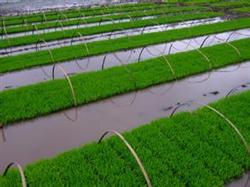
Mechanized rice transplanting is one of the most direct and efficient light and simple cultivation methods. In recent years, the technology of mechanized rice transplanting has matured through wider promotion and application, and seedling raising technology is one of the key techniques for machine transplanting. The following technical measures are provided for reference.
1. Requirements of the transplanter for seedlings: The seedling mat specifications required by walking-type or high-speed ride-on transplanters are 58.0 cm x 28.0 cm x 2.0-2.5 cm (length x width x height), with vertical and square corners and no missing edges or corners. Each square centimeter should have 1-2 seedlings, seedling height 10.0-20.0 cm, seedlings neat and uniform, roots matted together, not falling apart when lifted, and able to be placed into the seedling box as a whole.
2. Commonly used seedling raising methods: The machine-transplanting seedling raising methods developed in recent years include hard tray seedling raising, soft tray seedling raising, double-film seedling raising and other seedling raising methods. Hard tray seedling raising has a relatively high cost, so soft tray seedling raising and double-film seedling raising are suitable. Regardless of the seedling raising method, both dry seedling raising and wet seedling raising can be used. Dry-raised seedlings are easy to control in height, have well-developed roots, mat together well, have greater flexibility in seedling age, have a short recovery period after transplanting, and are more conducive to high yield.
3. Determination of sowing date: The sowing date should be determined by comprehensively considering the crop rotation, seedling age, variety and local climatic conditions. The seedling age for machine transplanting matched with a wheat rotation is generally within 25 days. Therefore, the sowing date for winter fallow fields and early-rotation fields is the same as that for local manual transplanting, and transplanting is carried out earlier in the suitable transplanting period. For wheat (rapeseed) rotation fields, sowing should be carried out 25 days backward from the harvest time of the previous crop.
4. Determination of sowing rate: The sowing rate is mainly determined by the requirements of mechanical seedling grasping and seedling quality. Under the condition of satisfying seedling grasping, the lower the sowing rate per unit area, the higher the seedling quality. Calculated at 1-2 seedlings per square centimeter, averaging 1.5 seedlings, each seedling tray (58 cm x 28 cm) needs 80-90 g of seed; the lower the 1000-grain weight, the smaller the sowing rate.
5. Key technical points for machine-transplanted dry-raised seedlings
(1) Carefully prepare the seedling bed. Select a field plot with flat terrain, shelter from wind and facing the sun, convenient water source, deep soil layer, fertile and loose soil, convenient seedling transport, and easy operation and management as the seedling board field, and prepare the seedling field according to a ratio of seedling field to main field of 1:80-100. Before sowing, plow (rotary till) the seedling field and level and finely prepare it. Then open ditches and make seedling beds. The seedling bed width is 1.40 m, the ditch width is 0.40 m, and the ditch depth is 0.15 m. The bed surface is required to be flat, and thoroughly irrigated with bottom water.
(2) Prepare nutrient soil. For raising seedlings for 1 hectare of main field, 750 kg of nutrient soil is needed (for about 240-270 seedling trays). In advance, take fertile vegetable garden soil or loose paddy field soil, pour in human and livestock manure and urine, add 2 kg of superphosphate per 100 kg, compost, then air-dry, crush and sieve. Before sowing, mix the soil with seedling-strengthening agent, but pay attention to the type and amount of seedling-strengthening agent, and it must be tested first. It is advocated to use seedling-strengthening agent suitable for local soil properties instead of inorganic fertilizer. When processing and sieving the bed soil, evenly mix 0.5-0.8 kg of dry seedling-strengthening agent per 100 kg of fine soil.
(3) Arrangement of seedling trays. For soft tray seedling raising, arrange two rows of soft trays horizontally, with the overlapping edges of the trays intersecting, and the tray bottoms closely attached to the bed surface, ensuring that the seedling trays do not deform and do not warp at the edges or corners.
(4) Spread flat bottom soil. Spread flat bottom soil on the seedling trays to a thickness of 1.8-2.0 cm (about 2.5 kg of nutrient soil). After spreading, scrape flat with a wooden strip, and the thickness must be uniform and consistent. After spreading the soil, moisten the bottom soil with a watering can.
(5) Sow evenly. Use the method of soaking by day and exposing at night to make the rice seeds reach the stage of breaking the hull and showing white. When sowing, weigh the seed according to the seedling tray, and achieve even sowing and sowing in batches.
(6) Cover with soil. Cover the seeds with the prepared nutrient soil that has not been mixed with seedling-strengthening agent. The covering thickness should be such that the seeds are not visible. There should be no mud on the frame edges, to prevent unfavorable seedling lifting due to root tangling.
(7) Seedling stage management. Within 1 week after sowing, the core of management is the regulation of moisture, and it is necessary to keep the seedling bed moderately dry and wet. The standard to grasp is: do not water when the surface soil of the seedling bed does not turn white; when watering, take measures to atomize or refine the water droplets, and do not pour or irrigate heavily with large water droplets; each watering must not form standing water on the tray surface or around the trays, and it is enough to always keep the soil at the seed-falling part moist. It is emphasized that during this period, the tray soil must not be allowed to dry and crack, nor must there be standing water on the trays or at the tray bottoms, so that water and air are coordinated to facilitate rooting and needle standing and the formation of strong buds, strong roots and strong seedlings.
(8) Lifting seedlings for transplanting. Soft tray seedling raising can be transplanted by rolling the seedlings after lifting the trays. During transplanting, minimize the number of times the seedling mats are moved, and achieve lifting, transporting and transplanting in immediate succession, ensuring no deformation, no breakage and no damage to the seedlings.