Key Technical Points and Fertilization Methods for Topdressing Peanuts and Soybeans
Carrying out topdressing of peanuts and soybeans at the mid-to-late growth stages according to different conditions is an important measure for raising the overall yield level. I. Peanuts: Peanut topdressing is mainly done at the pegging stage, when the nitrogen-fixing ability of peanut rhizobia has gradually declined, while the plants have entered the peak period of nutrient uptake. Topdressing can be carried out in two situations:...
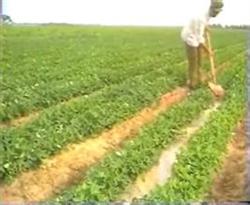
Carrying out topdressing of peanuts and soybeans at the mid-to-late growth stages according to different conditions is an important measure for raising the overall yield level.
I. Peanuts
Peanut topdressing is mainly done at the pegging stage, when the nitrogen-fixing ability of peanut rhizobia has gradually declined, while the plants have entered the peak period of nutrient uptake. Topdressing can be carried out in two situations:
1. Fields where no phosphate fertilizer or compound fertilizer was applied in the base fertilizer. For this type of peanut, because nutrients were insufficient in the early stage and the vegetative growth is generally weak, the main purpose is to increase fertilizer and promote growth. Generally, about 10 kg of high-concentration compound fertilizer per mu is dissolved in water and applied as a drench. If the leaf color is on the pale side, add another 3-5 kg of urea. After fertilizing, loosen the soil and earth up the roots in time.
2. Fields where phosphate fertilizer or compound fertilizer has already been used as base fertilizer. For those with average growth, apply 5-8 kg of urea per mu as a drench. For fields with relatively high soil fertility and overly vigorous growth, application may be omitted.
II. Soybeans
The nitrogen-fixing ability of soybean rhizobia is related to the level of soil fertility. Under the conditions of fairly acceptable soil fertility in our city, the amount of nitrogen fixed by rhizobia is equivalent to 1/4-1/2 of the nitrogen requirement, and the biological yield of soybeans is higher than that of peanuts, so the total nutrient uptake is correspondingly higher. Topdressing is an important measure for high soybean yield.
1. Skillfully apply flower and pod fertilizer. After soybean flowering, the plants enter the stage of simultaneous vegetative growth and reproductive growth, and nutrient demand reaches its peak. At this time, if nutrients are lacking and light is insufficient, a large number of flowers and pods will drop; in severe cases, the flower and pod drop rate reaches 70-80%. Soybean flower and pod fertilizer is generally applied as a drench with 8-10 kg of urea per mu. For fields where phosphorus and potassium were not applied in the base fertilizer, apply 10-12 kg of high-concentration compound fertilizer per mu dissolved in water as a drench. The amount of topdressing can be appropriately adjusted according to the growth condition and appearance of the soybeans.
2. Foliar fertilization. In the late growth stage of soybeans, root activity and fertilizer uptake capacity weaken, and fertilization is inconvenient, while the nutrient uptake function of the leaves is relatively strong, so foliar spraying can be carried out. For soybeans with average or weak growth, a 0.3% urea solution and a 0.2% potassium dihydrogen phosphate solution can be sprayed until dripping; for those with overly vigorous growth, a 0.2% potassium dihydrogen phosphate solution can be sprayed alone. At the same time, for most fields, trace element foliar fertilizer can be sprayed.