Implement three protection measures in the late growth stage of peanuts to promote increased yield
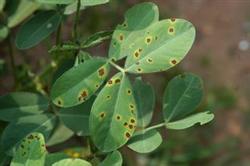
What is the difference between peanut black spot and peanut brown spot? Peanut black spot and peanut brown spot are the most common leaf diseases of peanuts. Their common feature is the formation of spots on the leaf surface, so they are collectively called leaf spot disease. The main differences are: brown spot occurs earlier, appearing at the early flowering stage, and in the later stage the lesions on the leaves are relatively large, round or irregular...
 Production practice has shown that in the middle and late stages of peanut growth, timely implementation of the "three protections," namely preventing excessive vine growth, preventing premature aging, and preventing pests and diseases, can increase yield by 20%-30%.
(1) Preventing excessive vine growth For peanut fields with good water and fertilizer conditions and vigorous plant growth, a plant growth regulator can be sprayed when a large number of pegs enter the soil. Spray 30-40 g of 15% paclobutrazol powder per mu mixed with 40-50 Kg of water, or 30 ml of 20% Zhuangfeng'an per mu mixed with 40 Kg of water. It is best to spray in the afternoon, avoid repeated spraying or missing spots, and if rain occurs within 8 hours after spraying, spray again.
(2) Preventing premature aging For peanut fields with insufficient basal fertilizer application or high-yield fields, spraying foliar fertilizer in the middle and late stages of peanut growth is an effective measure for achieving high-quality and high-yield peanuts. From 30-50 days before harvest, spray a mixed solution of 1% urea plus 0.5% monopotassium phosphate on the leaves, spraying 50 Kg of fertilizer solution per mu each time. Spray once every 10 days, generally 2-3 times, which has a clear effect on improving leaf photosynthetic capacity and promoting full pods.
(3) Preventing pests and diseases Because there is more rainfall and higher humidity in the middle and late stages of peanut growth, leaf spot disease is likely to occur, and after peanuts are affected, yield is generally reduced by 20%-30%. It can be controlled with 50% carbendazim 1000-fold solution, 70% mancozeb 500-600-fold solution, or 70% thiophanate-methyl 1500-fold solution, spraying once every 7 days for 2-3 consecutive sprays. The main pests in the late stage of peanuts are white grubs and cotton bollworms. To control white grubs, from late July to early August, use 0.5 Kg of amine phosphorus or phoxim per mu, diluted with water to an 800-1000-fold solution, and pour it into the holes. To control cotton bollworms, if damage is found from early July to early August, use 1500-fold kuailailing solution to spray in the evening or morning, and mix it with fungicides for spraying.