How should sunflowers be planted to achieve high yields?
A reader called in: My hometown is now planting sunflowers on a large scale for rural tourism, but the locals have no experience growing sunflowers. How can we grow beautiful, high-yielding sunflowers? Answer: To get high returns from sunflowers, you need to start from several aspects: a. Site selection and land preparation. Sunflowers are not very demanding about the previous crop. Apart from deep-rooted crops such as sugar beet...
A reader called in: My hometown is now planting sunflowers on a large scale for rural tourism, but the locals have no experience growing sunflowers. How can we grow beautiful, high-yielding sunflowers?
Answer: To get high returns from sunflowers, you need to start from several aspects:
a. Site selection and land preparation. Sunflowers are not very demanding about the previous crop. Apart from deep-rooted crops such as sugar beet, cereal crops and legume crops are all good previous crops for sunflowers. However, sunflowers should not be grown continuously; avoid repeated cropping and back-to-back cropping, and do not choose saline-alkali land or land that is waterlogged for a long time for planting. Land where the previous crop was sprayed with pesticides that leave long-lasting residues is not suitable for planting sunflowers. Autumn land preparation is best: form ridges in autumn and press them, preparing the seedbed. Deep plowing and land preparation are beneficial to the growth of the main and lateral roots and reduce damage from underground pests; plow to a depth of 20-30cm, and level and harrow the soil finely.
b. Fertilization. Sunflowers tolerate poor soil, but to achieve high yields, apply plenty of base fertilizer and also apply seed fertilizer. Apply 10t of well-fermented decomposed organic manure per hectare, or 100kg of diammonium phosphate, 25 kg of biological potassium fertilizer and 20kg of urea. Sunflowers require more potassium than other crops.
c. Select good varieties. Although sunflowers are relatively tolerant of low temperatures, they are also a warmth-loving crop. Jianbian Farm in Heilongjiang Province is affected by factors such as a short frost-free period, little sunlight and insufficient accumulated temperature, so early-maturing varieties need to be selected, requiring an accumulated temperature of 2000-2100°C at ≥5°C. In 2005, the variety planted by the Tenth Residential Group was Xinghuo No. 2.
d. Sowing. Before sowing, sun the seeds for 1-2d to increase the seed germination rate. Treat the seeds with 40% dimethachlon wettable powder at 0.5% of the seed amount, or with 35% metalaxyl at 0.3% of the seed amount, to control sclerotinia rot and downy mildew. Sow early at the right time; the sowing date can be determined according to the variety and growth period. At Jianbian Farm it is generally May 1-10. Use mechanical drilling or manual hole (hill) sowing, sowing 3-4 seeds per hole (hill). For manual sowing, the sowing rate is 30-35 kg per hectare. The sowing depth depends on soil moisture; generally cover with about 5 cm of soil, and it should not be shallower than 3 cm. For edible-type sunflowers, the planting density should be smaller, generally keeping 19,000-20,000 plants per hectare.
e. Field management. ① Thinning and final singling: sunflower seedlings grow quickly and develop early. To prevent the seedlings from being crowded and growing spindly, thin them as soon as 2 true leaves appear; carry out final singling when 4 true leaves appear, and it should not be too late. ② Cultivation and weeding: when the seedlings have 2 true leaves, carry out cultivation and weeding together with thinning; when the seedlings have 4 true leaves, carry out hoeing and ridging together with final singling, leaving 1 strong seedling per hole; when 6 true leaves appear, carry out the 3rd hoeing and ridging and earth up the soil to prevent lodging. ③ Removing branches: some sunflower varieties have a branching habit. Once branches appear, they disperse nutrients and affect the development of the flower head on the main stem. Therefore, when branches appear on the plant, they should be removed by hand in time.
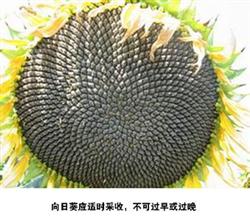
f. Harvest. Harvest when the back of the flower head turns yellow, the edge of the flower head is slightly green, the petals wither and dry up, the bracts are yellow-brown, the stalks are old and yellow, the leaves turn yellow, and the seed kernels do not contain too much moisture. Cut off the flower heads by hand, thresh mechanically or by hand, and dry them promptly in the sun. When the moisture content drops to 10%-12%, they can be bagged for storage and sale.