What causes onions to fork?
How are onions grown? Please give an introduction. For onion growing methods, you can refer to the following: 1. Variety selection. Onions are generally divided into three types: red-skinned onions, white-skinned onions, and yellow-skinned onions. The main excellent varieties include Water Chestnut Flat, Big Water Peach, Yellow-Skinned Onion, Purple-Skinned Onion, Xiongyue Round Onion, Red-Skinned Onion, etc. 2. Land preparation...
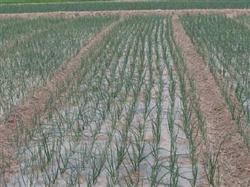 Why do onions fork? How should this be prevented? Please advise.
Onions grown in many regions have 2 leaf sheaths, with 2 bulbs growing together within one bulb ball, commonly known as onion "forking" or "twins." This kind of product cannot be used for export and seriously affects its commercial value.
I. Causes of forking
The onion bulb is composed of the thickened leaf sheaths at the base of the leaves (outer) and scales (only leaf sheaths, no leaf blades, on the inside). In the middle is the main bud growing point. At the base of the scales there are dormant axillary buds, which generally do not sprout. If an axillary bud sprouts, it becomes a separate bulb, which is the forking phenomenon.
1. Seedlings too large at transplanting time. When transplanting in North China from late October to early November of the previous year, the diameter of the seedling bulb should be 0.3-0.8 cm. Because temperatures in October-November of last year were too high, the seedling bulbs were too large, generally about 1 cm, and the axillary buds sprouted after passing through the vernalization stage, causing not only premature bolting but also easy occurrence of forking.
2. Warm winter, warm spring. Last winter the temperature was relatively high, and spring came earlier, which extended the onion seedling growth period, made the bulbs too large, and caused the axillary buds to sprout after passing through the vernalization stage, resulting in forking.
3. Plastic film mulching. In plots mulched with plastic film at transplanting time, because the soil temperature rises, the growth period is extended and forking occurs easily.
4. Excessive nitrogen fertilizer application at the seedling stage. Applying too much nitrogen fertilizer during the onion seedling stage makes the seedlings grow too large and can also lead to forking.
5. Insect pests. Pests during the seedling stage eat the main bud, causing more than 2 axillary buds to sprout.
6. Fertilizer burning of seedlings. When broadcasting chemical fertilizer, the main bud is burned to death, causing axillary buds to sprout.
7. Seed problems. Seeds saved by using forked bulbs as seed bulbs have a certain heredity, and the plants grown from them fork easily.
II. Techniques for preventing forking
1. At transplanting time, remove seedlings with bulb diameters of 0.8 cm or more.
2. Fertilization in the cultivation field should pay attention to the combined application of nitrogen, phosphorus, and potassium, and avoid one-sided application of nitrogen fertilizer.
3. When using plastic film mulching, appropriately use smaller seedlings.
4. During the seedling stage, promptly spray a 4000-fold dilution of 15% Anda suspension concentrate to control pests such as beet armyworm.
5. When broadcasting chemical fertilizer, be careful not to scatter it into the leaf sheaths.
6. Use high-quality seeds.
7. In spring, for plants found to have forked, a knife made of bamboo can be used to cut out one of the forks from the middle, keeping one. During the growth period, spray a 1:10000 solution of natural brassinolide Yishuofeng 481 1-2 times to promote growth and development, and the plant can still grow into a normal bulb.
8. For plants that have already forked, do not wait for the wrapping scale skin to rupture; harvest early, and they can still be sold on the market.
Click to get more onion growing techniques
Click to get more vegetable growing techniques