Key Technical Points for Greenhouse Luffa Cultivation and Management
How should luffa be managed when grown in a greenhouse? Please help advise. For greenhouse luffa management, you can refer to the following: Adjust temperature and light well. Luffa requires relatively high temperatures throughout its entire growth period. The suitable temperature for growth is 20°C-24°C, and the suitable temperature for fruit development is 24°C-28°C. At around 15°C, luffa grows slowly, and below 10...
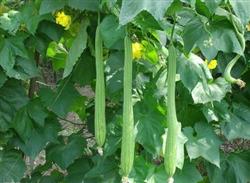
How should luffa be managed when grown in a greenhouse? Please help advise.
For greenhouse luffa management, you can refer to the following:
Adjust temperature and light well. Luffa requires relatively high temperatures throughout its entire growth period. The suitable temperature for growth is 20°C-24°C, and the suitable temperature for fruit development is 24°C-28°C. At around 15°C, luffa grows slowly, and below 10°C its growth is inhibited. During management, the temperature inside the greenhouse should be maintained at 25°C-30°C during the day and around 18°C at night. Before luffa begins to vine, straw mats can be used to appropriately control the duration of sunlight in order to promote stem and leaf growth and female flower differentiation. During the flowering and fruiting period of luffa, the straw mats should be opened in good time to make full use of sunlight to raise the temperature, which helps flowering and fruit setting.
Water and fertilize in good time. Luffa has a low water requirement at the seedling stage, and small amounts of water can be applied 1-2 times as needed according to soil moisture. When the luffa vine is about 5 cm long, in combination with earthing up, apply 30 kg of potassium dihydrogen phosphate per mu and give one heavy watering. The flowering and fruiting period of luffa occurs in mid-May, when the temperature is relatively high. Generally, water once every 7-8 days, and at the same time apply 5 kg of urea per mu.
Set up trellises and tie vines, and adjust the plants. Luffa vines can reach up to 8 m in length. When the vine is about 25 cm long, trellises need to be set up. To reduce the space occupied by trellis poles and shading, wire or nylon rope is generally tied directly to the greenhouse supports to form a single-row vertical trellis, with no crossing at the top, and the vines are guided vertically upward according to the original planting row spacing and density. After the luffa vines are trained onto the trellis, tie them once every 4-5 leaves, and an S-shaped tying method can be used. At the same time, be careful to lower the vines in good time. Since luffa itself has relatively strong disease resistance, the leaves on the lowered vines do not need to be removed.
Preserve flowers and fruits. Dipping flowers in a mixed solution of 2,4-D, 4-CPA, and "Luffa Shunzhiwang" can reduce flower drop and significantly increase the fruit-setting rate. Generally, the flower is dipped directly in the solution once, so that the top of the mature luffa will also carry a fresh flower, giving it higher commercial value. Flower dipping should be carried out at around 8 a.m.
Pest and disease control. The main diseases of luffa include anthracnose, phytophthora blight, and gray mold, which can be controlled with pesticides such as carbendazim, chlorothalonil, and dimethachlon. The main pests include melon aphids and whiteflies, which can be controlled with rotenone and buprofezin.
Click to get more luffa cultivation techniques
Click to get more vegetable cultivation techniques