What Is Soybean Cyst Nematode Disease? A Detailed Guide
What is soybean cyst nematode disease? How to prevent and control soybean cyst nematode disease: (1) Damage and symptoms Soybean cyst nematode disease is also called verticillium wilt, commonly known as "fire dragon seedling". It is a worldwide soybean disease, and large areas of occurrence are found in the major soybean-producing countries: the United States, Brazil, China and Japan. In China it mainly occurs in...
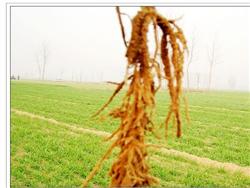
What is soybean cyst nematode disease? How to prevent and control it
Soybean cyst nematode disease:
(1) Damage and symptoms Soybean cyst nematode disease is also called verticillium wilt, commonly known as "fire dragon seedling". It is a worldwide soybean disease, and large areas of occurrence are found in the major soybean-producing countries: the United States, Brazil, China and Japan. In China it mainly occurs in Northeast China, North China, Henan, Shandong and Anhui, among other places. It is especially severe in the arid areas of western Northeast China, such as Kangping in Liaoning Province, the Baicheng area in Jilin Province, and Zhaodong, Anda, Daqing, Qiqihar and other areas in Heilongjiang Province. It generally reduces soybean yields by 10%-20%, and in severe cases by 70%-90%, or even causes total crop failure.
The soybean cyst nematode mainly damages the roots, and affected plants develop poorly and are stunted. After infection at the seedling stage, the cotyledons and true leaves turn yellow and growth is delayed; infected mature plants show stunting and yellowing of the aboveground parts, form few or no pods, and in severe cases the whole plant dies. The root system of diseased plants is poorly developed, with lateral roots markedly reduced, fine roots increased, and root nodules sparse. In the early stage of the disease (late June to early July in Heilongjiang Province), when diseased plants are pulled up and examined, many small white or yellowish-brown granules can be seen attached to the roots; these are the female adults of the cyst nematode, and this is an important feature for identifying cyst nematode disease. The cyst nematode overwinters in the soil as eggs inside cysts, and the cysts are highly resistant to adverse environments. In the spring of the following year, second-stage juveniles invade through the root hairs of the host's young roots and develop into adults within the cortex of the soybean's young roots. The female body gradually swells into a lemon shape as the eggs form inside, breaks through the surface layer and becomes exposed outside the host body, attaching to the host root only by its mouthparts; this is the small white granule we see on soybean roots.
Because of differences in pathogenicity, the soybean cyst nematode is divided into different physiological races. At present, the races identified in China are races 1, 2, 3, 4, 5 and 7. Race 1 is mainly distributed in major soybean-producing counties in Liaoning, Jilin, Weifang in Shandong and the Jiaodong Peninsula, Jiangsu and other provinces; race 2 is mainly distributed in Liaocheng, Dezhou and other areas of Shandong Province; race 3 is mainly distributed in the major soybean-producing areas of Heilongjiang, Jilin, Liaoning and other provinces. Race 4 is mainly distributed in the major soybean-producing areas of Shanxi, Henan, Jiangsu, Shandong, Anhui, Hebei and Beijing and other provinces and municipalities; race 5 is distributed in counties of Jilin, Anhui, Inner Mongolia and other places; race 7 is distributed in the soybean-producing areas of Shandong and Henan.
(2) Prevention and control The soybean cyst nematode is widely distributed, causes severe damage, has a wide host range, many transmission routes and a long survival time, making it a soilborne disease that is extremely difficult to control. Using resistant varieties is an economical and effective measure for controlling soybean cyst nematode disease. The United States and Japan have already bred more than a hundred resistant varieties, which have been widely promoted and applied in production with obvious yield-increasing effects. Since 1992, our province has successively promoted resistant varieties such as Kangxian No. 1, No. 2 and No. 3, Nenfeng 15 and Qingfeng No. 1, and their yield-increasing effect in the nematode areas of western our province has been very obvious. However, as the number of years of promotion of resistant varieties increases, the physiological races of the soybean cyst nematode may change due to the selection pressure from variety breeding and promotion. In recent years, we (Soybean Institute, Heilongjiang Academy of Agricultural Sciences) have carried out dynamic monitoring of the physiological races of the soybean cyst nematode in plots in Anda and Daqing where resistant varieties have been continuously planted, and the results showed that in addition to the original race 3, new physiological races 1, 4, 6 and 14 had appeared, indicating that the races did indeed change after continuous planting of resistant varieties. Therefore, in production, resistant varieties should be promoted in rotation with non-host crops of the soybean cyst nematode or with other nematode-resistant variety types, so as to slow the rate of physiological race variation, prevent resistant varieties from losing their resistance, and extend the useful life of resistant varieties. Where no resistant varieties are available, a combination of crop rotation of more than 3 years and chemical control should be adopted; 3% carbofuran granules or 5% aldicarb granules can be used, at 4-5 kg per mu, applied into the sowing furrow, and then sowing can be carried out.
Click to see more soybean cultivation techniques
Click to see more grain crop cultivation techniques