How to Grow Snake Gourd? Detailed Guide to Planting Methods and Key Techniques
How to grow snake gourd? Please introduce. Snake gourd is a superior variety developed through systematic selection from local varieties in Yuhuatai District, Nanjing, China. This variety has slender fruits, thick flesh, and few fibers, and is heat-tolerant, disease-resistant, high-yielding, and high-quality, making it a rare variety for "filling supply gaps during off-seasons." I. Variety Characteristics. Main...
How to grow snake gourd? Please introduce
Snake gourd is a superior variety developed through systematic selection from local varieties in Yuhuatai District, Nanjing, China. This variety has slender fruits, thick flesh, and few fibers, and is heat-tolerant, disease-resistant, high-yielding, and high-quality, making it a rare variety for "filling supply gaps during off-seasons."
I. Variety Characteristics
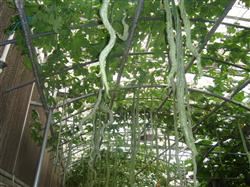
The main vine is 7.38m long and 0.76cm thick, green, pentagonal in cross-section, with white bristles, 8.8 branches, and the first branching node at the 3rd node. The leaves are dark green, palmately pentagonal, with sparse short bristles, and wavy leaf margins. The petioles are light green, round, with a groove on the upper side. The flowers are yellow; the first male flower appears at nodes 3-5, and the first female flower appears at nodes 6-7. The fruit is green, slender and snake-like, with black ridge stripes on the surface and dense white fuzz. The flesh is light green, with a longitudinal diameter of 147.2cm and a transverse diameter of 6.5cm; the fruit stalk is green, and a single fruit weighs 109.6g. The seeds are black, with a 1000-seed weight of 110.3g. It is early-maturing, with the first harvest about 120 days after sowing. It has strong fruiting ability, sometimes setting fruit at every node. It has strong heat tolerance and can still grow normally at temperatures above 30°C.
II. Cultivation Key Points
1. Opposing-pair trellis
Direct sow or transplant at the cotyledon stage, with a row-to-plant spacing of 4m x (0.2-0.25)m, under a small tunnel with plastic film mulching. When the seedlings are more than 50cm tall, insert trellis materials; the trellis materials should be at least 2.5m long. Every 4-5m, set up a wooden stake (at least 12cm in diameter at the top end of the 9) or a concrete post, and build an overhead trellis above with trellis bamboo or wire according to the plant spacing, with the trellis about 2m high. Keep 2-3 fruiting vines per plant, train the vines along the trellis bamboo or wire, and tie them onto the trellis. In the early fruiting stage, open a furrow 50cm away from the root zone and apply heavy fertilizer in a band, applying 250-300kg of decomposed oilseed cake fertilizer per 667 sq m, plus 50-60kg of NPK compound fertilizer; ensure water supply during the full fruiting stage. You can also reserve fruit paths in advance and intercrop with early-maturing leafy vegetables in a large greenhouse.
2. Magpie-nest trellis
(1) Seedling raising. In the Nanjing area, the sowing period is February 10-15. Soak the seeds in 0.1% potassium permanganate for 10-20 min, or soak them in 55°C warm water until it cools naturally, then place them at 30°C for germination. After the radicles emerge, sow them into large-diameter nutrient pots and raise seedlings with electric heating wires. Cover with a large greenhouse plus a small tunnel plus straw curtains and plastic film. During the seedling stage, management must focus on increasing the greenhouse temperature and reducing humidity, and preventing diseases early. Transplant when there are 4 true leaves and 1 heart leaf.
(2) Transplanting. Transplant in late March to early April, taking advantage of sunny weather. The cultivation method is a large greenhouse plus a small tunnel plus plastic film mulching. One week before transplanting, close the greenhouse to warm it, spray evenly with butralin (100ml/667 sq m) solution, and then cover with plastic film. For the magpie-nest trellis, transplant in wide and narrow rows, with a plant-to-row spacing of 40cm x 50cm, planting about 2,700 plants per 667 sq m.
(3) Management. After the plants survive transplanting, apply 1 application of dilute manure water, and spray 0.4%-0.5% monopotassium phosphate or other foliar fertilizer on the leaves to promote seedling growth. Keep the soil moist to encourage the seedlings to grow vigorously. Other management is the same as traditional cultivation methods.
(4) Trellis insertion and vine tying. When the seedlings are more than 30cm tall, insert trellis materials and tie the vines. For the magpie-nest trellis, first tie the vines upright, then use "S"-shaped tying. It is best to tie with rice straw so it is easy to untie later when collecting the vines. The height of the trellis materials on both sides of the greenhouse should preferably be about 20cm away from the film. When the vines grow beyond the top of the trellis materials, lower a section of the vine downward to prevent the terminal buds from touching the film and being scorched. In early May, the top film can be removed, and then plastic ropes, film-pressing ropes, or wire should be stretched lengthwise every 50cm on the greenhouse frame, and in the afternoon the vines should be guided one by one onto the greenhouse trellis.
3. Harvesting. Snake gourd has an inferior ovary. When the corolla withers and the ridge stripes on the fruit surface turn deep black, it is the suitable harvest time. Generally, the yield of the climbing trellis can reach about 4,000kg per 667 sq m, while the early yield of the magpie-nest trellis is 4-6 times that of the former, and the output value can reach about 10,000 yuan.
Click to get more snake gourd cultivation techniques
Click to get more vegetable cultivation techniques