Detailed Explanation of Key Points for High-Yield Loofah Cultivation Techniques
How can loofah be cultivated for high yield? Please help introduce it. Loofah is also called Tianluo, an annual climbing herbaceous plant of the Cucurbitaceae family. Because the quality requirements for processed export products are relatively high, corresponding cultivation techniques are needed to achieve high quality and high yield. Based on years of production practice in loofah sponge cultivation, the main cultivation techniques are now introduced....
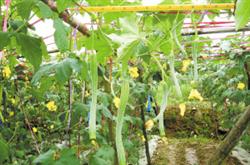
How can loofah be cultivated for high yield? Please help introduce it.
Loofah is also called Tianluo, an annual climbing herbaceous plant of the Cucurbitaceae family. Because the quality requirements for processed export products are relatively high, corresponding cultivation techniques are needed to achieve high quality and high yield. Based on years of production practice in loofah sponge cultivation, the main cultivation techniques are now introduced.
I. Sowing and Seedling Raising
1. Seedbed Preparation
The loofah seedbed should be chosen as a wind-sheltered, sunny plot with long sunlight exposure as the seedling-raising site, and base fertilizer should be applied 10-15 days in advance, mainly with decomposed organic fertilizer. 1-3 days before sowing, prepare the land and make nutrient pots. Cover well with plastic film and wait for sowing.
2. Sowing
Loofah sowing is best carried out at the end of March and the beginning of April. (1) Use seed soaking to promote germination. First sun-dry the seeds for 2-3 days, soak the seeds in warm water for about 6 hours (subject to the seeds fully absorbing water), then place the seeds in an incubator to promote germination. Once the seed sprouts show white, they can be sown in nutrient pots or grid cells. (2) Sow dry seeds directly in nutrient pots or grid cells, cover with plastic film in time after sowing, and set up a small arch shed to facilitate early emergence. The seedbed must be kept moist to prevent insufficient water from affecting emergence.
3. Seedbed Management
After sowing, seedbed management should be carried out promptly. Before emergence, the temperature inside the seedbed film is best kept at 20-30°C. Seeds that have been soaked to promote germination can emerge in 2-3 days, while dry seeds sown directly can emerge in about 6-7 days. After emergence, in the early stage when temperatures are low and seedlings are small, the focus is on keeping warm and preventing freezing; in the middle and later stages, as temperatures rise and seedlings grow larger, the focus should be on ventilation and hardening. Ventilation and hardening should be carried out flexibly according to temperature: on cloudy and rainy days with low temperatures, ventilation may be omitted; on sunny days with high temperatures, the film must be uncovered for ventilation, increasing the ventilation volume gradually from small to large. 2-3 days before transplanting, the film may be left off day and night.
II. Fixed-Hole Transplanting
Transplanting is generally carried out around April 20 (Grain Rain). When seedlings grow 1-2 true leaves, they can be transplanted with soil. 7-10 days before transplanting, apply sufficient base fertilizer on the determined transplanting rows: 20 loads of human and livestock manure per mu, 50-75 kg of phosphate fertilizer, and 15-20 kg of potassium fertilizer. After fertilizing, plow the land in time and prepare the soil finely into a plump-backed shape, spray herbicide well, and cover with plastic film to wait for transplanting. The planting density of loofah sponge is preferably about 500 plants per mu, with a row spacing of 3 m and a plant spacing of 0.4-0.5 m.
III. Trellising and Guiding Vines
After planting loofah, trellising can be carried out. For the trellis, erect poles at a distance of 1.5 m × 1.5 m, with a trellis height of 2 m, and weave the top with small bamboo, galvanized wire, or rope vertically and horizontally into squares. The trellis must be strong and sturdy, able to withstand the load of fresh gourds and typhoon attacks. When the vines grow to more than 2.5 m, the vines can be guided onto the trellis. When guiding vines onto the trellis, regardless of vine length, the vines should advance evenly after being put on the trellis, which helps the vines spread in a balanced way on the trellis. After the vines are on the trellis, the vines should be frequently arranged so that they are evenly distributed on the trellis.
IV. Management During the Fruiting Period
According to the different fruiting periods of loofah, they can be divided into plum-rain gourds, summer gourds, and autumn gourds. Loofah generally begins flowering and fruiting in mid-to-late June. From flowering and fruiting to mature harvest, plum-rain gourds take 45-50 days, summer gourds 35-40 days, and autumn gourds about 50 days. In order to achieve “three types of gourds fruiting together, early fruiting, and striving for high-quality loofah”, the following aspects should be emphasized in cultivation:
1. Removing Male Flowers
After the vines are on the trellis, pruning, bud removal, and removal of an appropriate number of male flowers should be carried out continuously. For loofah, generally only one main vine is retained per plant, and other side branches and buds should be removed at any time. Loofah has female and male flowers borne at the same node. Male flowers are numerous. To reduce nutrient consumption, more than 70% of male flower buds can be removed in time. When removing male buds, be careful to avoid injuring the female buds at the same node.
2. Selecting Superior Gourds
Remove inferior gourds. For each loofah plant, in each fruiting period, only 1-2 superior gourds should be retained. The young gourds selected as superior gourds should be symmetrical from top to bottom, straight in shape, with a thick and sturdy stalk that is not slender. At the same time, on the several nodes before the selected small gourd, temporarily retain one young gourd first to compete for nutrients. When the selected superior gourd has grown to the point where it will not split, remove the small gourd in front. The set gourds should not be left resting on top of the trellis; they should be lowered promptly to hang freely. If the gourd shape becomes bowed, it must be manually straightened (a small stone can be hung on the flower base).
3. Fertilization
The rational application of topdressing plays an important role in fruit setting and in the filling and enlargement of loofah. The timing, frequency, and amount of topdressing depend on the growth vigour of the loofah and the amount of fruit set: when the first-period young gourds grow to a diameter of more than 4 cm, the first topdressing must be applied, with about 3 kg of pure nitrogen per mu (equivalent to about 7 kg of urea); after 10 days, apply 4-5 kg of pure nitrogen per mu (equivalent to about 10 kg of urea) to promote the enlargement and filling of the loofah; thereafter, apply topdressing once every about 15 days, each time using 4-5 kg of pure nitrogen per mu (equivalent to about 10 kg of urea). Seed China reminds you: in terms of fertilization method, pouring application should be the main method, applied alternately at about 50 cm away from the stem base to prevent fertilizer damage near the roots.
V. Control Methods for Major Loofah Diseases and Pests
1. Loofah Leafroller
The loofah leafroller occurs for several generations a year, with the largest occurrence from July to September, and generations overlap, causing serious damage. It mainly feeds on leaf mesophyll, and in severe cases only the leaf veins remain on large areas of leaves, seriously affecting loofah yield and quality. Control method: when larvae are at peak occurrence, use carbamate pesticides for control, such as 3000-fold Bailing solution and 1000-fold Shachongdan solution. For palm thrips, 10-20 g of 10% Yibianjing per mu can be sprayed for control.
2. Gourd Cottony Leak Disease
The harmful periods of loofah cottony leak disease are divided into the seedling stage and the fruiting stage; after being damaged, it causes gourd rot. Control method: mainly agricultural control, emphasizing the complete set of three ditches, reducing field humidity, balanced fertilization, preventing excessive and heavy application of nitrogen fertilizer, and strengthening chemical control, mainly spraying with 1:2:200 Bordeaux mixture. If there is much rainy weather during the gourd period and humidity is high, early and frequent prevention should be carried out.
3. Loofah Downy Mildew
Loofah downy mildew generally does not easily occur under ordinary environmental conditions. When it occurs, large numbers of leaves wither and die, directly affecting loofah sponge yield and quality. Control method: combine agricultural control and chemical control. For agricultural control, appropriately increase phosphate and potassium fertilizer to improve the disease resistance of the plants. When the disease first appears, remove diseased leaves in time to reduce the spread of pathogens. For chemical control, 500-fold metalaxyl can be used for early root drenching; at the initial stage of disease, spray with 2000-fold Treacle for control, once every 7 days, for 1-2 consecutive treatments.
VI. Selecting Gourds for Seed Retention
Because there are many loofah varieties and because of insect and wind-mediated cross-pollination, varietal variation is relatively large. Therefore, purification and rejuvenation are needed every year, and isolated seed production should be carried out. For retaining seed gourds, high-quality loofah with a straight and well-proportioned gourd body, a length of more than 70 cm, and a large number of ovary chambers should be selected and retained as good seed.
VII. Harvesting and Peeling
Harvesting is generally based on the following standard: the gourd body changes from soft to hard, the stalk turns yellow, the gourd tip becomes soft and has a yellow ring band, a slight cracking sound can be heard when pinched by hand, and the depression at the gourd tip gradually becomes larger. Peeling: after loofah is harvested, it must be peeled to obtain the loofah sponge. Peeling is mainly done by soaking to rot the skin: take the freshly picked gourds, break the outer skin with a wooden stick or cut the skin layer with a knife, soak in a river or in a container such as a water vat for several days, then remove the rotted outer skin, wash the loofah sponge clean, and dry it in the sun.
Click to get more loofah cultivation techniques
Click to get more vegetable cultivation techniques