What are the key technical points for loofah cultivation and management?
How should loofah be managed when grown? Please help guide. Loofah has strong heat and moisture tolerance, but poor cold resistance, so loofah is often planted in spring and summer and harvested in summer and autumn. Loofah can flower and bear fruit continuously, so in most regions it is arranged for one crop per year within the frost-free period. 1. Variety selection for spring sowing...
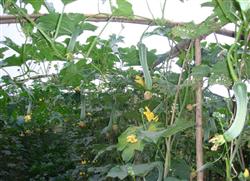
How should loofah be managed when grown? Please help guide.
Loofah has strong heat and moisture tolerance, but poor cold resistance, so loofah is often planted in spring and summer and harvested in summer and autumn. Loofah can flower and bear fruit continuously, so in most regions it is arranged for one crop per year within the frost-free period.
1. Variety selection
For spring sowing, especially early spring sowing, choose varieties that are not prone to female flowers under low-temperature and short-day conditions; do not choose varieties that have early female flowers, many female flowers, and poor growth vigor. For summer and autumn sowing, choose varieties that do not have strict daylight requirements and produce female flowers early.
2. Sowing and seedling raising
Loofah can be cultivated by raising seedlings in advance and transplanting to the balcony immediately after the last frost. On balconies, trellis cultivation is generally used (such as flat trellises, semicircular tunnel trellises). Before sowing, disinfect the seeds, soak them to promote germination. The treatment method, seedbed preparation, sowing, and seedling-stage management can all refer to the seedling-raising methods for cucumber and similar crops. The soaking time is generally 8-10 hours, and germination takes 2-3 days before the sprouts can be sown. Because the seeds are relatively large, the soil cover at sowing should reach about 1.5 cm.
The seedling age of loofah is preferably about 40 days. When the seedlings grow 3-4 true leaves, they can be transplanted. Loofah has a well-developed root system. To reduce root damage during transplanting and help it resume growth promptly, loofah seedlings are best raised using root-protecting methods such as nutrient pots.
3. Transplanting
Applying sufficient base fertilizer is the key to high-quality and high-yield loofah. Fully decomposed organic fertilizer can be applied at 50 g/kg soil. Because loofah has relatively large plant and row spacing (especially for trellis cultivation on southern balconies), base fertilizer is most effective when applied in furrows or holes. The transplanting spacing is about 30-50 cm. The period suitable for loofah growth in the south is relatively long, and trellis cultivation is often used, with a row spacing of about 2-3 m and a plant spacing of 30-100 cm. When transplanting, the seedlings must carry a complete soil ball to protect the roots and help them recover from transplanting. After transplanting is completed, water thoroughly to settle the roots in time, and later water to help the seedlings recover according to soil moisture and weather conditions.
4. Timely intertillage and weed control
After watering to help the seedlings recover, new leaves begin to emerge, but at this time the trellis has not yet been set up and the seedlings are still small, so the first intertillage and loosening of the soil should be carried out in time, following the principle of not damaging the seedling roots and not loosening the base of the seedlings. During the second intertillage, soil between the rows of each trellis should be appropriately banked to both sides at the base of the plants, turning the flat bed into a tile-ridge bed, promoting the development of adventitious roots, expanding the area for the plants to absorb nutrients, and enhancing the absorption capacity of loofah. When the plants grow larger and their stems and leaves cover the trellis, the soil surface is shaded and intertillage should no longer be done; if there are weeds at this time, they should be pulled out. When loofah has just been transplanted in early spring, the temperature is relatively low, so watering should be appropriately controlled and intertillage management strengthened to promote the growth of the loofah root system.
5. Trellising
After the second deep intertillage, the trellis should be set up in time. The trellis method should be determined according to specific conditions. Generally, for varieties with long vines, vigorous growth, and strong branching ability, and where the local suitable growing period is relatively long, a shed trellis is better (such as a flat trellis, semicircular arch trellis, etc.). For early-maturing varieties with weak growth vigor and shorter vines, and where the local suitable growing season is relatively short, an A-frame trellis or flower trellis is preferable. Before the loofah stems and vines climb the trellis, pay attention to removing side buds at any time and carry out artificial vine guiding; when guiding vines, according to the plant's growth, combine zigzag guiding so that the stems and vines are evenly distributed and the growing points are at the same level. Tie the vines in time to fix the stems and vines. After the plant stems and vines climb to the upper part of the trellis, especially in trellis cultivation, no more vine tying and guiding are needed. The trellis must be built firmly to prevent collapse during operation and in windy weather. For varieties that no longer have side vines removed, remove side branches, weak branches, and severely overlapping or diseased side vines in areas where the stems and vines are too dense. You can also leave 1-2 fruits on strong side vines and then pinch off the growing tip.
6. Fertilizer and water management
Although loofah is relatively tolerant of poor soil, under conditions of sufficient fertilizer and water it grows robustly, has deep roots and lush leaves, many flowers and fruits, and thick, straight fruits. Therefore, in loofah cultivation, in addition to applying sufficient base fertilizer, a small amount of fertilizer can be applied when watering to settle the roots at transplanting to promote recovery and growth. Later, topdressing can be carried out whenever watering. Loofah can also tolerate high concentrations of fertilizer, and when fertilizer is sufficient it is not prone to excessive vegetative growth. Throughout the entire loofah cultivation process, the number and amount of topdressing should be greater than for other cucurbits.
If fertilization is not timely, nutrient deficiency is likely to occur, causing female flowers to turn yellow and wilt and drop, and the fruits in the process of growth and development to become deformed, affecting yield and quality. In actual cultivation, after every 1-2 harvests of fruit, fertilizer must be applied once. Each time, ammonium sulfate can be applied at 0.5 g/kg soil or urea at 0.5 g/kg soil, or chlorine-phosphorus-potassium compound fertilizer at 0.5 g/kg soil. When fertilizing, it is best to bury the fertilizer in the soil (compound fertilizer must be buried in the soil). Dig a hole about 10 cm deep about 12 cm from the plant roots, bury the fertilizer, and water after fertilizing. Loofah can also be foliar-fertilized together with pesticide application, such as spraying a 0.4% urea solution.
7. Harvesting
Generally, loofah takes about 50-60 days from transplanting to the start of harvest. From 7-10 days after the female flower opens, when the fruit stalk becomes smooth, the fruit skin color turns dark green, the fuzz on the fruit surface decreases, and the fruit skin feels soft to the touch, it can be harvested. Ridged loofah ages more easily, and the harvest period is generally 1-2 days earlier than ordinary loofah. When fertilizer and water are insufficient, the fruit tends to age, so it should be harvested appropriately earlier; when fertilizer and water are sufficient, harvest can be appropriately delayed.
8. Seed saving
For loofah seed saving, the first fruit on the vine is best. The first fruit flowers and sets fruit early, has a long growth period, and plump seeds; its offspring have strong vitality, good varietal characteristics, and bear many fruits early. When the fruit is fully mature, the skin hardens, and the skin color turns withered yellow, it can be harvested. When harvesting, select those whose fruit shape matches the characteristics of this variety, with thick and straight fruits, enlarged fruit stalks, fast growth and development, and no pests or diseases, as seed fruits. After harvesting the seed fruit, cut off the tip, or poke a few small holes at the top of the fruit, and hang it indoors in a well-ventilated place so that the moisture inside the fruit dries thoroughly, which facilitates seed extraction. When extracting seeds, tear off the outer skin, cut the fiber bundle lengthwise, and beat it forcefully; the seeds will fall out, then dry and store them.
Click to get more loofah cultivation techniques
Click to get more vegetable cultivation techniques