How to grow loofah? Key technical points from sowing to management
How to grow loofah? For detailed information on how to grow loofah, you can refer to the following methods: 1. Select good varieties. Choose varieties suitable for summer cultivation, that is, varieties that are not sensitive to short-day conditions: such as Xiayou loofah, Xinxiatang loofah, Fengkang loofah, Yalu No. 1, Xiuyu loofah, etc. 2. Raise seedlings and transplant. Summer loofah...
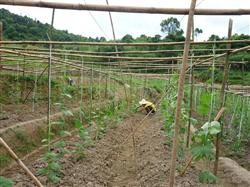
How to grow loofah? Please give a detailed introduction
For growing loofah, you can refer to the following methods:
I. Select good varieties
Choose varieties suitable for summer cultivation, that is, varieties that are not sensitive to short-day conditions: such as Xiayou loofah, Xinxiatang loofah, Fengkang loofah, Yalu No. 1, Xiuyu loofah, etc.
II. Raise seedlings and transplant
Summer loofah is not suitable for direct sowing. Instead, choose a field with good drainage for raising seedlings and transplanting. Soak the loofah seeds in clean water for 8-10 hours, then remove and drain them before sowing. Common sowing methods include raising seedlings in plastic nutrient cups and seedling trays. The nutrient soil should use new soil or garden soil that has not previously grown cucurbit crops. When sowing, sow 1 seed per hole. Before transplanting the seedlings, appropriately control water and fertilizer to cultivate strong seedlings.
III. Field selection
Loofah likes fertilizer, so choose a field with good sunlight, fertile and moist soil, high organic matter content, and strong water- and fertilizer-retention capacity, such as loam or clay loam.
IV. Land preparation and planting
1. Land preparation: Make beds for planting, with a bed surface width of 1.2-1.5 m, a ditch width of 30-40 cm, and a bed height of 35 cm. Apply sufficient base fertilizer while preparing the land, applying 2000 kg of farmyard manure + 50 kg of Norwegian compound fertilizer or 50 kg of Western compound fertilizer per mu. 2. Planting: Summer loofah cultivation uses double-row planting, with row and plant spacing of 70-80 cm x 50 cm, and about 1700 plants per mu is appropriate. The seedlings can be transplanted to the field when they have 2-3 true leaves.
V. Field management
1. Vine and leaf arrangement: Generally, the first vine pressing is carried out when the vine is about 35 cm long, and the second vine pressing when the vine is about 70 cm long. The direction of vine pressing can be the same direction or opposite directions. The method of vine pressing depends on the weather conditions. On sunny days, open a small ditch, press the vine into the ditch, and then cover it with a small clod of soil; on rainy days, press the vine on the bed surface without opening a small ditch to avoid stem rot; during continuous rain, when there is standing water on the bed surface, simply press the leaves with mud clods without pressing the stems and vines, which can also fix the vines and roots while preventing rot from pressing the stems and vines.
When guiding vines onto the trellis, in order to adapt to the characteristics of summer loofah having many and long vines, generally wait until male flowers appear before guiding the vines onto the trellis. After they are on the trellis, use zigzag guiding to distribute the vines evenly. In the middle and late growth stages, appropriately remove dead old leaves or diseased leaves at the base. If vines and leaves grow too vigorously, some leaves can be removed at intervals in different parts of the upper, middle, and lower sections, or leaves can be removed where vines and leaves are too dense, which helps ventilation and light penetration or reduces pests and diseases.
2. Timely fruit management: During flowering and fruiting, when small fruits are found resting on leaves or on the trellis, or when vines are entangled by tendrils, they should be promptly adjusted so that they hang vertically inside the trellis. At the same time, diseased fruits should be removed to prevent the spread of diseases.
3. Reasonable fertilization: The general principle of fertilization is: apply frequently and thinly; control water and fertilizer before fruiting; apply heavy fertilizer after fruiting and when side vines are growing vigorously; and pay attention to the application of phosphorus and potassium fertilizers.
Apply sufficient organic fertilizer and an appropriate amount of chemical fertilizer. With enough organic fertilizer, loofah grows straight and long; otherwise, the fruits are prone to deformity. After transplanting, 5-7 days later, apply 1500 kg of diluted manure and urine water at 1:10 per mu to promote stem and leaf growth. After that, until flowering and fruiting, fertilization depends on seedling condition: if seedlings grow vigorously and are dark green, apply less or no fertilizer; if growth is weak, apply every about 15 days 4-6 kg of compound fertilizer leachate in 1500 kg of water per mu, or 1500 kg of diluted manure and urine water at 1:10. After fruiting, apply topdressing once every 5-7 days, applying 10-15 kg of compound fertilizer per mu each time; during the peak harvest period, the fertilization amount should be increased by 1-2 times, and 50-100 kg of plant ash per mu should be added 1-2 times.
4. Water management: Loofah requires a relatively large amount of water throughout the whole growth period. In the early growth stage, keep the soil moist. During flowering and fruiting, the plant needs the most water and the root system is also stronger, so irrigation should be strengthened. Loofah needs water but also dislikes waterlogging. When irrigating, irrigate and drain promptly, and do not use flood irrigation. Especially on rainy days, pay more attention to drainage to prevent standing water on the bed surface.
VI. Pest and disease control
1. Disease control: For damping-off, use 70% Dexon 300x solution, 75% chlorothalonil 800x solution, or thiophanate-methyl 800x solution; for Phytophthora blight, use 72% Kelu 800x solution or 70% mancozeb 800x solution; for downy mildew, use 58% metalaxyl 600x solution or 72% Kelu 750x solution; for powdery mildew, use 20% triadimefon 2000x solution; for anthracnose, use 70% thiophanate-methyl 800-1000x solution or 50% carbendazim 1500x solution.
2. Insect control: For melon webworm, use 1.8% abamectin 2000x solution or Bacillus thuringiensis preparations, etc.; for melon fruit fly, use 48% chlorpyrifos 1000x solution, 90% trichlorfon 1000x solution, or 80% dichlorvos 1000x solution; for aphids, use 10% imidacloprid 1500x solution.
Click to get more loofah growing techniques
Click to get more vegetable growing techniques