How should loofah be grown in a home garden?
How do you grow loofah in a home garden? An introduction: it is cool in nature and sweet in taste, rich in nutrients, can clear heat and promote bowel movement, dispel wind and resolve phlegm, and promote blood circulation, making it a commonly eaten summer vegetable. Loofah has a long harvest period; growing one trellis of loofah in a home garden means you won't need to spend money on vegetables for quite a long time. Variety requirements: choose varieties with strong heat tolerance and resistance to viral diseases...
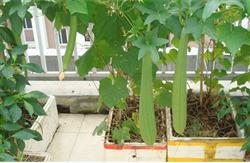
How do you grow loofah in a home garden? An introduction
It is cool in nature and sweet in taste, rich in nutrients, can clear heat and promote bowel movement, dispel wind and resolve phlegm, and promote blood circulation, making it a commonly eaten summer vegetable. Loofah has a long harvest period; growing one trellis of loofah in a home garden means you won't need to spend money on vegetables for quite a long time.
Variety requirements: choose varieties with strong heat tolerance, strong resistance to viral diseases, high yield and excellent quality, such as Cuiyu loofah, Jiangshu No. 1 loofah, Wuyexiang loofah, Shanghai Xiang loofah, etc.
Sowing and raising seedlings: before sowing loofah, treat the seeds with water at 55-60°C for 15 minutes, then soak them in water at 25°C for 4 hours, rinse off the mucilage on the seed coat surface, wrap the seeds in moist gauze and place them in an incubator to germinate. Select well-germinated seeds and sow 1-2 seeds per pot; generally 500 grams of seed are used per 667 sq m. Before emergence, maintain the temperature at 28-33°C; after emergence, ventilate and cool in good time to avoid leggy seedlings, with 23-25°C being suitable.
Timely planting out: generally in mid-April, when the seedlings have 4 true leaves and 1 heart leaf, choose a sunny day to plant out. Before planting out, apply sufficient base fertilizer: per 667 sq m, apply 5000 kg of high-quality barnyard manure, 80-120 kg of superphosphate and 25-30 kg of urea, then plow 20 cm deep, rake level and build beds. Plant about 2800 seedlings per 667 sq m.
Field management: after planting out, cover with a small arched shed and ventilate as little as possible to raise the temperature inside and help the seedlings recover. After recovery, spray 120 mg/kg ethephon or 2000 mg/kg daminozide to prevent leggy growth and promote more female flowers. At the same time, water thoroughly once, then switch to root-establishing with controlled watering. When the seedlings are 30 cm tall, set up supports and tie the vines in a zigzag pattern to guide them upward. Main vines bear the fruit, and all side vines are removed. When the vines are growing at the same time, apply heavy water and fertilizer; in principle, water once every 2-3 days and fertilize once every 5-6 days. For each topdressing, use 500 kg of human manure and urine or 20-25 kg of ammonium nitrate per 667 sq m.
Timely harvest: 10-14 days after flowering, harvest in time when the fruit has fully grown and is relatively crisp and tender. Picking is best done in the evening.
Click to get more loofah growing techniques
Click to get more vegetable growing techniques