How to fertilize ginger well? A detailed explanation of scientific fertilization methods
How to fertilize ginger well? A detailed introduction: the rhizome of ginger absorbs relatively little nitrogen, phosphorus and potassium during the seedling stage; during the vigorous growth period, phosphorus uptake increases slowly, while demand for nitrogen and potassium rises sharply. In particular, during the early part of the vigorous growth period, potassium requirement is highest, followed by nitrogen fertilizer; during the middle and late parts of the vigorous growth period, nitrogen uptake exceeds...
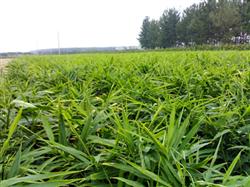
How to fertilize ginger well? A detailed introduction
The rhizome of ginger absorbs relatively little nitrogen, phosphorus and potassium during the seedling stage. During the vigorous growth period, phosphorus uptake increases slowly, while demand for nitrogen and potassium rises sharply. In particular, during the early part of the vigorous growth period, potassium requirement is highest, followed by nitrogen fertilizer; during the middle and late parts of the vigorous growth period, nitrogen uptake exceeds potassium uptake, and potassium uptake exceeds phosphorus uptake. Therefore, in production, formula fertilization should be carried out according to the fertilizer requirement pattern of ginger, and timely topdressing with nitrogen fertilizer helps increase yield.
Fertilization of ginger is divided into base fertilizer and topdressing. Base fertilizer includes organic fertilizer, cake fertilizer and chemical fertilizer. Organic fertilizer is spread before sowing in combination with land preparation; generally, 5-8 cubic meters of high-quality decomposed chicken manure is applied per mu, followed by rotary tillage. Cake fertilizer and chemical fertilizer are applied in concentrated furrows, that is, before sowing, crushed cake fertilizer and chemical fertilizer are applied in a concentrated manner into the sowing furrow. Generally, 75-100 kg of cake fertilizer per mu, 50 kg of nitrogen-phosphorus-potassium compound fertilizer, or 25 kg each of urea, superphosphate and potassium sulfate are applied.
In addition to applying sufficient base fertilizer, generally three topdressings are carried out. The first is the "seedling-strengthening fertilizer": during the seedling stage, plant growth is small and fertilizer demand is not high, but the seedling growth period is long. To promote robust seedling growth, the first topdressing is usually carried out when the seedlings are about 30 cm tall and have 1-2 branches. This topdressing is mainly nitrogen fertilizer, and 20 kg of ammonium sulfate or diammonium phosphate can be applied per mu. If sowing is too early and the seedling stage is longer, 2-3 fertilizations can be carried out along with watering, with the same application amount as above.
The second is the "turning-point fertilizer": around the Beginning of Autumn, this is the turning point in ginger growth and also the turning point in nutrient uptake. After this, the plant grows faster and accumulates large amounts of nutrients to form the product organ. Therefore, demand for fertilizer and water increases. To ensure high yield of ginger, around the Beginning of Autumn, combined with weeding in the ginger field, the second topdressing is carried out. This topdressing plays an important role in promoting tillering and rhizome expansion. This topdressing generally combines cake fertilizer or farmyard manure with long-lasting fertilizer efficiency together with quick-acting chemical fertilizer. Per mu, use 70-80 kg of crushed cake fertilizer, 3-4 cubic meters of decomposed chicken manure, 50-100 kg of compound fertilizer, or 20 kg of urea, 30 kg of diammonium phosphate and 50 kg of potassium sulfate. Open a fertilization furrow on one side of the ginger seedlings 15 cm from the plant base, scatter the fertilizer into the furrow and mix it evenly with the soil, then cover with soil to close the furrow, earth up, and finally water thoroughly.
The third is the "ginger-strengthening fertilizer": in early September, when the ginger seedlings have 6-8 branches, which is also the period of rapid rhizome expansion, the third topdressing can be carried out according to plant growth, called "ginger-strengthening fertilizer". For ginger fields with weak or average growth and ginger fields with low soil fertility, quick-acting chemical fertilizers can be applied at this stage, especially potassium fertilizer and nitrogen fertilizer, to ensure the nutrients needed by the rhizome. Generally, 25-30 kg of compound fertilizer per mu, or 2.5 kg each of ammonium sulfate and potassium sulfate, is applied. For ginger fields with high soil fertility and vigorous plant growth, nitrogen fertilizer should be applied less or not at all, to prevent excessive stem and leaf growth from affecting nutrient accumulation.
Zinc fertilizer and boron fertilizer can usually be used as base fertilizer or foliar topdressing. When used as base fertilizer in zinc-deficient and boron-deficient ginger fields, generally 1-2 kg of zinc sulfate and 0.5-1 kg of borax are applied per mu, evenly mixed with fine soil or organic fertilizer, and applied in the sowing furrow during sowing and mixed evenly with the soil. If used as topdressing and foliar spraying, 0.05%-0.1% borax can be used at 50-70 liters per mu, sprayed three times respectively at the seedling stage, the tillering stage and the rhizome expansion stage.
Click to get more ginger cultivation techniques
Click to get more vegetable cultivation techniques