What are the main fertilizer requirements of ginger?
What are the fertilizer requirements of ginger? A detailed explanation of ginger's fertilizer requirements: (1) Fertilizer requirements. Ginger growth requires fertilizers with a complete range of nutrients; no nutrient element can be omitted, otherwise both yield and quality will be affected to some degree. During its growth, ginger continuously absorbs nitrogen, phosphorus, potassium, calcium...
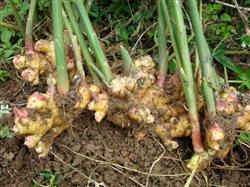
What are the fertilizer requirements of ginger? A detailed explanation
Fertilizer requirements of ginger:
(1) Fertilizer requirements
Ginger growth requires fertilizers with a complete range of nutrients; no nutrient element can be omitted, otherwise both yield and quality will be affected to some degree. During its growth, ginger continuously absorbs elements such as nitrogen, phosphorus, potassium, calcium, magnesium, boron and zinc, among which nitrogen, phosphorus and potassium have the greatest effect on yield. Because ginger's growth amount differs at different stages, its absorption of various mineral elements also differs. Overall, the absorption of mineral elements is consistent with its growth pattern, and each specific element has its own characteristics.
It has been reported that ginger's absorption of nitrogen, phosphorus and potassium shows a typical "S"-shaped curve, and this absorption pattern is consistent with its own growth pattern. During the seedling stage, the plant grows slowly and the growth amount is small, so the seedlings absorb relatively little nitrogen, phosphorus and potassium. The nitrogen absorbed at this stage accounts for 12.59% of the total absorption over the whole growth period, phosphorus 14.44%, and potassium 15.71%. Whether measured by absolute or relative amount absorbed, ginger plants absorb the most potassium during the seedling stage, followed by nitrogen, and the least phosphorus. During this period, the absorption of nitrogen, phosphorus and potassium accounts for 14.4% of the total absorption, with an absorption ratio of 1:0.10:1.83. After the three-branch stage, the plant's growth rate accelerates, the number of branches increases, the leaf area expands rapidly, and the rhizome grows vigorously, so fertilizer demand increases rapidly. Over the entire vigorous growth period, the absorption of nitrogen, phosphorus and potassium accounts for 87.41%, 85.56% and 84.29% of the total absorption over the whole growth period, respectively. The vigorous growth period can be further divided into 3 stages, namely the early, middle and late vigorous growth stages. In the early vigorous growth stage, the nitrogen absorbed accounts for 34.75% of the total absorption, phosphorus 35.03%, and potassium 35.18%, with an absorption ratio of 1:0.09:1.48. In the middle vigorous growth stage, the amounts of nitrogen, phosphorus and potassium absorbed account for about 21.3% of the total absorption, with an absorption ratio of 1:0.09:1.47, basically the same as that of the early vigorous growth stage. In the late vigorous growth stage, the nitrogen absorbed accounts for 31.43% of the total absorption, phosphorus 29.27%, and potassium 27.75%, with an absorption ratio of 1:0.08:1.29. From the absorption ratios of nitrogen, phosphorus and potassium at different growth stages, it can be seen that as growth progresses, the absorption ratio of potassium declines slightly while that of nitrogen rises slightly. In short, ginger absorbs the most potassium, followed by nitrogen, and the least phosphorus, with an absorption ratio of 1:0.09:1.46.
Besides absorbing large amounts of nitrogen, phosphorus and potassium, ginger also absorbs elements such as calcium, magnesium, boron and zinc. Ginger's absorption patterns for calcium and magnesium are consistent, and the absorbed amounts are also very close. By harvest, a single plant absorbs about 461.5 mg of calcium and 483.03 mg of magnesium. Ginger's zinc absorption shows an exponential curve; in the late growth stage, a single plant absorbs up to 49.5 micrograms of zinc per day, nearly 1 times higher than in the early growth stage. Its boron absorption shows a double "S" curve, with a gentle absorption zone in the middle growth stage. According to sampling and yield measurement at harvest, the amounts of calcium, magnesium, boron and zinc absorbed by a single ginger plant were 461.5 mg, 483.07 mg, 1,340.26 micrograms and 3,119.51 micrograms, respectively.
According to experimental yield measurements, producing 1,000 kg of fresh ginger requires absorbing about 6.34 kg of nitrogen (N), 0.57 kg of phosphorus pentoxide (P2O5), 9.27 kg of potassium oxide (K2O), 3.69 kg of calcium (Ca), 3.86 kg of magnesium (Mg), 3.76 g of boron (B) and 9.88 g of zinc (Zn) from the soil.
(2) Fertilization techniques
Ginger growth requires the application of sufficient organic fertilizer as a base, combined with the application of major-element fertilizers such as nitrogen, phosphorus and potassium, while also supplementing trace elements such as zinc and boron, in order to achieve high yield and high quality.
1. Apply sufficient base fertilizer
In conjunction with deep plowing and land preparation, apply 1200-2000 kg of high-quality decomposed organic fertilizer per mu, 60-80 kg of pure sulfur-based organic-inorganic compound fertilizer (13-7-10), 1-2 kg of zinc sulfate, and 1 kg of borax.
2. Reasonable topdressing
① Light application of seedling-strengthening fertilizer: in early to mid-June, when the seedlings have grown 1-2 branches, apply fertilizer by flushing with irrigation water twice, at an interval of 10-15 days, each time flushing 15-20 kg of high-nitrogen compound fertilizer per mu.
② Heavy application of jointing fertilizer: also called turning-point fertilizer (around the Start of Autumn), at the three-branch stage, when ginger enters the vigorous growth period; this is the key period for topdressing, applying 70-80 kg of organic-inorganic compound fertilizer (13-7-10) per mu. ③ Flushing supplementary fertilizer: carried out during the tuber expansion period, in mid-September when the plants show 6-8 branches, flushing about 40-50 kg of high-nitrogen-potassium compound fertilizer per mu, applied in two split applications at an interval of about 15 days.
Click to get more ginger cultivation techniques
Click to get more vegetable cultivation techniques