Detailed Explanation of Pollution-Free Control Methods for Rice Pests and Diseases
Pollution-free methods for controlling rice pests and diseases: (1) Rice field plowing and water-soaking technique for killing borers: during the peak pupation period of the overwintering generation of rice borers (before March 20 in southern Jiangxi, April 1 in central Jiangxi, and April 10 in northern Jiangxi), plow winter fallow fields and green manure fields, then flood with deep water and soak, so that the borers cannot emerge normally, thereby killing the pupae and borers and reducing the occurrence base...
Pollution-free methods for controlling rice pests and diseases:
(1) Rice field plowing and water-soaking technique for killing borers: during the peak pupation period of the overwintering generation of rice borers (before March 20 in southern Jiangxi, April 1 in central Jiangxi, and April 10 in northern Jiangxi), plow winter fallow fields and green manure fields, then flood with deep water and soak, so that the borers cannot emerge normally, thereby killing the pupae and borers and reducing the occurrence base. For winter-cropped fields, plowing and soaking immediately after harvest also has a certain borer-killing effect.
(2) Technique of selecting disease-resistant varieties for disease prevention: selecting varieties resistant (tolerant) to rice blast and rice false smut, eliminating varieties with poor resistance and high susceptibility, and timely rotating varieties that have been planted for many years are the fundamental measures for preventing rice blast and rice false smut.
(3) Seed disinfection technique for preventing pests and diseases: for early rice, to prevent bakanae disease and rice blast, soak seeds intermittently in 25% prochloraz emulsifiable concentrate at 2000-3000 times dilution for 24-36 hours, then directly germinate and sow; for middle and late rice, to prevent rice thrips, rice planthoppers and rice gall midge during the seedling stage, dress sprouted grain with imidacloprid, using 10 g of 10% imidacloprid wettable powder to dress 2.5 kg of rice seed.
(4) Technique of applying super seedling-transplanting pesticide in seedling fields to prevent pests and diseases in the main field: 2-3 days before transplanting the seedlings, spray the super seedling-transplanting pesticide to prevent or reduce the occurrence and damage of pests and diseases in the main field. For early rice, use 100 ml of 40% triazophos emulsifiable concentrate or 60 ml of 5% fipronil suspension concentrate plus 60 g of 75% tricyclazole wettable powder, diluted in 30 kg of water, and spray to prevent borers and rice blast, etc.; for middle and late rice, use 100 ml of 40% triazophos emulsifiable concentrate or 60 ml of 5% fipronil suspension concentrate plus 40 g of 10% imidacloprid wettable powder, diluted in 30 kg of water, and spray to prevent rice thrips and borers.
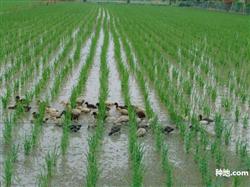
(5) Rice-duck co-culture technique for controlling insects and weeds: during the peak tillering stage of rice, release 12-15 ducks aged 15 days per mu of rice field, and gather the ducks before the booting stage. Through the feeding and activities of the ducks, reduce the occurrence and damage of sheath blight, rice planthoppers and weeds.
(6) Technique of using sex pheromone lures to trap and kill the striped stem borer: use sex pheromone lures for the striped stem borer to trap and kill male moths, so that female moths cannot mate and reproduce normally, reducing the base of the next generation and alleviating the damage. During the moth period of the main damaging generation of the striped stem borer, place one trap per mu, with one lure core inside, replaced once per generation; the trap should be 30 cm above the rice plants.
(7) Light trapping technique for killing pests: install one frequency-vibration insect-killing lamp every 30-50 mu of rice field, with the bottom of the lamp 1.5 m above the ground, to trap and kill many rice pests such as the striped stem borer, yellow stem borer, rice leaf roller and rice planthopper. From mid-April to early October, turn on the lamp every night from dark until 12 midnight.
(8) Application technique of biological pesticides: promote the use of biological pesticides to control rice pests and diseases, using validamycin or a mixture of validamycin and Bacillus cereus to control sheath blight and rice false smut; using Bacillus subtilis or kasugamycin to control rice blast; using agricultural streptomycin to control bacterial leaf streak; using Bacillus thuringiensis and abamectin to control borers and rice leaf roller.
Biological pesticides should be used 2-3 days earlier than chemical pesticides, and should be avoided during high temperature and drought.
(9) Technique of protecting and utilizing natural enemies to control pests: protect and utilize natural enemies in rice fields and give play to their control effect on pests. Common measures include: planting beans on field ridges to protect and utilize spiders and other natural enemies, protecting frogs, and releasing Trichogramma, etc.
(10) Scientific pesticide application technique: according to different crops and different pests and diseases, correctly select the appropriate chemical pesticide varieties with high efficiency, low toxicity and low residue, and apply the right pesticide for the right target. For borers, use triazophos, butylene fipronil, fipronil, etc.; for rice leaf roller, use profenofos; for rice planthopper, use buprofezin and thiamethoxam; for rice blast, use tricyclazole and isoprothiolane; for sheath blight and rice false smut, use difenoconazole; for bacterial leaf streak, use thiodiazole-copper and trichloroisocyanuric acid.
Add synergists to the spray liquid to enhance the adhesion, spreading and penetration of the pesticide, improve efficacy and reduce the amount of pesticide used. Common synergists include azone and organosilicon, etc.
At the booting stage of rice, adopt mixed pesticide application and unified prevention and control to reduce the number of applications and improve the control effect. Early rice mainly controls borers, rice leaf roller, rice planthopper and rice blast, etc.; late rice mainly controls borers, rice planthopper and rice false smut, etc.
When using chemical pesticides to control pests and diseases, apply the pesticide during the young larval stage of pests and the early stage of disease onset. For application at the ear stage, the pre-harvest interval should be observed.
Click to get massive rice cultivation techniques
Click to get massive grain cultivation techniques