What is cilantro black rot? Symptom identification and control methods
How to grow cilantro in summer? Please guide me. To grow cilantro well in summer, you can refer to the following methods: 1. Land preparation and fertilization. For cilantro plots, choose fertile, loose sandy loam with good water retention and drainage and close to a water source. Before sowing, while turning the soil, apply 3000-3500 kg of high-quality decomposed manure per mu as a base fertilizer, then build beds 2 m wide...
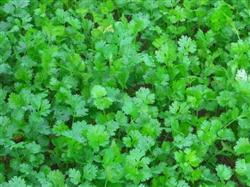 What is cilantro black rot? How should it be controlled?
Harmful symptoms of cilantro black rot:
It mainly harms the root crown and the base of the leaf stalks, mostly infecting near the ground, and sometimes also infecting the roots. After infection, the affected parts first turn grayish brown, and after expansion become dark green to dark brown. At first the epidermis of the diseased part remains intact, then it ruptures and exposes the infected tissue underneath, which turns black and rots. The root crown is especially prone to rotting, the leaves droop and appear withered, and the rotten area rarely spreads upward or downward. Many small black dots are produced on the diseased part, namely the pathogen's pycnidia. In severe cases, the outer leaves rot and fall off.
Pathogen morphological characteristics:
Phoma apiicola Kleb., called cilantro phoma, belongs to the Deuteromycotina fungi. Young hyphae are initially colorless and become black after maturing, and can produce small sclerotia on potato agar medium. Pycnidia are spherical or hemispherical, black, initially embedded and later exposed, mostly formed in inconspicuous spots; the pycnidia have ostioles, and the conidiogenous cells are mostly single-celled, with phialidic conidiogenesis, which distinguishes it from Phyllosticta. Conidia are single-celled, colorless, long elliptical, measuring 3.0-3.8 x 1.0-1.6 micrometers. The temperature range for pathogen growth and development and conidial germination is 5-30°C, with 16-18°C being optimal.
Control methods:
(1) In the early stage of disease onset, choose 36% thiophanate-methyl suspension concentrate at 400 times dilution, or 10% shuangxiaoling aqueous solution at 250 times dilution, and spray 50-60 kg per 667 sq m once every 7-10 days, for 2-3 consecutive treatments.
Click to get more cilantro cultivation techniques
Click to get more vegetable cultivation techniques