What are the cultivation methods and key technical points for pollution-free asparagus?
How do you grow pollution-free asparagus? Please provide guidance. Pollution-free asparagus cultivation can follow the methods below: 1. Variety selection. Choose mid-season varieties suitable for both green and white spears, such as Atlas, Apollo and other excellent varieties. These varieties have good quality, excellent flavor and strong adaptability, generally yielding 800-100...
How do you grow pollution-free asparagus? Please provide guidance.
Pollution-free asparagus cultivation can follow the methods below:
I. Variety selection
Choose mid-season varieties suitable for both green and white spears, such as Atlas, Apollo and other excellent varieties. These varieties have good quality, excellent flavor and strong adaptability, generally yielding 800-1000 kg of green asparagus per mu.
II. Seedling raising
Choose a sandy soil with higher terrain, loose and fertile, as the seedbed. Each mu of field requires a seedbed about 1.3-1.5 m wide and about 10 m long. Evenly mix into each seedbed 150-200 kg of decomposed organic fertilizer, 1 kg of superphosphate and 1 kg of potassium chloride. After the soil and fertilizer are mixed evenly, use a pot-making tool with a diameter of 8-10 cm and a height of 10 cm to make pots; about 2500 pots are needed per mu. Each mu of field requires 50-70 g of seed. After sprouting, sow 1 seed per pot from March 10 to April 10. After sowing, cover with 1.5-2 cm of fine soil, lay plastic film flat over the bed surface, and then set up a small tunnel. Before emergence, control the temperature inside the bed at 25-30°C during the day and not lower than 12°C at night. When 70% of the seedlings have emerged, remove the plastic film and gradually ventilate to harden the seedlings. The seedling age is 60 days, and they can be transplanted once a single plant has more than 3 aboveground stems and tillers.
III. Transplanting
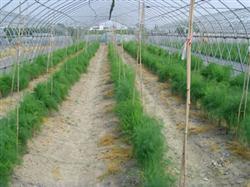
Choose sandy and loamy land with no pollution sources within 3 km around the planting site, good irrigation water quality and a low groundwater table. Transplant from early to mid-May to early to mid-June. Before transplanting, apply 2000-2500 kg of organic fertilizer, 4-5 kg of pure nitrogen, 4-5 kg of phosphorus pentoxide and 5-6 kg of potassium oxide per mu. Deeply plow, prepare the land and rake it level, then dig transplanting trenches with a row spacing of 1.3-1.5 m, a trench width of 40-50 cm and a depth of 30-40 cm. Dig a complete set of field ditches, with three ditches matching one another. Set plants at a spacing of 25-30 cm, planting 1800-2000 plants per mu. After the seedlings send up new stems, gradually fill in and level the transplanting trenches in stages until a fish-back shape is formed.
IV. Field management
(1) Weeding. According to the occurrence and damage of weeds, cultivate and loosen the soil in time to eliminate weeds.
(2) Irrigation and drainage. During the growing period, if the weather is dry, irrigate in time to prevent drought; during the flood season or after heavy rain, drain waterlogging and reduce waterlogging in time.
(3) Fertilization. Apply the "three fertilizers" well: the sprouting fertilizer is generally applied in early to mid-March together with loosening the soil between the ridges, applying 2000-2500 kg of organic fertilizer, 7-8 kg of pure nitrogen, 5-6 kg of phosphorus pentoxide and 5-7 kg of potassium oxide per mu. The spear-strengthening fertilizer is generally applied in early June, after the mother stems are retained in the field, applying 1500-2000 kg of organic fertilizer, 10-11 kg of pure nitrogen, 7-8 kg of phosphorus pentoxide and 8-9 kg of potassium oxide per mu. The autumn growth fertilizer is applied in late August, after spear harvesting stops in the field, applying 2000-2500 kg of organic fertilizer, 10-11 kg of pure nitrogen, 6-7 kg of phosphorus pentoxide and 6-7 kg of potassium oxide per mu.
(4) Earthing up and removing soil. If harvesting white spears, in late March each year, together with cultivating and loosening the soil, build high ridges in the young spear growing area with a bottom width of 60 cm, a top width of 30 cm and a height of about 40 cm, loose inside and firm outside, with a smooth surface. After harvest, remove the soil in time and restore the land to level.
(5) Asparagus renewal. In general, the 2-3 years after transplanting are the juvenile period of asparagus, also called crown and root nurturing; the 4-5 years after transplanting are the peak yield period of asparagus, called the adult period; and 8-9 years of spear harvesting, when yield gradually declines, is called the aging period. After entering the aging period, promptly select new varieties and raise seedlings again for transplanting or rotate to another crop.
Click to get more asparagus cultivation techniques
Click to get more vegetable cultivation techniques