How to grow potatoes for higher yields? A detailed guide to cultivation methods
How can potato yields be increased? Here is some guidance. To increase potato yields, you can refer to the following methods: 1. Remove the tail buds: Experiments have shown that after tail buds of potatoes grow into plants, the yield is only 1/3 of that from plants grown from top buds or side buds. For this reason, when cutting seed potatoes, the tail buds should be discarded. 2. High-ridge cultivation: High-ridge cultivation with soil hilled up on both sides can increase the loose soil layer around the roots and stems in the plow layer, which helps the stolons extend, and can also raise soil temperature, meeting the temperature needed for early root and stem development.
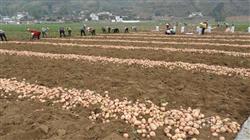
How can potato yields be increased? Please give guidance.
To increase potato yields, you can refer to the following methods:
1. Remove the tail buds: Experiments have shown that after tail buds of potatoes grow into plants, the yield is only 1/3 of that from plants grown from top buds or side buds. For this reason, when cutting seed potatoes, the tail buds should be discarded.
2. High-ridge cultivation: High-ridge cultivation with soil hilled up on both sides can increase the loose soil layer around the roots and stems in the plow layer, which helps the stolons extend, and can also raise soil temperature, meeting the temperature needed for early root and stem development.
3. Formula fertilization: Potatoes need large amounts of nutrients throughout their growth and development period. In areas with poor soil and low nutrient content, formula fertilization must be used to meet the crop's demand for nitrogen, phosphorus, potassium and trace elements during growth and development, especially during tuber expansion, which can greatly increase yield.
4. Remove flower buds: The usable part of the potato is the underground tuber, which does not need flowering and pollination at all, and budding and flowering also consume large amounts of nutrients. To achieve high yield, buds must be pinched off as soon as they are seen, to save nutrients and promote tuber growth.
5. Less hoeing and more direct furrowing: The fleshy roots of potatoes that can form tubers grow horizontally in the soil. Deep hoeing often cuts the fleshy extending roots, artificially causing yield reduction. Therefore, after the first hoeing, only furrow without hoeing. Combining furrowing to bury grass with manual pulling to remove grass to prevent weed infestation can effectively increase yield.
6. Supplement magnesium to promote yield: Expert research has shown that during potato growth, especially during tuber expansion, if magnesium fertilizer is sufficient, not only is the yield high, but starch accumulation is also greater and quality is better. Therefore, when the plant is 45 cm tall, each plant should be topdressed with 500-100 g of magnesium sulfate dissolved in water.
7. Foliar spraying: Under the condition of sufficient base fertilizer, starting from leaf unfolding, spray the leaves once every 10 days with a mixture of 0.1% magnesium sulfate, 0.3% monopotassium phosphate, and 1000-fold triacontanol, spraying 3-5 times continuously, which can significantly increase yield. If supplemented with other measures such as sunning the seed potatoes, soaking seeds in rice alcohol, leaving only one strong sprout per plant, and breaking off small seedlings to fill gaps and ensure a full stand, the yield will increase further.
Click to get more potato growing techniques
Click to get more vegetable growing techniques