What are the main pests and diseases of sweet corn? Learn it all in one article
What are the main pests and diseases of sweet corn? How to control them The main pests and diseases occurring in sweet corn are: corn borer, northern leaf blight and southern leaf blight, and sheath blight. I. Occurrence of pests and diseases Corn borer: moderate occurrence, locally on the heavy side. According to surveys, at maturity the average damage rate of corn plants was 10.06%, and in severely affected fields the average plant damage rate was 31.43%. At present, the larval stage in the field is mainly late-instar larvae, with an average of 1971 larvae per mu, reaching as high as 2500.
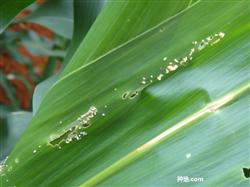
What are the main pests and diseases of sweet corn? How to control them
The main pests and diseases occurring in sweet corn are: corn borer, northern leaf blight and southern leaf blight, and sheath blight.
I. Occurrence of pests and diseases
Corn borer: moderate occurrence, locally on the heavy side. According to surveys, at maturity the average damage rate of corn plants was 10.06%, and in severely affected fields the average plant damage rate was 31.43%. At present, the larval stage in the field is mainly late-instar larvae, with an average of 1971 larvae per mu, reaching as high as 2500.
Northern leaf blight and southern leaf blight: moderate occurrence, locally on the heavy side. At maturity the average diseased leaf rate of corn was 19.05%, reaching as high as 30%; at the seedling stage the average diseased leaf rate of corn was 42.86%, reaching as high as 60%.
Sheath blight: light occurrence, locally severe. The average diseased plant rate was 10%, and in a few severely affected fields it reached 93.33%.
II. Analysis of occurrence trends
According to the weather forecast, in September there will still be 1 tropical cyclone affecting our city; rainfall in most areas will be about the same as in previous years, while some areas will have 10% to 20% more, at 100 to 200 mm.
At present, the growth stages of corn in the field vary greatly, and the abundant food supply is conducive to pests moving from field to field and causing damage. It is expected that in the next stage the corn borer will occur on the heavy side, and the suitable control period for the next generation of corn borer is September 10 to 15; northern leaf blight, southern leaf blight and sheath blight will occur moderately, locally on the heavy side.
III. Control recommendations
(1) Because corn planting times vary from place to place, control strategies must be formulated according to local actual conditions and adapted to local circumstances, and timely control must be guided.
(2) Carry out integrated control combining agricultural, physical and chemical control. Strengthen field management, promptly drain standing water from fields, remove diseased and pest-damaged leaves, branches and residues, and bury them deeply in a centralized place or destroy them; carry out good health cultivation to improve plant disease resistance; where conditions permit, use insect-killing lamps to trap and kill adult corn borers, reducing field pest density and the number of eggs laid.
(3) Use high-efficiency, low-toxicity pesticides for timely chemical control. If it rains after application, reapply the pesticide promptly.
Corn borer: focus on control during the peak egg-hatching period, the late whorl stage (funnel stage) and the tasseling stage. At the peak egg-hatching period, spray with 1.8% abamectin at 1000 times dilution; at the late whorl stage (funnel stage), use 1.8% abamectin at 800 times dilution per mu or Bacillus thuringiensis (BT) wettable powder 100 to 200 grams mixed with fine sand 3.5 to 5 kg, both applied into the funnel leaves; at the tasseling stage, use 90% trichlorfon at 800 times dilution or 50% phoxim emulsifiable concentrate at 800-1000 times dilution to spray the ear or inject at the base of the silks at the top of the female ear.
Northern leaf blight and southern leaf blight: choose 70% thiophanate-methyl wettable powder at 800 times dilution for spraying, or 10% difenoconazole water-dispersible granules at 1000 times dilution for spraying, applying once every 7 to 10 days, for 2 to 3 consecutive applications.
Sheath blight: use 70% thiophanate-methyl or 50% carbendazim wettable powder at 600 to 800 times dilution to spray the base of the stems and leaf sheaths, and after the jointing stage peel off the diseased leaf sheaths, take them out of the field and burn them, cutting off the route of reinfection and spread.
Note: Pesticide application should be stopped 10 to 15 days before harvesting sweet corn to ensure food safety.
Click to get more corn planting techniques
Click to get more grain crop planting techniques