How to manage zucchini during the fruiting stage? Master these technical key points
How to manage zucchini well during the fruiting stage? Please give an introduction. During the zucchini fruiting stage, you can refer to the following methods for management: 1. During the fruiting stage, leaves should be removed reasonably. As the plant continues to grow, the leaves gradually increase, which easily causes the field to become closed and poorly ventilated and lit. The lower leaves find it difficult to receive light for photosynthesis, and instead...
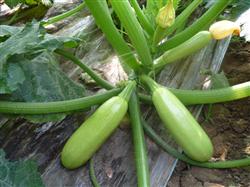
How to manage zucchini well during the fruiting stage? Please give an introduction
During the zucchini fruiting stage, you can refer to the following methods for management:
I. During the fruiting stage, leaves should be removed reasonably
As the plant continues to grow, the leaves gradually increase, which easily causes the field to become closed and poorly ventilated and lit. The lower leaves find it difficult to receive light for photosynthesis; instead, because of high humidity, they are easily infected by pathogens, leading to disease outbreaks. Especially in deep winter, the temperature inside the greenhouse is low, humidity is high, and there are many pathogens. In addition, the lower leaves are easily injured or broken during spraying and melon picking, making disease occurrence even more likely. Therefore, reasonable leaf removal on zucchini to improve ventilation and light penetration is very necessary.
Leaf removal on zucchini should depend on the plant's growth vigor. Vigorous plants can have more leaves removed, while weak ones should have fewer removed, with the aim of ensuring good ventilation and light penetration in the field. To avoid the stem being slow to heal after injury, it is recommended that vegetable growers only remove the leaf blade and not the petiole. Because the petiole is thick and brittle, removing the leaf from the base can easily cause a large wound on the stem that is difficult to heal. The leaf blade can then be removed entirely or mostly, which can promote faster drying and shedding of the petiole. In addition, note that when removing leaves, it is best to have several consecutive sunny days, so that the environment inside the greenhouse is relatively dry and disease infection is less likely. After leaf removal, vegetable growers can spray streptomycin 4000-fold solution or Jiaruinong 600-fold solution to prevent disease infection in advance.
II. Protecting flowers and melons is also very important
If the time for pollinating melons differs too greatly, it easily leads to an increase in curved melons and large-headed melons. Vegetable growers had best pollinate melons on the day before zucchini flowering or between 9-11 a.m. on the day of flowering. When zucchini is cultivated in greenhouses, the seedling development period is mostly under conditions of short daylight and low night temperature, which favors female flower formation. Generally, when it grows to 3-4 true leaves, female flowers appear, and there may even be female flowers at every node, with multiple female flowers at one node. If too many female flowers are allowed to grow and develop, they will inevitably consume a large amount of organic nutrients, causing intense nutrient competition, affecting plant and young melon growth, and also causing a large number of melons to abort, leading to a serious decline in yield. Therefore, excess female flowers must be thinned as early as possible to reduce nutrient competition and promote fruit set. Excess female flowers are best thinned just when they first appear. The number of female flowers to thin should be determined according to the growth vigor of the vines. For weak-growing plants, the root melon should be thinned first, and afterward about one female flower should be retained every three nodes; for strong-growing vines, the root melon can be retained, but it should be harvested early, and afterward about one female flower should be retained every two nodes. The number of melons retained should also be adjusted in a timely manner according to the vine's growth vigor and fruit-setting situation, minimizing unnecessary nutrient consumption, maintaining the vine's robust growth vigor, and achieving the goal that every retained melon becomes a good melon.
III. During the late fruiting stage, lower the vines at the proper time
In the late fruiting stage, the plants are extremely tall, some even exceeding 2 m, which causes trouble for management such as harvesting and spraying. Vegetable growers should pay attention to lowering the vines at the proper time. The stem vines that are lowered to the ground can be covered and pressed with soil to promote new adventitious roots, improve the root system's ability to absorb water and fertilizer, delay plant senescence, and increase later-stage yield.
Click to get more zucchini cultivation techniques
Click to get more vegetable cultivation techniques