How should purple cabbage be planted to achieve high yields?
How can purple cabbage be grown for high yields? Please give an introduction. Purple cabbage is also known as red cabbage, purple-leaf cabbage, etc. This cabbage is cold-resistant and heat-tolerant, highly adaptable, high-yielding, tolerant of transport, with a growth period of 90-120 days. It is one of the rare specialty vegetables of Shandong Province, and the economic benefits of growing purple cabbage are far higher than those of ordinary cabbage varieties....
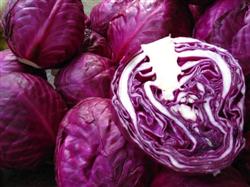
How can purple cabbage be grown for high yields? Please give an introduction
Purple cabbage is also known as red cabbage, purple-leaf cabbage, etc. This cabbage is cold-resistant and heat-tolerant, highly adaptable, high-yielding, tolerant of transport, with a growth period of 90-120 days. It is one of the rare specialty vegetables of Shandong Province, and the economic benefits of growing purple cabbage are far higher than those of ordinary cabbage varieties.
Raising seedlings: For the seedbed soil, take 6-7 parts of clean soil from a plot previously planted with onions or garlic, add 3-3 parts of fully decomposed, sieved, high-quality barnyard manure, and then mix in a small amount of diammonium phosphate. Disinfect the seedbed with chlorothalonil or thiram plus metalaxyl. Soak the seeds for 2-3 hours, then germinate and sow; if the seed germination rate is high, germination can be skipped. When the seedlings have 2 true leaves and 1 heart leaf, transplant them once. Seedling-raising time: for the winter-spring crop, from late November to early December. Use the double-film method for raising seedlings, that is, raise seedlings in a small arch tunnel inside a greenhouse. For the summer crop, raise seedlings in a small arch tunnel from late February to late March. For the autumn-winter crop, raise seedlings from late July to mid-to-late August. Because July and August are rainy, the seedbed should be built on a plot with higher terrain and convenient drainage, and the seedbed should be shaded above with straw mats or shade netting. Generally, on sunny days, cover with straw mats at around 10 a.m. and uncover them at 3 p.m.; on cloudy days, they may be left uncovered.
Field planting: Choose a plot with fertile soil and convenient irrigation and drainage for cultivation. Transplant when the seedlings have 6-7 true leaves. Before planting, apply 5000 kg of organic fertilizer, 30 kg of diammonium phosphate, and 50 kg of potassium sulfate per 1/15 hectare. Plant on ridges, with each 150 cm as one planting belt and a bed width of 110 cm. Plant 2 rows on the bed, with a row spacing of 50 cm and a plant spacing of 35 cm.
Field management: Within 7-10 days after planting, control the daytime temperature at 25-27°C and the nighttime temperature at 13-15°C. Entering the rosette stage and head-forming stage, control the daytime temperature at 18-20°C and the nighttime temperature at 12-15°C. If the daytime temperature exceeds 25°C, open the film to ventilate. When the temperature is below 17°C, cover with film to block the wind. 15 days after the seedlings recover, carry out the first topdressing together with watering, applying 15-20 kg of urea per 1/15 hectare. For the second topdressing, before the rosette leaves close the rows and when the head leaves begin to fold inward, apply 10 kg of urea and 5 kg of potassium sulfate per 1/15 hectare. For the third, at the head-forming stage, apply 20 kg of urea, 10 kg of potassium sulfate, and 10 kg of phosphate fertilizer per 1/15 hectare, followed immediately by watering. Keep the soil moist during the head-forming stage. Watering should be done on sunny, warm days; watering on cloudy days is not advisable.
Disease and pest control: (1) Black rot and soft rot: remove diseased plants promptly and spray with 77% Kocide 500-fold solution or Xinzhiromycin 300-fold solution. (2) Downy mildew: spray with 63% metalaxyl 500-fold solution or 75% chlorothalonil 500-fold solution for control. (3) Sclerotinia rot: spray with 30% dimethachlon 1000-fold solution or 50% iprodione 1500-fold solution for control. (4) Aphids and cabbage caterpillars: use 2.5 deltamethrin 3000-fold solution or 20% fenvalerate 3500-fold solution for control. (5) If the humidity inside the greenhouse is high, appropriate smoke agents may be chosen for control.
Click to get more cabbage growing techniques
Click to get more vegetable growing techniques