When is the best time to control wheat blossom midges?
When is the best time to control wheat blossom midges? Please advise. The following methods can be used for reference in controlling wheat blossom midges: 1. Occurrence characteristics. Through long-term survival in nature, wheat blossom midges have formed a close symbiotic relationship with wheat growth and development. Their emergence from the soil, pupation, eclosion, egg laying, hatching, and...
When is the best time to control wheat blossom midges? Please advise
The following methods can be used for reference in controlling wheat blossom midges:
I. Occurrence characteristics
Through long-term survival in nature, wheat blossom midges have formed a close symbiotic relationship with wheat growth and development. Each growth and development stage, including emergence from the soil, pupation, eclosion, egg laying and hatching, is always consistent with the growth and development of wheat, namely: at the booting stage of wheat, the midges emerge from the soil and pupate; at the heading stage of wheat, the midges eclose; and at the early filling stage of wheat, the larvae hatch. In other words, as long as wheat can survive, the midges can survive. The occurrence area and range are large, basically throughout the winter wheat producing areas nationwide. Once it occurs and control is inadequate, it will cause severe yield reduction or even no harvest at all, so it must not be taken lightly. Its damage characteristics are:
1. Small individual size: 30 wheat blossom midges can fit inside 1 wheat grain.
2. Strong concealment: in 1 year there is only 1 week during which pupation on the soil surface can be seen directly; the rest of the time they hide in the soil and inside wheat grains, making them very difficult to find visually.
3. Destructive: if 3 wheat blossom midges bore into 1 wheat grain, that grain will be sucked dry. In other words, if 1 wheat blossom midge bores into a wheat grain, 1/3 of the grain milk will be sucked away.
4. Outstanding persistence: wheat blossom midges can survive in the soil for 6~12 years, and every year there is always a batch of larvae that remain dormant in the soil without emerging to cause damage, so as to maintain population reproduction.
5. Short critical control period: the pupal stage lasts 1 week, and the adult stage lasts 3 days. These two links are also the weakest links in the survival of the midges. Once control is not timely, yield reduction or severe yield reduction often results.
II. Seize the appropriate period for efficient control
In view of the above characteristics of wheat blossom midges, it is recommended that all localities deploy early and mobilize early, effectively overcome complacency, highlight the "strategy of placing equal importance on control during the pupal stage and the adult stage", and do a good job in the following two control links:
1. Firmly grasp the link of spreading poisonous soil during the pupal stage of the midges
When the larvae of wheat blossom midges pupate, they are all on the soil surface. At this time, spreading poisonous soil on the soil surface is the best opportunity to eliminate the midges. Because the wheat seedling condition this year is generally weak, the development progress will be somewhat delayed, and the development period of the midges will also be delayed along with wheat. All localities should, on the basis of accurate forecasting, strengthen cooperation with local news media, conduct good publicity lectures on control techniques, and guide farmers to do a good job in control during the critical period.
At present, there is especially a lack of pesticide varieties for spreading poisonous soil to control midge pupae, which makes it difficult for farmers to choose and worsens the phenomenon of arbitrary and excessive pesticide use. Summarizing control experience from various localities in recent years, during the pupal stage of the midges, per mu use 1.5 kg of "2.5% isofenphos-methyl granules produced by Hubei Tianmen Yipule Agrochemical Co., Ltd.", or 600~900 g of "Huayang brand 5% chlorpyrifos granules produced by Shandong Huayang Pesticide Co., Ltd.", mix with 25~30 kg of poisonous (sand) soil, and spread evenly on the surface of the wheat field. Both of the above granular formulations are processed into powder form according to production requirements and are specially used for spreading poisonous soil to control midge pupae. When spreading poisonous soil, do not spread it with dew, to avoid sticking to wheat leaves and causing phytotoxicity and affecting the exertion of efficacy. At the same time, the poisonous soil scattered on wheat leaves should afterward be knocked down to the ground with tools such as a broom, so as to give full play to the efficacy. Highly toxic and extremely toxic pesticide varieties are prohibited. It is necessary to organize uniformly, direct uniformly, and supply pesticides uniformly, mobilize farmers to carry out control at a unified time, either uniformly or by household at a unified time, and effectively do a good job in unified control and specialized control. At the same time, work on cracking down on counterfeit pesticides must be done well.
II. Do a good job at the adult stage control link
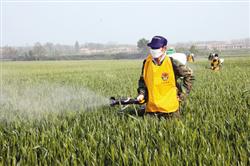
From the end of April to early May, when wheat is from the heading stage to the early flowering and filling stage, adults begin to eclose and fly to wheat ears to lay eggs. Spraying at this time is the critical period to eliminate adults before egg laying. Use 5% beta-cypermethrin 1500-fold solution or 40% dimethoate 1000-fold solution, or a combined spray (imidacloprid + dichlorvos + beta-cypermethrin), or a reasonable mixture of imidacloprid (acetamiprid) with dichlorvos (beta-cypermethrin, dimethoate) and other 1000-fold solution spray, while also controlling wheat aphids. Emphasize even spraying and thorough penetration; do not be sparing with water while being sparing with pesticide, so as to achieve the goal of effectively controlling the adult population number and the number of eggs laid. This not only plays a key role in controlling the damage in the current year, but is also very important for controlling the insect source base for the following year.
Click to get more wheat planting techniques
Click to get more grain planting techniques