What are the precautions for growing radishes in summer?
What should be noted when growing radishes in summer? Here is an introduction. When growing radishes in summer, the following aspects should be noted: Use good seed: Selecting the right improved variety is the prerequisite for obtaining high quality and high yield in over-summer radishes. Therefore, when cultivating radishes in the hot summer season, early-maturing varieties with good heat tolerance and strong stress resistance must be selected....
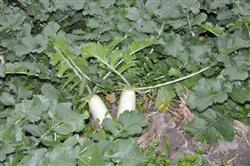
What should be noted when growing radishes in summer? Here is an introduction
When growing radishes in summer, the following aspects should be noted:
Use good seed: Selecting the right improved variety is the prerequisite for obtaining high quality and high yield in over-summer radishes. Therefore, when cultivating radishes in the hot summer season, early-maturing varieties with good heat tolerance and strong stress resistance must be selected.
Apply sufficient base fertilizer: Early-maturing radishes have a short growing period and relatively high nutrient requirements, so sufficient base fertilizer must be applied in combination with land preparation. The amount of base fertilizer applied should account for 70% of the total fertilizer application; per mu, 4000 kg of fully decomposed farmyard manure and 30-40 kg of compound fertilizer can be applied. Radishes should be cultivated in deep furrows with high beds, with a bed height of 25-30 cm.
Sowing and raising seedlings: When cultivating radishes in over-summer and early autumn, sowing can be carried out in batches from May to August according to market demand during the summer and autumn off-season. There are two sowing methods, dibbling and broadcasting, which can be reasonably chosen according to the variety type. Large-fruited varieties should be dibbled, with a plant spacing of 20 cm and a row spacing of 35 cm; the sowing holes should be shallow, and after sowing the seeds should be covered with fine soil. Small-fruited varieties can be broadcast, and after thinning the seedlings should be kept at a spacing of 6-12 cm. After sowing, cover the bed surface with rice straw or a shade net to protect against sun and reduce heat, prevent rainstorm erosion, and reduce the loss of fertilizer and water. After the seedlings emerge uniformly, remove the rice straw and shade net in time to avoid pressing the seedlings or causing the seedlings to become spindly and weak. During the seedling stage, thinning must be done early and final thinning late. After the seedlings emerge, they grow rapidly; when the seedlings have 1-2 leaves and 3-4 leaves, thin them once each time, and when the seedlings reach the 5-6 leaf stage, final thinning should be done.
Fertilizer and water management: Radishes require a relatively large amount of water, and the amount of water is closely related to yield and quality. Too much water makes the radish skin rough and can easily cause root cracking and rot; a lack of water during the seedling stage makes viral disease likely. When fertilizer and water are insufficient, the radish fleshy root is small and lignified, with a strong bitter and pungent taste, and is prone to pithiness. In cultivation, water should be supplied evenly according to the characteristics of each growth stage of the radish and its water needs; do not let the soil alternate between dry and wet. After sowing, water thoroughly, and after most seeds have emerged, water once more to help ensure a full stand. After planting, the seedlings quickly enter the peak leaf growth period, and watering should be moderate. In the late vegetative growth stage, water should be properly controlled to prevent excessive leaf growth from affecting fleshy root growth. When the plant has 12-13 leaves, the fleshy root enters a rapid growth period; at this time, fertilizer and water supply should be sufficient, and watering can be done flexibly according to weather and soil conditions. After heavy rain, drainage must be carried out in time to prevent excess water from waterlogging the roots, causing cracked or rotten roots. In hot and dry seasons, watering should be done in the evening, and watering at noon must be avoided to prevent tender leaves from wilting and fleshy roots from rotting; stop watering 7 days before harvest. Radishes also have special nutrient requirements; boron deficiency can cause the fleshy root to turn black and become pithy. During the fleshy root enlargement period, appropriately increase potassium fertilizer. From emergence to final thinning, apply seedling-protecting fertilizer as needed; when the seedlings have 2 true leaves, apply a small amount of fertilizer; after the second thinning, apply fertilizer once in combination with intertillage and weeding. During the period from "breaking white" to "showing shoulder" in radishes, carry out the second topdressing, and afterward apply topdressing according to seedling growth. It should be noted that topdressing should not be applied too close to the fleshy root, so as to avoid burning the roots. Intertillage and weeding can be carried out in combination with irrigation and fertilization; intertillage should be deep first and then shallow, near first and then far, and should stop after the rows close.
Click to get more radish growing techniques
Click to get more vegetable growing techniques