Detailed Explanation of the New Ridge-Trench Cultivation Technique for Gastrodia elata
1. Sexual reproduction ① "First cultivate the fungal bed method": From March to April each year, use Armillaria mellea spawn to cultivate new fungal wood, and in May to June use germination-promoting fungal spawn mixed with Gastrodia elata seeds for sowing. In November, harvest the sexually produced seed corms, and in November of the following year harvest the commercial corms. This method gives stable and high yields with significant economic benefits. ② "Two fungi and one seed mixed planting method": From May each year...
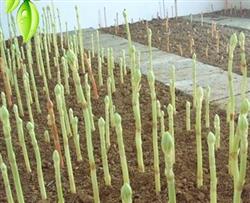 The production efficiency of Gastrodia elata is relatively high. Since the fourth quarter of 2006, the purchase price of fresh corms has generally been 20 yuan per kilogram. The first year of planting requires slightly higher investment, with production efficiency of about 200 yuan per sq m; after the second year, using self-produced seed corms to expand cultivation makes it natural for the benefits to be even higher than the previous year. Furthermore, with the current adoption of new high-yield cultivation techniques, yields can be increased by a relatively large margin -- this is one point. Second, it is expected that the market price will rise considerably by the end of this year, and the current average protective purchase price has already reached about 30 yuan per kilogram, which shows the market demand for Gastrodia elata from one angle. Where there is demand, there is a market; where there is a market, there must inevitably be production. Third, as the international reputation and status of traditional Chinese medicine continue to grow and improve, foreign consumers also favor products such as Gastrodia elata, and Gastrodia elata health products are gradually rising in overseas markets. Therefore, on the basis of continuously increasing domestic demand, export volume is rising substantially at the same time, so Gastrodia elata has enormous market potential and promising prospects.
Calculated at current prices, generally for the first cultivation, planting one sq m of Gastrodia elata requires "Luji No. 2" Gastrodia elata hybrid seeds and Armillaria mellea spawn at about 85 yuan, plus sand, log sections, etc., with a total investment of about 120 yuan. The general yield is about 30 jin, and at current market prices, the profit per sq m is about 200 yuan (not including the remaining seed corms, which can expand about 3 sq m or more per sq m).
Ridge-trench cultivation of Gastrodia elata is a new technique developed and promoted through years of research. According to analysis, the fundamental reasons this technique can greatly increase Gastrodia elata yields are: first, the underground temperature is suitable and basically constant year-round, so there is essentially no dormancy problem during the growth process of Gastrodia elata. Second, the underground moisture and humidity are stable; as long as the plot does not accumulate water and the soil has good permeability, there will be no problems such as uneven and unbalanced moisture from alternating dry and wet conditions. Finally, it is basically unaffected by the surface environment. The specific cultivation techniques mainly include the following points:
1. Select good fungal spawn or fungal wood: When cultivating with fungal spawn plus log sections, first-generation isolated fungal spawn must be used, free of pests and diseases.
2. Select good seed corms: Sexually hybridized seed corms are required, with corms free of any bruising, disease spots, or pest damage.
3. Select a good site: Choose a location with slightly higher terrain but not dry, with soft soil that does not accumulate water and has no possibility of water accumulation, and with good permeability.
4. Dig trenches: Dig trenches running north-south about 60-80 cm wide and 80-100 cm deep; spread a layer of coarse sand about 10-20 cm at the bottom of the trench, irrigate once, and then spray or apply with the water an 800-fold phoxim solution and an 800-fold carbendazim solution.
5. Preparation before sowing: When using fungal spawn for cultivation, cut wood 2-3 days in advance, or soak dry log sections in clean water, and transport them together to the cultivation plot before sowing.
6. Sowing: Same as conventional sowing. A rain-shelter arched shed should be set up over the top of the trench to prevent rainwater from directly entering the trench.
7. Management: On the 10th day after sowing, water thoroughly once; set up low shade materials along the trench such as weeds, corn (2338,-1.00,-0.04%) stalks, etc. After that, water about once every 20 days; in low-temperature seasons, consider covering the cultivation trench with plastic film and a layer of straw-like material for insulation.
From many years of production practice and investigation, the asexual propagation cultivation method used in Gastrodia elata production has the problems of declining yields year by year and declining quality. Therefore, from a long-term perspective, it is necessary to "change seeds" for Gastrodia elata, so sexually hybridized seeds should be promoted and used to achieve ideal production results. It should be noted that Gastrodia elata hybrid seeds are not like corn seeds that are planted for only one generation; rather, one hybridization breeding can be self-propagated and used for many years. This can both maintain the hybrid vigor of Gastrodia elata hybrids and reduce production costs, and is deeply welcomed by the vast number of growers, which is conducive to technology promotion.