How can over-summer radishes be planted to achieve high yields?
How can over-summer radishes be planted to achieve high yields? Please provide guidance. Over-summer radish cultivation requires attention to the following aspects: select excellent varieties. In summer, because of high temperatures and frequent rain, conditions are unfavorable for radish growth, so the varieties cultivated must be selected for good heat tolerance, drought tolerance, strong resistance to pests and diseases, and the ability to form fleshy roots under high-temperature conditions...
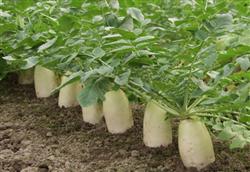
How can over-summer radishes be planted to achieve high yields? Please provide guidance.
Over-summer radish cultivation requires attention to the following aspects:
Select excellent varieties. In summer, because of high temperatures and frequent rain, conditions are unfavorable for radish growth, so the varieties cultivated must be selected for good heat tolerance, drought tolerance, strong resistance to pests and diseases, and the ability to form fleshy roots under high-temperature conditions. These include Re Bai, Xiao Gou Bai, Xia Chang Bai No. 2, Dongfang Huimei, Xia Meinong Zaosheng No. 3, Xia Kang 40 Days, and others.
Soil preparation and fertilization. Choose flat terrain with deep soil and good drainage and water retention, preferably sandy loam. After the previous crop is harvested, promptly clear the residual branches and weeds from the field, then apply 4000 kg of fully decomposed barnyard manure, 15 kg of potassium sulfate, and 30 kg of superphosphate per 667 sq m, and carry out deep plowing and soil preparation. After raking level and fine, cultivate on ridges, with a ridge spacing of 80 cm and a ridge height of 15-20 cm, 2 rows per ridge, and a plant-to-row spacing of 20 cm x 20-25 cm.
Sowing. 1) Sowing rate: for large-type varieties, the seeding rate is 0.5 kg per 667 sq m; for medium-type varieties, 0.75-1 kg; for small-type varieties, 1.5-2 kg. 2) Sowing time: the sowing time for summer radishes can be arranged in batches from June to August according to market demand. 3) Sowing method: large-type varieties use hole sowing, with a hole depth of 1.5-2.0 cm, placing 2-3 seeds per hole, and after sowing cover with 2 cm of sieved fine soil; medium-type varieties use hole sowing or drill sowing, and when drill sowing is used, the furrow depth should be 2-3 cm; small-type varieties can use broadcast sowing.
Field management. 1) Timely thinning and final thinning: after the seedlings emerge, they grow rapidly, so thinning must be carried out in time to ensure uniform and strong seedlings. The first thinning is done when the cotyledons are fully expanded, and the second thinning is done when there are 2-3 true leaves. When the seedlings grow to 5-6 leaves and the radish fleshy root breaks through the soil, final thinning is carried out. 2) Cultivation, weeding, and earthing up: combine cultivation and weeding with thinning; when cultivating, go shallow first and then deep, avoiding root damage. During the first and second thinning, cultivate shallowly, just loosening the surface soil; after the third thinning, carry out one deep cultivation and move soil from the furrows onto the ridge surface to prevent lodging. 3) Watering: summer temperatures are high and soil moisture evaporates quickly, so water timely and appropriately according to soil moisture and the growth characteristics of radishes. Germination stage: water according to the principle of "three waterings for full emergence," that is, water once after sowing to help the seeds germinate; water once when the sprouts push through the soil to help emergence; and water once more after full emergence to help seedling growth. Seedling stage: because the seedling root system is relatively shallow and water demand is small, water appropriately and moderately according to the principle of "water less but often." Leaf growth peak stage: during this period the number of leaves on the upper plant continuously increases, leaf area gradually expands, and the fleshy root also begins to swell, so water demand increases rapidly; water according to the principle of "water appropriately and often." Fleshy root swelling peak stage: during this period water demand is greatest, so water frequently and keep the soil moist to avoid root cracking caused by water shortage. 4) Fertilization: after final thinning of radish seedlings, apply 8-15 kg of urea per 667 sq m with irrigation water to promote leaf growth; when the fleshy root shoulders become exposed, apply 5-10 kg of urea, 10 kg of potassium sulfate, and 3-5 kg of superphosphate with irrigation water to promote fleshy root swelling. When the radish fleshy root begins to swell and during the swelling peak stage, foliar spray can be applied multiple times with 0.3% borax, a mixture of 0.4% calcium chloride and 0.3% borax, or a mixture of 0.2% potassium dihydrogen phosphate and 0.3% borax, to promote fleshy root swelling.
Pest control. Summer temperatures are high and there are many pests, mainly cabbage caterpillars, aphids, diamondback moths, striped flea beetles, and others. In control, besides setting black light traps and yellow sticky boards in the field for trapping and killing, at the early stage of occurrence, for striped flea beetles, spray with BT emulsifiable concentrate at 800-1000 times dilution or 80% trichlorfon wettable powder at 1000 times dilution; for aphids, cabbage caterpillars, and diamondback moths, spray with 48% chlorpyrifos emulsion at 1000 times dilution, 10% imidacloprid wettable powder at 2500 times dilution, or 5% chlorfluazuron emulsifiable concentrate at 1000 times dilution, spraying alternately once every 5-7 days, and 2-3 consecutive sprays are sufficient.
Timely harvest. The harvest period for summer radishes is still during the high-temperature period. After the fleshy roots have fully swollen, harvest and bring to market promptly according to market demand.
Click to get more radish cultivation techniques
Click to get more vegetable cultivation techniques