How to grow off-season green onions? Key technical points explained in detail
How to grow off-season green onions? Please give an introduction. Off-season green onions can be grown by referring to the following methods: 1. Variety selection. To grow green onions for off-season marketing, you should choose green onion varieties that are cold-resistant, bolt-resistant, heat-resistant, disease-resistant and of good quality. Such as Zhangqiu Changbaitiao green onion, Zhonghua Giant Onion superior line and other varieties. ...
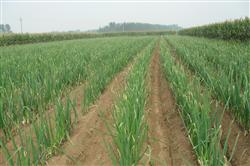
How to grow off-season green onions? Please give an introduction
Off-season green onions can be grown by referring to the following methods:
1. Variety selection
To grow green onions for off-season marketing, you should choose green onion varieties that are cold-resistant, bolt-resistant, heat-resistant, disease-resistant and of good quality. Such as Zhangqiu Changbaitiao green onion, Zhonghua Giant Onion superior line and other varieties.
2. Cultivating strong seedlings
1. Seedling raising and transplanting time arrangement: For the first crop, raise seedlings from late June to early July, transplant in September, and market from March to April of the second year; for the second crop, raise seedlings in mid-September, transplant from March to April of the second year, and market from August to early September.
2. Selection of seedling-raising land: Since the seedling-raising time of both crops falls almost in the rainy season, you should choose a plot that is flat, slightly higher in terrain, can be irrigated in drought and drained in waterlogging, and has not grown Liliaceae vegetables such as green onions, onions, Chinese chives and garlic for more than 3 years.
3. Apply sufficient base fertilizer: Because green onion seedlings have short roots that penetrate shallowly into the soil and have a poor ability to absorb soil nutrients, to cultivate strong seedlings you must apply sufficient fully decomposed organic fertilizer and a certain amount of phosphorus and potassium fertilizer. The specific method is: before ploughing, apply 5000-6000 kg of decomposed, finely crushed barnyard manure per mu (excluding chicken, duck and sheep manure and fresh human excrement and urine), and prepare the beds well. Before sowing, broadcast 25 kg of sulfuric-acid-type three-element compound fertilizer.
4. Fine ploughing and harrowing, ridging and bed making: To prevent underground pests from damaging the seedlings, after the organic fertilizer is spread, poison bait should be broadcast once more. That is, use 5 kg of wheat per mu, fry it until yellow, then mix it evenly with 250 ml of diluted phoxim, seal and cover it for 3 hours, then scatter it on the ground and turn it into the soil together with the organic fertilizer, which can kill many kinds of underground pests at one time. The ploughed land should be fully harrowed fine, harrowed firm and leveled.
Before making the beds, first open the irrigation furrow on one side of the field, then make the beds. The clear width of the bed is 1-1.2 m, the bed ridge is 20-23 cm wide and 8-10 cm high (tread firm). After the beds are made, first broadcast 25 kg of three-element compound fertilizer per mu in the beds (N, P and K each 15%), hoe through and rake level, then sow by hand.
5. Sowing: use 3-4 kg of seed per mu. There are two sowing methods, and you may choose either one.
Raking sowing: evenly broadcast the seeds on the leveled bed surface, then after sowing rake once carefully with a rake so that the seeds are fully mixed with the soil and buried shallowly in the soil, then water.
Cover sowing: after the bed is leveled, use a flat shovel to remove 1 cm of fine moist soil from the bed surface, and level the bed surface again.
Watering: stop watering when the water in the bed reaches a depth of 6-7 cm. Sow after the standing water on the bed surface has seeped dry, and after sowing cover with fine soil about 1 cm thick. Seedlings from cover sowing have deep roots, many roots, are more drought-tolerant with more seedlings, and the seedlings are strong. If you can raise seedlings by shading against storms and rain, the effect is even better. After sowing, when manual operation is possible, spray herbicide while the soil moisture is suitable.
6. Seedling stage management
From full seedling emergence to the 5-leaf stage, thin the seedlings 1-2 times. The seedling spacing is 1-1.5 cm. Along with thinning, pull out the weeds that have not been killed by the herbicide. Control watering, and do not water unless dry, to reduce the occurrence of "disease incidence" and "yellowed seedlings". If the seedlings grow rather thin and weak, you may appropriately apply topdressing along with watering. Apply 7.5-10 kg of urea per mu flushed with water, once every 20 days, for a total of 2 times. If continuous overcast and rainy weather occurs during the growing period, attention should be paid to controlling downy mildew and white blight to ensure strong seedlings.
3. Timely transplanting
Summer-sown green onions are transplanted in early to mid-September, and autumn-sown green onions in March to April of the following year. Row spacing 80 cm, plant spacing 1.5-2 cm, transplant in opened furrows (arranging the onions). Before transplanting, first grade the onion seedlings strictly, then carry out chemical treatment to eliminate root maggots (seed corn maggot larvae) and ensure a full stand. The specific method is to dip the roots of the onion seedlings into a 4000-fold dilution of 1.8% abamectin solution, or an 800-1000-fold dilution of phoxim solution, or a 3000-fold dilution of beta-cypermethrin solution for 2-3 minutes. The transplanting furrow should not be opened too deep or too shallow: too deep, and the dead soil layer is unfavorable for root growth; too shallow, and earthing up later is rather difficult. After the transplanting furrow is opened, the newly turned-up loose soil should be slightly compacted to prevent later collapse from crushing the onion seedlings. After the onion seedlings are arranged in the furrow, an appropriate amount of root-pressing fertilizer should be applied. Decomposed barnyard manure is better as root-pressing fertilizer. Apply 5000 kg per mu mixed evenly with 25 kg of three-element compound fertilizer. Along with opening the next furrow, cover the root-pressing fertilizer with an appropriate layer of fine moist soil. The thickness should be such that the root-pressing fertilizer plus soil does not bury the onion heart (growth point), and after slight compaction it is finished. Just-transplanted onion seedlings must not be watered, to prevent root rot causing mass seedling death. In case of heavy rain, make every effort to drain all standing water from the onion field; after the seedlings recover, water an appropriate amount in case of drought.
4. Field management
After off-season green onions are transplanted, the temperature is just at the period most suitable for green onion growth, and once the seedlings recover they grow rapidly. Therefore, fertilizer and water management are important links for high yield and good quality. Wherever root-pressing fertilizer has been applied as required, there will be no fertilizer shortage before the mid-growth stage, and as long as the soil moisture is suitable, rapid and strong growth can be ensured. The soil moisture should preferably be kept at about 70% of saturated water-holding capacity. Water when dry, and after watering carry out timely intertillage and loosening of the soil, so as to preserve soil moisture, increase soil aeration, promote root development and improve the ability to absorb water and fertilizer.
The length of the white pseudostem is determined by how much soil is earthed up. Generally, off-season green onions need to be earthed up 3-4 times to ensure the pseudostem length reaches 70-80 cm. The thickness of each earthing up is based on not burying the onion heart. For off-season green onions grown overwinter, carry out one thick earthing up before the ground freezes, to minimize the amount of leaf drying, accumulate nutrients and ensure early regrowth after winter.
As the growth rate accelerates and the leaf mass increases greatly, the plant's demand for soil nutrients rises sharply. To ensure high yield, topdressing must be carried out in time. Topdressing can be done along with watering. Apply 15-20 kg of urea per mu each time. Broadcast along the furrow, and after application shallowly hoe to bury the fertilizer, to prevent the fertilizer from concentrating with the water at the lower end of the field when watering, so as to achieve balanced fertilization. It is best to additionally apply a certain amount of phosphorus and potassium fertilizer, which has a significant effect on increasing the yield of green onions and improving their quality.
Click to get more green onion growing techniques
Click to get more vegetable growing techniques